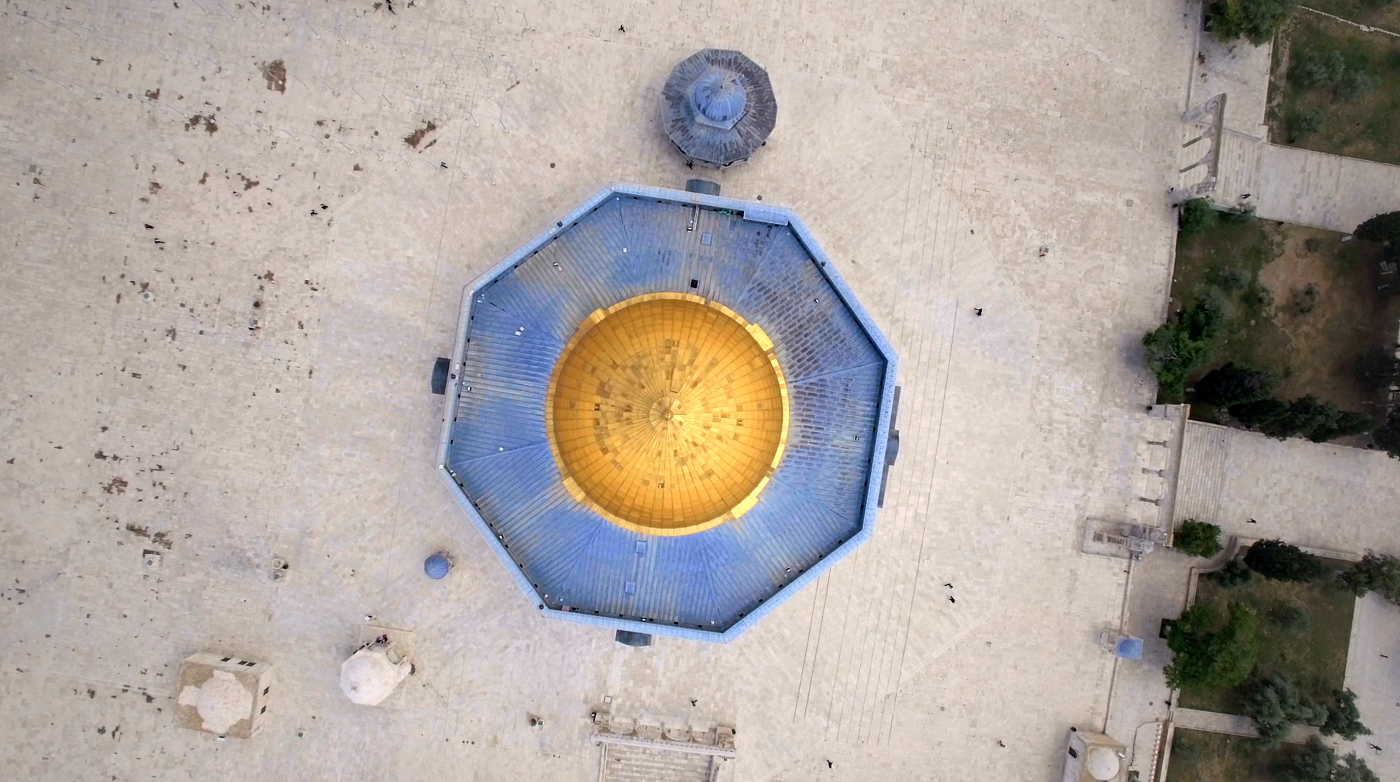
A controversial covert plan backed by senior U.S. and Israeli figures to dismantle Jordan’s century-old custodianship of Jerusalem’s Al-Aqsa Mosque complex has been revealed by multiple anonymous sources in an exclusive reporting to Middle East Eye, threatening to upend decades of regional stability and upend the long-standing status quo governing one of the Muslim world’s most revered religious sites.
Multiple layers of sources—including serving U.S., Jordanian, Palestinian, Western and Gulf Arab officials—have confirmed the proposal is being spearheaded by former White House advisor Jared Kushner, who holds no official role in the current U.S. administration, and current U.S. Ambassador to Israel Mike Huckabee. Under the terms of the draft plan, the Jordanian-backed Islamic Waqf, which has overseen day-to-day administration of the site for generations, would be stripped of all governing authority immediately. A new Israeli-created regulatory body would reclassify the 35-acre compound, known to Jews as the Temple Mount, as a multi-faith religious center, granting Jews equal access and formal permission for organized large-group communal prayer on the site, which has been an exclusively Islamic holy site under the long-standing international status quo.
The plan would also grant the Israeli government significant influence over key personnel decisions at the mosque, including the appointment of imams, senior clerics and preachers, as well as approval power over the content of weekly Friday sermons. Two senior U.S. officials confirmed that Washington has already drafted a policy document outlining this vision for the site’s future, stating the Trump administration’s goal is to erase the site’s exclusive Muslim identity and rebrand it as a cross-religious tourist landmark open to followers of all three Abrahamic faiths.
According to one proposal that has circulated among regional stakeholders, Arab nations including Bahrain, Egypt, Morocco and the United Arab Emirates have already received briefings on the plan and could be offered rotating oversight responsibilities for the complex. Multiple Gulf Arab sources and a source familiar with Jordanian government policy confirmed that Saudi Arabia—Jordan’s close historic ally—has already publicly taken a stance opposing the proposal.
The idea of altering Al-Aqsa’s governance was first raised by Israeli officials to the U.S. government nearly a decade ago, but gained new momentum after Huckabee took up his post as U.S. ambassador last year. A devout Evangelical Christian and long-time hardline pro-Israel advocate who has openly supported illegal Israeli settlements in occupied Palestinian territory, Huckabee has repeatedly pressured Washington to move forward with the plan, sources say. A source familiar with Jordan’s position noted the U.S. has long resented Amman’s frequent use of its custodianship status to file formal complaints against Israeli actions at the compound, most recently this month when Jordan’s parliament formally condemned Israeli seizures of Palestinian property and Islamic endowments in areas adjacent to the mosque.
The proposal also leaves the future of Jerusalem’s Christian holy sites—for which Jordan’s Hashemite monarchy also holds formal custodianship, including the Church of the Holy Sepulchre and the Church of the Ascension, plus a veto over appointments to the Greek Orthodox Patriarchate of Jerusalem—unaddressed, a gap that has sparked deep new concerns among regional stakeholders. “This plan says nothing about the Christian sites, which raises a whole new set of concerns,” one senior source told MEE.
A senior Jordanian government official reaffirmed Amman’s unwavering position on the issue, stressing that Hashemite custodianship of Jerusalem’s holy sites is formally recognized under international law and binding bilateral treaties, including Article 9 of the 1994 Jordan-Israel peace treaty. The official added that Jordan is coordinating closely with Palestinian, Arab and international partners to protect the sites’ Arab, Islamic and Christian identity and block any attempt to alter the historical and legal status quo.
The current governing framework for Al-Aqsa, the status quo arrangement, has been in place for more than half a century. Following Israel’s 1967 seizure of East Jerusalem, the two countries reached a formal agreement that left the Islamic Waqf in charge of all internal religious and administrative affairs at the compound, while Israel retained control over external security. Under the terms of this arrangement, non-Muslims are permitted to visit during set time windows, but are barred from holding prayer services at the site. For Jewish communities, the site holds deep religious significance as the location of the two ancient Jewish temples destroyed in antiquity.
Jordanian and Palestinian officials warn the proposed new framework closely mirrors Israel’s long-standing policy at Hebron’s Ibrahimi Mosque, also known to Jews as the Tomb of the Patriarchs. Following a 1994 massacre carried out by an Israeli extremist settler that killed 29 Muslim worshippers, Israel imposed a formal division of the site, allocating 63% of the compound to Jewish worship even though the site is equally revered by all three Abrahamic faiths as the burial place of the Prophet Abraham.
For Jordan’s Hashemite monarchy, custodianship of Jerusalem’s holy sites is a core pillar of its domestic and regional legitimacy. The ruling family’s claim to custodianship dates back to 1924, shortly after the collapse of the Ottoman Empire and the abolition of the Islamic Caliphate, when the British Mandate administration granted the Hashemites oversight of Jerusalem’s Muslim and Christian holy sites after the family lost control of Mecca and Medina, Islam’s two holiest sites, to the Al Saud dynasty. The custodianship was later reaffirmed in the 1994 peace treaty with Israel, which explicitly recognized Amman’s special role in governing Jerusalem’s Islamic holy sites.
For years, Palestinian and Jordanian officials have warned that the status quo is being steadily eroded by successive Israeli governments and emboldened far-right nationalist groups pushing for greater Jewish control of the compound. Frequent Israeli police raids inside the mosque, growing numbers of visits by ultranationalist Jewish activists, and repeated calls by senior Israeli cabinet ministers for formal Jewish prayer rights at the site have led to widespread accusations that Israel is incrementally altering the long-standing arrangement. Waqf officials have also repeatedly documented that Israel imposes harsh restrictions on Palestinian worshippers and blocks the Waqf from carrying out critical maintenance and repair work at the site.
Mustafa Abu Sway, deputy head of the Waqf council, described Hashemite custodianship as an non-negotiable foundation for regional peace. “The Hashemite Custodianship is a cornerstone for stability in the region, undermining it is tantamount to undermining the very principles for peace,” he said, adding that Palestinians view Jordan’s role as a strategic lifeline that has consistently defended the status quo in international forums including UNESCO.
The Palestinian Jerusalem Governorate said it had not received formal notification of the proposal but rejected it outright, noting that there has already been a dangerous escalation in Israeli interference in the Waqf’s work, including restrictions on Waqf security and staff, and growing incursions into the compound by extremist Israeli settlers.
Gulf Arab sources say Jordan, which relies on regional support to counter the U.S.-Israeli proposal, can count on Saudi opposition to the plan. Saudi Arabia fully understands that any move to alter Hashemite custodianship would ignite widespread anger across the Middle East and inflame regional conflict, one senior Gulf Arab source said. “The Saudis may have disagreements with Jordan on some issues, but on Jerusalem and Al-Aqsa they understand the consequences of dismantling the existing arrangement,” the source added.
In recent years, Jordanian Crown Prince Hussein bin Abdullah has built a close working relationship with Saudi Crown Prince Mohammed bin Salman, with bilateral ties deepening following the 2020 Abraham Accords that saw a number of Arab states normalize relations with Israel. It remains unclear how Saudi Arabia would respond if the UAE or Bahrain chooses to publicly back the proposal, sources noted.
Since signing the Abraham Accords, both the UAE and Bahrain have significantly deepened political, economic and security ties with Israel, even as regional anger over Israeli actions in Jerusalem and Gaza has grown. The UAE has positioned itself as Israel’s closest Arab partner, expanding cooperation across trade, technology, energy and defense sectors. Emirati-backed diplomatic and religious initiatives have also promoted a framework of multi-faith coexistence that Jordanian and Palestinian officials fear could be used to legitimize changes to Al-Aqsa’s historical status quo. In 2023, the UAE opened a state-backed multi-faith complex in Abu Dhabi housing a mosque, church and synagogue. Bahrain has similarly built close ties with Israel, framing its engagement as a critical tool to counter Iran, and has generally avoided public criticism of Israeli policy in Jerusalem, stoking fears it is willing to accommodate Israeli demands over the holy sites.
“They [UAE and Bahrain] understand how explosive this issue is in the Arab and Muslim world,” a Gulf Arab source said. “Given that they are closely aligned with Israel, they should be cautious about publicly supporting changes to the status quo.”
MEE reached out to the foreign ministries of Bahrain, Egypt, Morocco, Saudi Arabia and the UAE for comment, but received no response prior to publication. The Jordanian government, which has banned MEE access in the country since May 2025, acknowledged receipt of questions but declined to comment.