As a new U.S. naval blockade of Iran entered into force Monday and a fragile two-week ceasefire between the two sides remained largely intact, former U.S. President Donald Trump claimed Tehran is urgently pushing to reach a negotiated agreement with his administration.
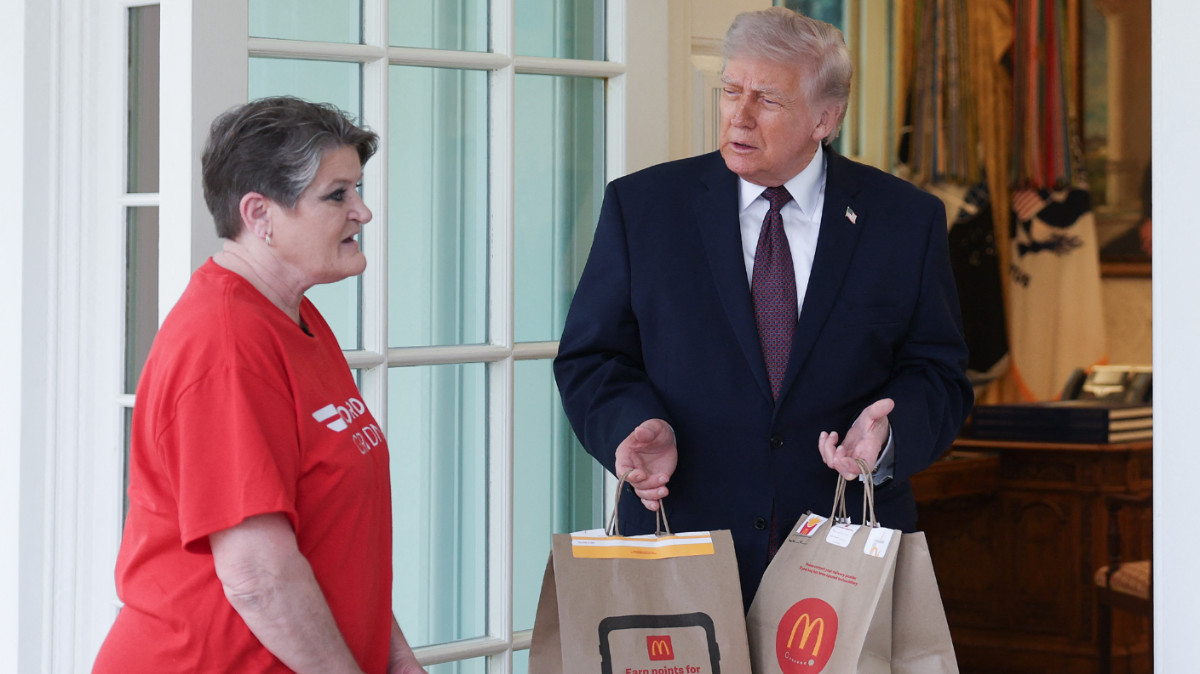
Speaking to reporters outside the Oval Office while receiving a McDonald’s delivery via DoorDash, Trump asserted that Iranian officials had reached out through backchannels to signal their desire for a deal. “I can tell you that we’ve been called by the other side. They’d like to make a deal. Very badly, very badly,” he told the press corps.
High-stakes indirect negotiations between U.S. and Iranian delegations hosted in Islamabad, Pakistan, wrapped up over the weekend without a final agreement. But multiple current and former U.S. and Arab officials confirmed to Middle East Eye that both parties remain committed to the negotiating process. Reuters further reported Monday that diplomatic backchannels are still active, with Pakistan continuing to serve as an intermediary for communications between Tehran and Washington.
According to sources familiar with the talks, discussions were at times tense, and the two sides came close to agreeing to a broad framework for a final deal. Three core sticking points scuttled a breakthrough: disagreements over Tehran’s nuclear program, competing claims to control over the Strait of Hormuz, and disputes over the amount of frozen Iranian assets that would be unlocked under any agreement.
Pakistani Prime Minister Shehbaz Sharif confirmed Monday that diplomatic efforts are continuing, saying, “I want to tell you that a full effort is still on to resolve the issues.” Despite the lack of progress in Islamabad, the 14-day ceasefire that went into effect ahead of talks has held, with no major armed clashes reported as of Monday.
When pressed by reporters on what would happen if no deal is reached before the ceasefire expires, Trump issued a blunt warning: “It won’t be pleasant for them.” This is not the first time the former president has issued sharp threats against Iran; he previously drew widespread international criticism for threatening to destroy Iranian civilization before walking back the comment.
Monday marked the official launch of the U.S. naval operation aimed at breaking what the Trump administration frames as Iran’s restrictive control over the Strait of Hormuz, a critical global energy chokepoint. The Wall Street Journal reported that at least 15 U.S. warships are participating in the blockade. Speaking to reporters, Trump laid out the current state of play: “Right now there’s no fighting…We have a blockade. Right now, Iran is doing absolutely no business.”
Iran’s control of the strait has emerged as the most intractable strategic conflict between the two sides, and a core sticking point in the ongoing negotiations. Tehran currently allows its own vessels to transit the waterway, alongside select ships from Russia, China, India and Pakistan, while blocking most vessels registered to Western countries. One of Iran’s key demands in talks is the establishment of a formal transit toll system for the strait, with payments potentially denominated in Chinese yuan or cryptocurrency. Maritime experts consulted by Middle East Eye note that Iran has a logistically feasible path to implementing such a system at the global energy chokepoint.
Trump has framed the blockade as an economic pressure tactic designed to force concessions from Iran by cutting off the country’s oil export revenue. But independent energy and security experts warn the move could backfire on the U.S., triggering a sharp spike in global energy prices and escalating the risk of open armed conflict between the two countries.
In response to the U.S. blockade, Iranian military officials have pushed back hard. An Iranian military spokesperson called any restrictions on Iranian shipping equivalent to “piracy,” and warned that if Iranian ports come under threat, Tehran would retaliate by targeting Arab Gulf ports. The Islamic Revolutionary Guard Corps further stated that any foreign military vessels entering restricted waters near the strait would be considered a violation of the ongoing ceasefire.
U.S. military deployments signal the Biden administration (continuing Trump’s policy) is moving cautiously to avoid escalation. U.S. Naval Institute News reports that the U.S. aircraft carrier USS George H.W. Bush is rerouting its journey to the Middle East around Africa and the Cape of Good Hope, rather than taking the shorter route through the Mediterranean Sea and Red Sea. This detour avoids the Bab el-Mandeb Strait and keeps the carrier out of missile range of Yemen’s Houthi movement, which is aligned with Iran and has previously disrupted shipping in the strategic waterway.
While Trump has repeatedly bragged about “obliterating” Iran’s navy and air defense systems in past confrontations, he acknowledged Monday that Iran’s fleet of small fast-attack craft could pose a meaningful threat to U.S. surface vessels operating in the northern Indian Ocean. He doubled down on his warning to Iran in a post on social media, writing: “Warning: If any of these ships come anywhere close to our BLOCKADE, they will be immediately ELIMINATED, using the same system of kill that we use against the drug dealers on boats at Sea. It is quick and brutal.”