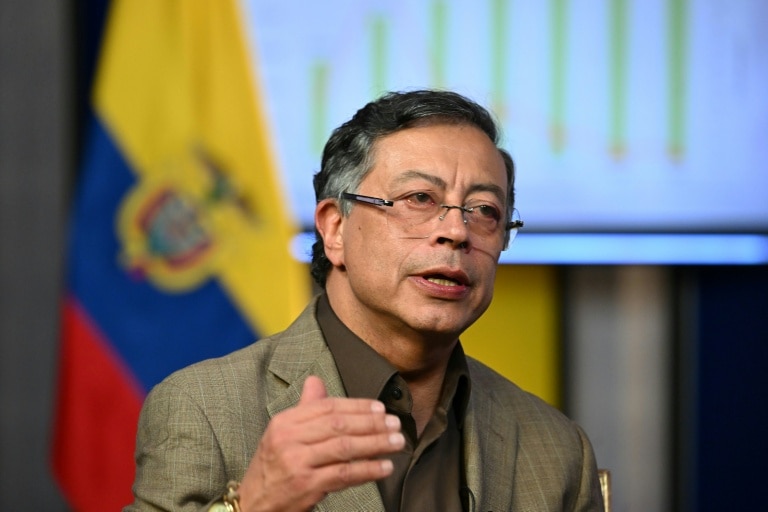
Colombia’s sitting President Gustavo Petro, the country’s first left-wing head of state who is constitutionally ineligible to seek reelection, has launched a scathing rebuke of former US President Donald Trump over his intervention in Colombia’s upcoming presidential runoff. Petro claims Washington has broken a previous non-interference agreement by backing a hard-right candidate tied to the same drug trafficking networks the US claims to fight.
The controversy erupted after Trump threw his full weight behind Abelardo de la Espriella, a 47-year-old conservative lawyer who rose to shock wealth by representing drug-trafficking linked paramilitaries, white-collar fraudsters and high-profile soccer athletes. De la Espriella pulled off an unexpected upset in Sunday’s first-round voting, defeating leftist Senator Ivan Cepeda – a close ally of Petro and architect of the administration’s landmark peace strategy – setting the stage for a head-to-head runoff on June 21.
In an exclusive interview with Agence France-Presse held at the Colombian presidential palace, Petro did not mince words about the US endorsement. “Their allies in Colombia come from the narco-paramilitary regime; they are genocidal and drug traffickers,” he stated, speaking as he sampled chocolate produced by former coca farmers who transitioned to legal cocoa cultivation under his administration’s alternative development program.
Trump’s move to back de la Espriella marks the latest in a pattern of the former US president interfering in Latin American elections, consistently throwing his support behind hardline right-wing candidates who take aggressive stances on crime and migration, while painting left-wing opponents as dangerous Marxists. De la Espriella has already pledged to deepen US-Colombia bilateral ties “like never before” should he win the runoff, and counts hardline former Colombian President Alvaro Uribe among his most powerful backers. Uribe has long faced allegations of colluding with paramilitary groups responsible for the mass murder of thousands of civilians during the bloodiest decades of Colombia’s 60-plus year internal conflict.
For Petro and his ally Cepeda, these ties are not just political coincidence. Both leaders have repeatedly accused paramilitary forces of carrying out a systematic “genocide” of left-wing political organizers and leaders, a list that includes Cepeda’s own father – a communist senator assassinated in 1994.
In response, the Colombian political right and Trump’s circle have pushed back against Petro, claiming he has taken an overly soft stance on remaining left-wing guerrilla groups, many of which still operate outside state control and fund their activities through cocaine trafficking. Colombia is the world’s largest producer of cocaine, a fact that has long been a flashpoint in bilateral relations between Bogota and Washington.
Tensions between Petro and Trump run deep: Last year, the former US president imposed sanctions on Petro, labeling him a “drug leader” over his failure to curb rising cocaine production and trafficking. The pair have also clashed repeatedly over Trump’s hardline migrant deportation policies and his campaign of lethal airstrikes targeting suspected drug trafficking vessels off Latin America’s coasts. The two leaders seemingly de-escalated these tensions during a February meeting at the White House, where Petro says the pair agreed the US would not interfere in Colombia’s 2025 election. Trump’s recent endorsement, Petro argues, is a clear violation of that pact.
“What they are implementing is an ideological policy that divides the world between those who think like them and those of us who don’t,” Petro added, expressing deep regret that “figures and governments who want to fight drug trafficking are actually helping to bring crime to political power in Colombia.”
The Colombian presidential election is unfolding against a backdrop of rising security instability: the country is currently facing the worst wave of political and criminal violence since the 2016 landmark peace deal between the state and former Marxist rebel group FARC. While much of Colombia has seen economic and social progress in the decade since the agreement, large swathes of rural territory remain under the control of armed factions fighting for control of cocaine smuggling routes, illegal gold mining operations and extortion rackets.
The two runoff candidates represent starkly different ideological paths for Colombia’s future: De la Espriella has rejected Petro’s signature “total peace” policy of negotiated talks with remaining armed groups, vowing instead to crush all insurgent and criminal factions through full-scale military force. Cepeda, by contrast, who helped negotiate the 2016 FARC peace deal, has pledged to continue prioritizing dialogue, economic development and social investment in regions long controlled by armed groups.