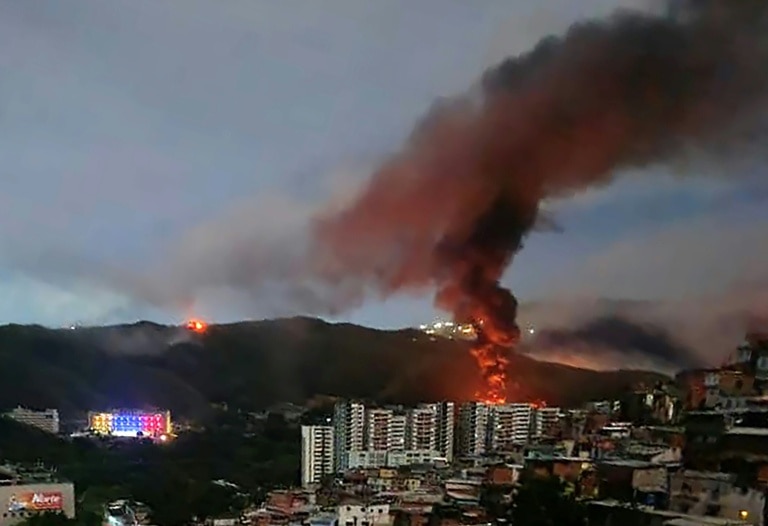
A dramatic U.S. military operation culminating in the capture of Venezuelan President Nicolás Maduro has triggered widespread international condemnation, drawing sharp criticism from both American allies and adversaries alike. The pre-dawn assault on Caracas, which involved airstrikes and special forces, resulted in Maduro and his wife being transported to New York to face serious drug-trafficking and weapons charges.
President Donald Trump’s declaration that the United States would ‘run’ Venezuela and access its substantial oil reserves, accompanied by an image of a blindfolded and handcuffed Maduro on a U.S. naval vessel, has intensified global scrutiny. The operation has sparked a complex diplomatic firestorm, revealing deep divisions in the international community’s response to unilateral military action.
Nations with longstanding ties to Caracas, including China, Russia, and Iran, issued swift condemnations. China’s Foreign Affairs Ministry denounced the operation as a ‘clear violation of international law,’ while Russia demanded the immediate release of ‘the legally elected president of a sovereign country.’ Iran similarly condemned what it termed a ‘flagrant violation of national sovereignty.’
Remarkably, Washington’s traditional European allies expressed significant reservations. France emphasized that no solution to Venezuela’s crisis could be externally imposed, with President Emmanuel Macron advocating for political transition under opposition figure Edmundo Gonzalez Urrutia. Spain warned the intervention ‘pushes the region toward a horizon of uncertainty and militarism,’ while Germany acknowledged the legal complexity of the operation despite recognizing Maduro’s disastrous leadership.
The European Union collectively urged respect for international law while noting Maduro’s lack of legitimacy, though candidate country North Macedonia and Balkan allies Albania and Kosovo broke ranks to support Washington. Britain adopted a nuanced stance, with Prime Minister Keir Starmer stating the UK would ‘shed no tears’ over Maduro’s demise while planning discussions with U.S. counterparts about the evolving situation.
Italy’s far-right Prime Minister Giorgia Meloni provided rare European support, characterizing the operation as ‘legitimate and defensive.’ Israel hailed American action as leadership of ‘the free world,’ while Ukraine focused criticism on Maduro’s repressive governance rather than addressing the military operation’s legality.
Beyond official government reactions, United Nations Secretary-General Antonio Guterres expressed deep alarm, warning the operation could ‘constitute a dangerous precedent’ in international relations. The broader implications for regional stability were emphasized by Mexico and Colombia, with the latter predicting a humanitarian crisis resulting from what it termed an ‘assault on the sovereignty of Latin America.’