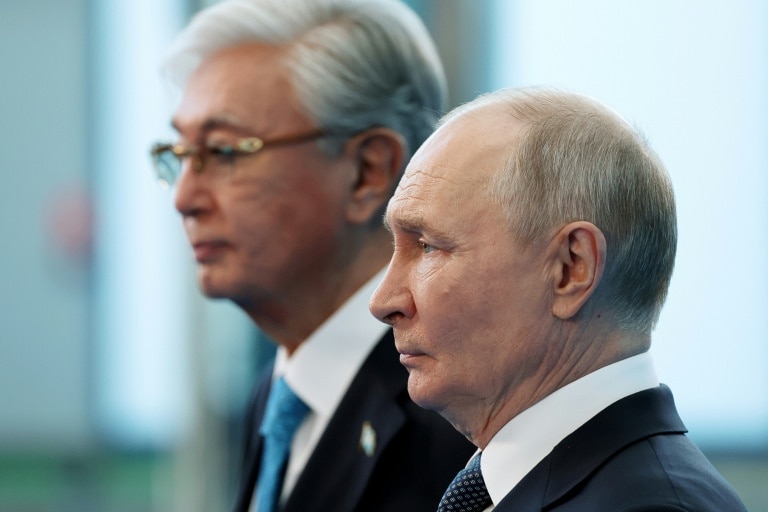
Nearly four and a half years into Russia’s full-scale invasion of Ukraine, a dramatic escalation of cross-border attacks and a rare public rebuke from a key ally have shifted the trajectory of the conflict in a single 24-hour period. On Saturday, Ukrainian drones reached deep into Russian territory, striking an oil refinery in Western Siberia, disrupting a national athletics competition in the Ural Mountains, and triggering fresh civilian casualties on both sides of the front line, as Kazakhstan’s President Kassym-Jomart Tokayev openly called on Russian President Vladimir Putin to end the war during a bilateral summit in Siberia’s Omsk.
The wave of strikes marked one of the farthest advances of Ukrainian aerial attacks into Russian territory since the war began. Tyumen region governor Alexander Moor confirmed that a local oil refinery caught fire after the drone attack, while in the Ural city of Yekaterinburg, Russia’s national athletics federation called an abrupt halt to an ongoing all-Russian competition over repeated drone threats. Leading Russian online retailer Wildberries, which has been the target of sustained Ukrainian drone attacks for a week, also evacuated staff from its Yekaterinburg facility amid the alerts, though no damage was reported. Ukrainian President Volodymyr Zelensky later claimed responsibility for the Siberian refinery strike, adding that Ukrainian forces had also hit a military factory in Kirov region for the second consecutive day. Local Russian authorities reported five people were killed in the Kirov strike on Friday.
The deep strikes have already had widespread ripple effects across Russia. Moscow announced Saturday that it would extend its temporary ban on fuel exports through the end of 2025, a direct response to widespread fuel shortages triggered by repeated Ukrainian attacks on Russian oil infrastructure. Long queues have formed at petrol stations across multiple Russian regions, marking the most severe disruption to civilian life inside Russia since the start of the full-scale invasion. Ukraine has repeatedly stated that its cross-border strikes are a deliberate strategy to weaken Russia’s war economy and force the Kremlin to enter good-faith peace negotiations.
Civilian casualties continued to mount across the conflict zone Saturday. Russian-installed occupation authorities in Ukraine’s Zaporizhzhia region claimed a Ukrainian strike on a seaside tourist camp in the Azov Sea town of Kyrylivka killed 12 people, including four children, with eight more still missing and rescue operations ongoing. Another civilian death was reported in occupied Kherson region, and two more were killed in Russian border villages near the front line. Kyiv has not yet issued an official comment on the Kyrylivka strike. For its part, Ukraine reported five civilian deaths from Russian attacks across the country: three killed in a double-tap strike on a private courier facility in the northeastern town of Sumy, with two more fatalities recorded in the eastern and southern parts of the country.
The United Nations has recently warned that civilian casualty rates have climbed sharply in recent weeks, as the conflict intensifies after nearly four and a half years of fighting. Against this backdrop of escalating violence, Tokayev’s public call for peace marked a rare break for Putin, who rarely faces public calls to end the war from leaders of allied states. “It is a shame, young people are dying… All this has to be stopped,” Tokayev said in televised remarks made while sitting beside Putin during the Omsk summit. The Kazakh leader proposed freezing the conflict along existing lines, restarting the 2022 Istanbul peace talks, and working toward a long-term ceasefire. He added that the roots of the conflict remain “not understandable” to him, and has never publicly endorsed Russia’s full-scale invasion, despite maintaining close strategic and economic ties with Moscow.
Putin offered only a vague response, saying he would share further details of the conflict with Tokayev, and has repeatedly reaffirmed Russia’s goal to seize the entirety of eastern Ukraine by force. US-led international negotiations to end the conflict, which is Europe’s largest military confrontation since World War II, remain stalled, with neither side showing willingness to make significant territorial concessions to restart talks.