After months of largely static ground fighting and no visible progress in international mediation efforts, both Ukraine and Russia have sharply ramped up long-range cross-border strikes targeting key energy, logistics and military infrastructure, marking a new escalation of the three-and-a-half-year conflict.
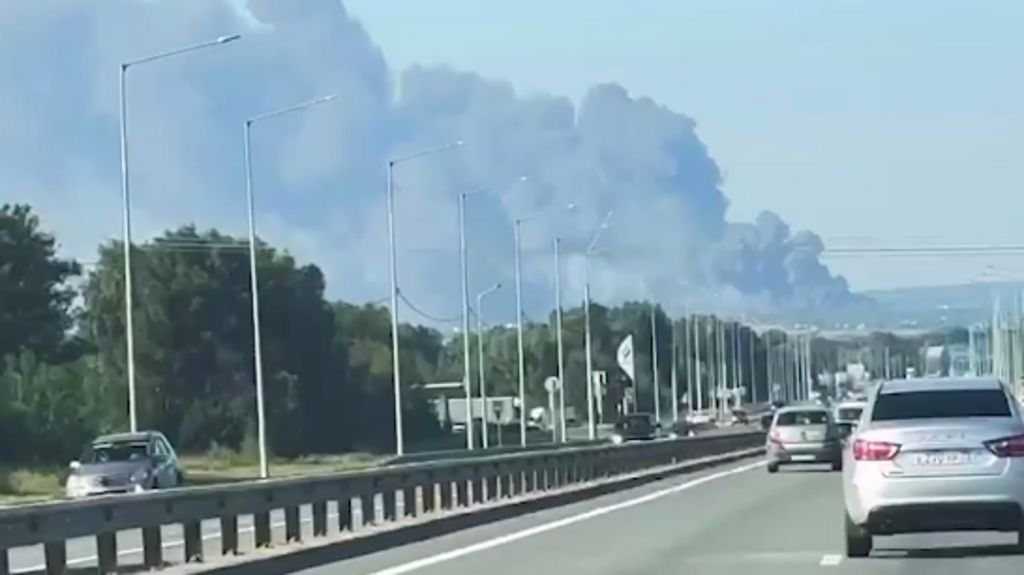
In overnight strikes carried out deep into Russian territory, Ukraine targeted multiple high-value sites hundreds of kilometers from its own border. Ukrainian President Volodymyr Zelenskyy confirmed that the attacks hit two key facilities in Russia’s Saratov Region, roughly 600 kilometers northeast of the Ukrainian border: the Engels-2 air base, a central hub for Russia’s strategic long-range aviation fleet, and a major crude oil refinery. Additional strikes were carried out against an oil storage depot in Russia’s Kaluga Region and a drone launch facility in Bryansk Region, which shares a border with northern Ukraine.
Zelenskyy framed these deep strikes as “our long-range sanctions” in a social media post Sunday, noting that the targeted facilities directly contribute to funding and executing Russia’s full-scale invasion of Ukraine. “These are strategic facilities that enable the Russian war machine,” he stated. The Ukrainian military confirmed that the attack on Engels airfield sparked a large blaze at the base, which regularly deploys Tu-95MC and Tu-160 strategic bombers to launch cruise missile strikes against Ukrainian cities and infrastructure.
Russian regional officials acknowledged the damage from the strikes, with Saratov Governor Roman Busargin confirming that drone attacks damaged civilian infrastructure in both Saratov and Engels and killed two people. Across other Russian regions, the death toll from Sunday’s coordinated strikes continued to climb: three people were killed in a drone strike on a civilian vehicle in the Udmurtia Republic, another three died in strikes in the border Belgorod Region, and Russian authorities reported a total of eight fatalities across all overnight attacks. Russian air defense forces also claimed to have intercepted and shot down 635 Ukrainian drones launched across multiple regions in the attack wave.
A separate strike hit a logistics warehouse owned by Wildberries, Russia’s largest domestic e-commerce retailer, in the Samara Region. Samara Governor Vyacheslav Fedorishchev labeled the attack “another terrorist act” by Ukraine, though no casualties were reported in this strike. In recent weeks, Ukraine has repeatedly targeted Wildberries distribution hubs across Russia, justifying the attacks by claiming the retailer supplies drone components, navigation equipment and other military-grade gear to Russian forces. Often called “Russia’s Amazon,” Wildberries employs roughly 48,000 people nationwide, and repeated strikes on its logistics network have created significant disruptions for hundreds of small and medium-sized Russian businesses that rely on the platform to reach customers.
Russia quickly retaliated for the Ukrainian strikes with its own overnight attacks on Ukrainian infrastructure. Moscow confirmed that its forces targeted two Ukrainian Black Sea ports and struck two commercial cargo vessels operating in the waterway. Later Sunday, a Russian strike on a Nova Poshta postal terminal near the northeastern Ukrainian city of Kharkiv killed one Ukrainian civilian, Ukrainian officials confirmed.
Russia has mirrored Ukraine’s strategy of targeting commercial logistics infrastructure in recent weeks, launching repeated strikes on warehouses operated by Ukraine’s leading postal service Nova Poshta and top domestic e-commerce retailer Rozetka. Overnight, Russian drones hit Rozetka’s largest warehouse facility, the company confirmed Sunday. No injuries were reported in the attack, which comes as part of a sustained Russian campaign against Ukrainian logistics and retail networks.
The escalation of cross-border strikes comes as the main front line stretching across eastern and southern Ukraine remains largely stagnant, and US-led international mediation efforts to negotiate a end to the conflict have failed to produce any breakthrough. Russian President Vladimir Putin launched the full-scale invasion of Ukraine in February 2022, and the conflict has entered its fifth year of continuous fighting with little prospect of a near-term diplomatic resolution.