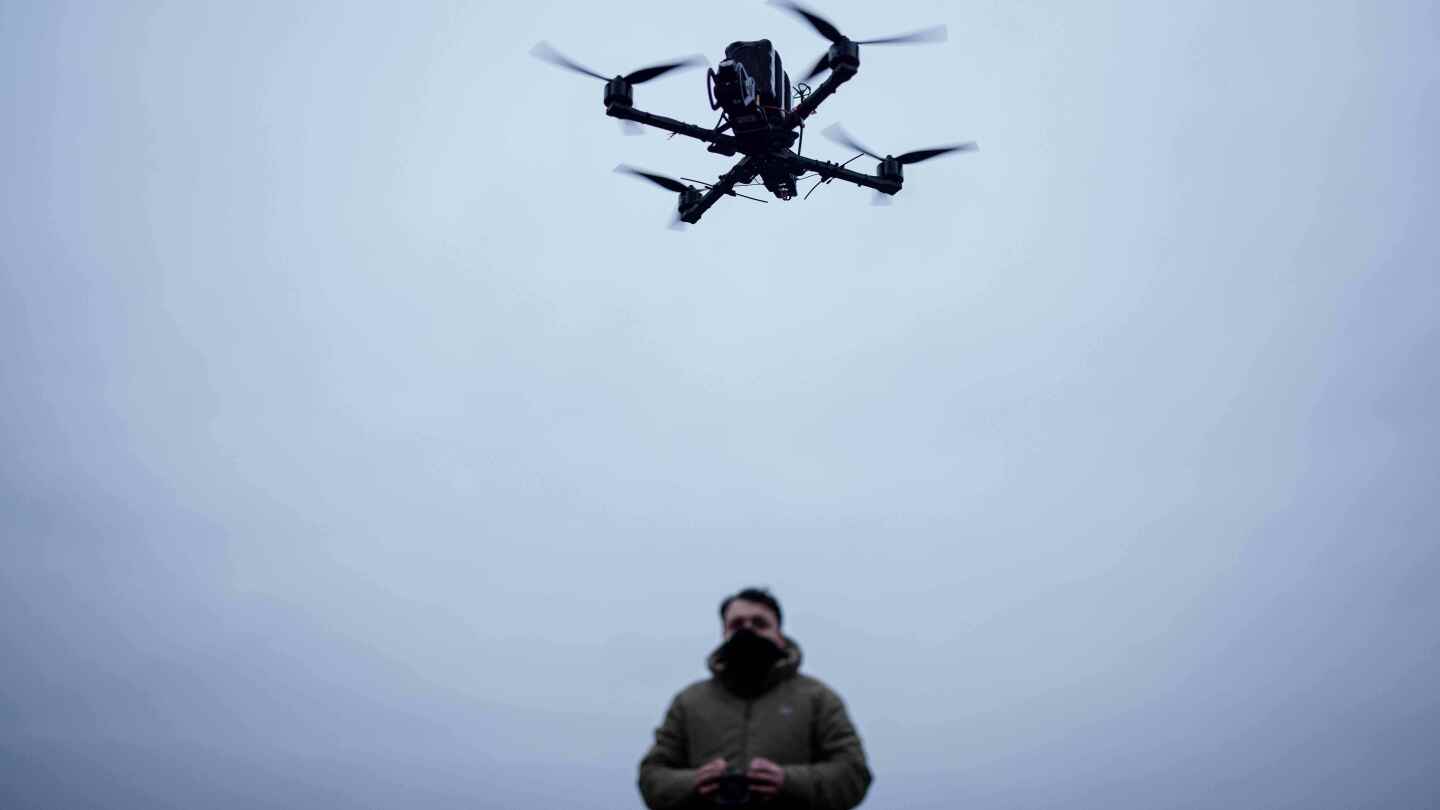
On the frozen Ukrainian terrain, elite drone-hunting teams deploy cutting-edge technology against Russia’s evolving aerial threats. Under the crackling ice, specialists assemble sophisticated monitoring equipment and prepare a revolutionary domestic weapon system—the Sting interceptor, resembling a flying thermos—that represents Ukraine’s innovative response to nightly attacks on urban centers and critical infrastructure.
This tactical evolution stems from military necessity: Ukrainian defense strategists have completely rewritten air defense doctrine by developing affordable drone-killing solutions costing as little as $1,000 per unit. According to a commander identified only by the call sign “Loi” under Ukrainian military protocol, these interceptors effectively counter Russia’s increasingly sophisticated suicide drones that now operate at higher altitudes with enhanced speed. “Every destroyed target is something that did not hit our homes, our families, our power plants,” Loi stated, emphasizing their continuous operational readiness: “The enemy does not sleep, and neither do we.”
The rapid development cycle—from prototype to mass production within months during 2025—demonstrates Ukraine’s remarkable adaptive capabilities. Startup companies like Wild Hornets (producing the Sting model) and General Cherry (developing the Bullet interceptor) have pioneered these systems that can surge in speed before colliding with enemy drones. These are operated by pilots monitoring screens or using first-person-view goggles, creating a new paradigm in aerial warfare.
Economic considerations prove fundamental to this strategy. Andrii Lavrenovych of General Cherry’s strategic council revealed that the destroyed Russian drones cost between $10,000 and $300,000, meaning Ukraine inflicts substantial economic damage with each successful interception. Russia primarily employs Iranian-designed Shahed suicide drones with numerous variants featuring jammers, cameras, and turbojet engines, creating an ongoing innovation race between the two nations. “In some areas they are one step ahead. In others, we invent an innovative solution, and they suffer from it,” Lavrenovych noted.
Defense analyst Federico Borsari from the Center for European Policy Analysis in Washington confirmed these interceptors’ strategic value: “Cheap interceptor drones have become so important, and so quickly, that we can consider them a cornerstone of modern counter-unmanned aerial systems. They realign the cost and scale equation of air defense.” However, Borsari cautioned against viewing them as standalone solutions, emphasizing their dependence on sensors, rapid command systems, and skilled operators within a layered defense framework that includes multimillion-dollar missiles and traditional antiaircraft weapons.
The conflict has accelerated drone production scaling on both sides, with NATO and Ukrainian defense planners anticipating continued escalation through 2026. This urgency has propelled European initiatives to establish a comprehensive “drone wall” along eastern borders—a networked system designed to detect, track, and intercept drones over two years, potentially incorporating Ukrainian-style interceptors as central components.
Future developments include expanded coproduction agreements between Ukrainian drone manufacturers and Western firms, merging battle-tested designs and valuable combat data with Western production capabilities and funding. This collaboration will increase output while integrating Ukraine into NATO-member supply chains. Lavrenovych also predicts increased automation: “Our mobile groups shouldn’t have to approach the front line, where they become targets. Drones must become fully autonomous robots with artificial intelligence—as scary as that may sound—to help our soldiers survive.”