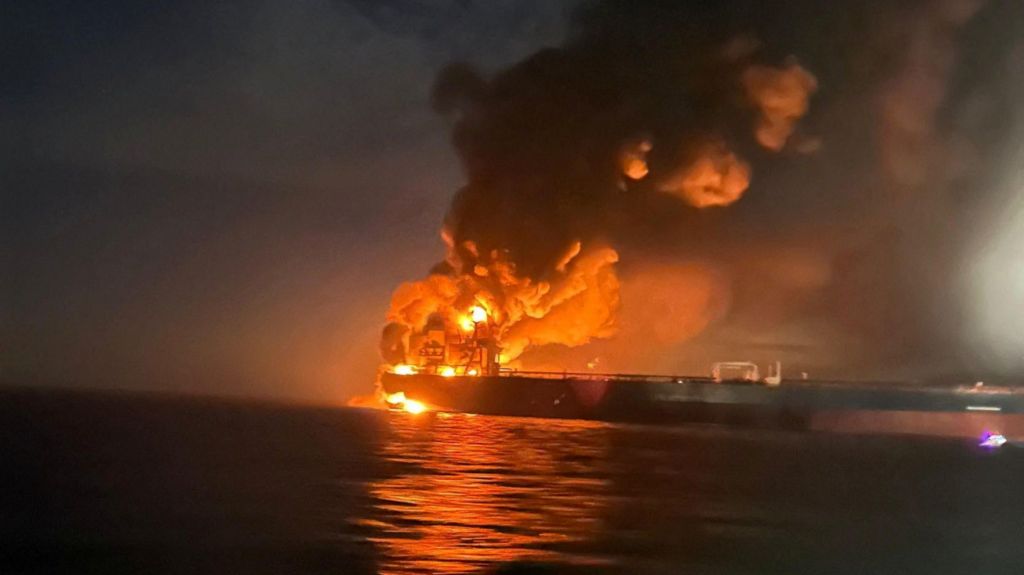
In a significant escalation of its maritime campaign, Ukrainian security forces have successfully targeted two Russian-affiliated oil tankers traversing the Black Sea using advanced naval drones. Verified footage reveals the precise moment Ukrainian Sea Baby drones—specially engineered unmanned surface vessels—slammed into the vessels before detonating in massive fireballs that engulfed the ships in black smoke.
The targeted vessels, identified by Turkish authorities as the Kairos and Virat (both registered under Gambian flags), were struck in separate operations. The Kairos was hit southwest of the Black Sea while the Virat was attacked further east near the Turkish coast. Reports indicate the Virat sustained additional drone strikes on Saturday following the initial Friday attacks. Remarkably, no casualties were reported from either incident.
These sophisticated strikes represent a strategic shift in Ukraine’s efforts to cripple Russia’s war-funding capabilities. The targeted tankers belong to Moscow’s so-called ‘shadow fleet’—an armada of aging, often poorly documented vessels deployed to circumvent Western sanctions imposed after Russia’s 2022 invasion. According to London Stock Exchange data, both vessels were already subject to international sanctions.
The attacks have triggered immediate regional consequences. The Caspian Pipeline Consortium—a major oil transportation group co-owned by Russia, Kazakhstan, and several Western energy giants including Exxon Mobil and Chevron—announced suspension of loading operations at Russia’s Novorossiysk port following unrelated drone attacks that damaged critical infrastructure.
Turkish coast guard units responded to assist the stricken vessels, releasing footage showing firefighting efforts aboard the burning Kairos. Meanwhile, diplomatic developments unfolded as Ukrainian President Zelensky confirmed a security delegation led by Rustem Umerov was en route to the United States for continued peace negotiations, following the resignation of previous lead negotiator Andriy Yermak after corruption probes.