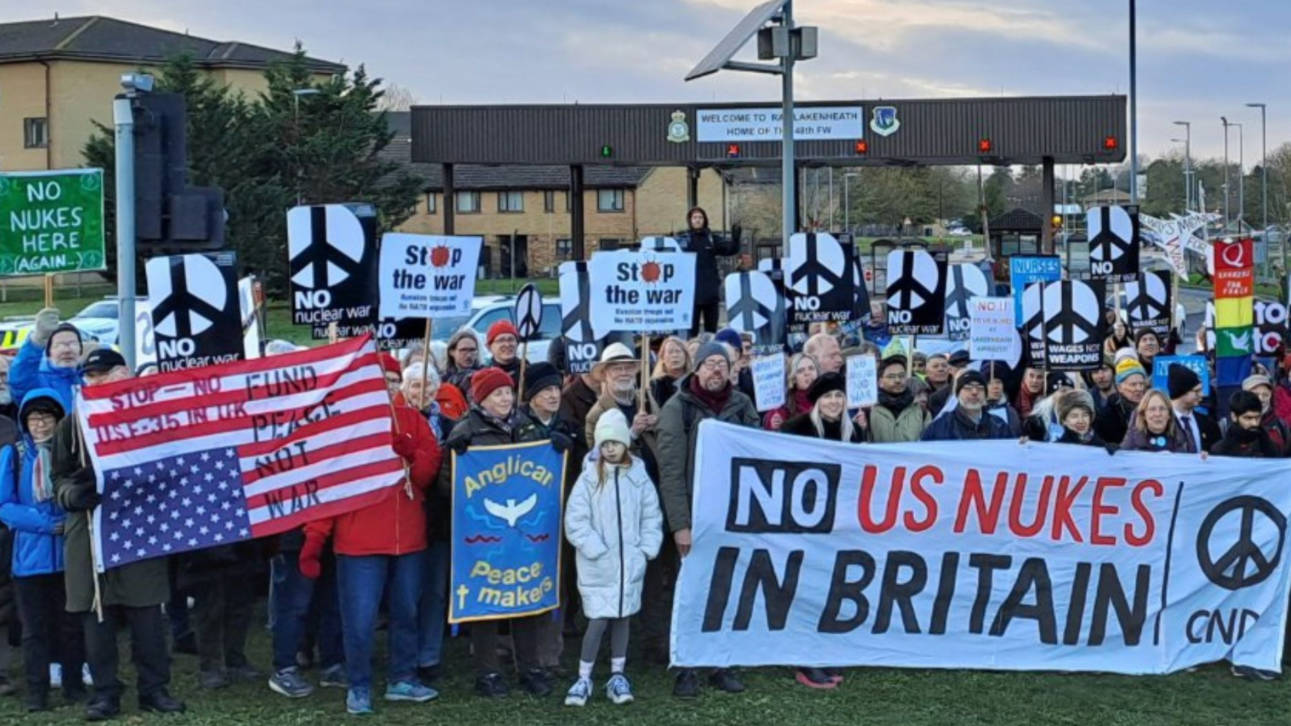
On a Sunday in eastern England, law enforcement officers took seven people into custody during a demonstration held just outside RAF Lakenheath, a British base long leased to the United States military that military analysts now connect to a US fighter jet downed over Iran just two days prior. The arrests mark a sharp flashpoint in a growing controversy over the UK government’s role in supporting the US-led war on Iran, unfolding against a tangled legal backdrop over the status of the activist group the arrestees are accused of supporting.
Military observers have confirmed that the F-15E strike fighter shot down by Iranian forces on Friday matches the profile of aircraft permanently stationed at RAF Lakenheath, the largest US fighter operations hub in Europe, which is home to the 48th Fighter Wing. Both UK Ministry of Defence and US Central Command officials have declined to comment on Iranian claims that the aircraft originated from this Suffolk base. Independent verification from The New York Times, citing senior Royal United Services Institute air power analyst Justin Bronk, adds weight to these claims: Bronk found that wreckage markings published by Iranian state-linked news agency Tasnim align directly with the markings of the 494th Fighter Squadron, a unit permanently based at Lakenheath.
Local anti-war activists have monitored air traffic at the base closely since the outbreak of the war, and have documented sustained sortie activity linked to strikes on Iran. In the week leading up to the jet’s downing, activists recorded unusual movements: five F-35C stealth fighters landed at Lakenheath on March 24, and more than 20 aircraft departed the base on the morning of April 2, according to local anti-war group claims. Peter Lux, organizer of the Lakenheath Alliance for Peace, told reporters on Sunday that his group has tracked between 116 and 118 US bombers departing the base for combat missions since the war began. Lux argued that as a British military facility on UK sovereign territory, the UK government holds full legal responsibility for all operations launched from its grounds. “We need the accountability of those bases, particularly with what’s going on in Iran, which the British government have said they’re not happy about because of international law,” Lux said. The six-day 24-hour vigil organized by his group outside the base concluded on the same day as the arrests.
The seven detainees – five men and two women – were arrested on suspicion of acting in support of Palestine Action, a direct-action group that organizes demonstrations against Israeli war crimes. The legal status of the organization remains contested: Keir Starmer’s Labour government opted to ban Palestine Action as a terrorist organization in July 2025, but the UK High Court ruled earlier this year that this proscription was unlawful. The government has since appealed the ruling, creating an unusual legal limbo that law enforcement has had to navigate.
In a statement following the arrests, a Suffolk Police spokesperson clarified that the force is required to enforce existing law as it stands currently, rather than pending the outcome of the government’s appeal. “Although the High Court found the proscription of Palestine Action to be unlawful, it also confirmed that the impact of that judgement will not take effect until the government’s appeal has been considered,” the spokesperson explained, adding that the force “has a duty to enforce the law without fear or favour” and will take appropriate action when offences are suspected.
The controversy over activity at RAF Lakenheath is part of a wider breakdown of British policy on the war in Iran, marked by repeated U-turns from Prime Minister Keir Starmer’s government. When the US-Israeli invasion of Iran first began, Starmer initially banned the US from launching combat strikes from the joint UK-US base on Diego Garcia in the Indian Ocean. That position flipped within just 48 hours, when Starmer approved US use of the base for strikes targeting Iranian missile sites, framing the move as a purely defensive measure. Two weeks later, Starmer announced a second reversal, approving US use of all British bases for strikes targeting Iranian sites in operations meant to protect commercial shipping in the Strait of Hormuz.
Despite Starmer’s repeated concessions that have allowed expanded US war operations from UK territory, former US President Donald Trump has repeatedly attacked Starmer’s leadership, even going so far as to suggest that the decades-long “special relationship” between the US and UK is in jeopardy.
RAF Lakenheath is not the only British base being used to support US strikes on Iran. US combat aircraft have also launched missions from RAF Fairford in Gloucestershire, southwest England, while nearby RAF Mildenhall – another Suffolk-based facility that supports US Air Force operations – has seen a surge in activity over the past week. On March 31, two US EA-37B Compass Call electronic warfare aircraft were photographed landing at Mildenhall.
The growing involvement of British bases in the war has sparked serious retaliatory threats from Tehran. Speaking to Times Radio the previous Wednesday, Iranian ambassador to the UK Seyed Ali Mousavi confirmed that the Iranian government is “considering” targeted strikes on British military bases in retaliation for the UK’s support for US operations.