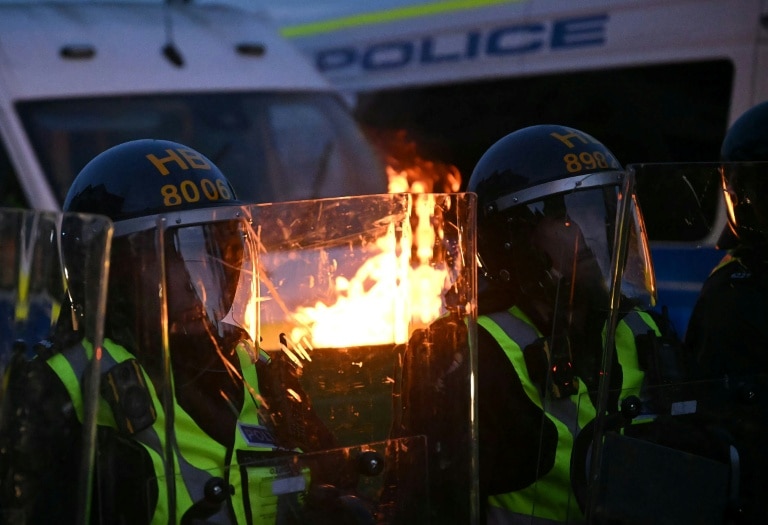
Tensions have erupted in southern England following the conviction of a murderer and the release of bodycam footage showing dying 18-year-old Henry Nowak being handcuffed by police, with far-right activists triggering violent clashes that have drawn sharp condemnation from Prime Minister Keir Starmer. The controversy began on Monday, when 23-year-old Vickrum Digwa was sentenced to a minimum of 21 years in prison for stabbing Nowak to death with an 8-inch ceremonial knife during a dispute over a mobile phone in Southampton. Digwa, a Sikh man, misled responding officers by falsely claiming Nowak had racially abused him, leading police to initially restrain the fatally wounded teenager rather than provide urgent medical aid. Bodycam footage from the December incident captured Nowak repeatedly telling officers he could not breathe as he lay bleeding, before he lost consciousness moments later. The case has become a flashpoint for political polarization in the UK, after far-right figures including former UKIP leader Nigel Farage and ex-English Defence League leader Tommy Robinson (real name Stephen Yaxley-Lennon) seized on the incident to push their unsubstantiated claim of so-called “two-tier policing” — the false assertion that British police treat ethnic minority suspects more leniently than white people. Farage went so far as to call on the public to respond to Nowak’s death with “pure cold rage”, a comment Starmer labeled unforgivable. On Tuesday, a protest organized by far-right figures descended into chaotic violence in Southampton, despite an explicit plea from Nowak’s father not to use his son’s murder to fuel “further division, hatred or tension”. Agence France-Presse reporters on the scene documented that roughly 100 protesters tore down residential garden fences, hurled bricks, flares and chairs at officers, and rolled a burning bin toward police lines. Eleven officers were injured in the clashes, and two protesters were arrested by the end of the night. More than 1,000 people attended the wider rally, many waving Union Jack and English flags, where Robinson told the crowd that white British people are treated as “second-rate citizens” by UK law enforcement. Addressing lawmakers in Parliament on Wednesday, Prime Minister Starmer stressed that regardless of public grief over Nowak’s death, there is no excuse for the violence that unfolded. “No matter the pain we feel, there is no justification for more violence and disorder,” Starmer said. “This is a time for serious work, not rage. We will ensure anyone found engaging in disorder meets the full force of the law.” The prime minister, a former Director of Public Prosecutions for England and Wales, described the police bodycam footage of Nowak’s final moments as “harrowing” and acknowledged there are “serious questions” that must be answered about the officers’ handling of the incident. An investigation by the Independent Office for Police Conduct (IOPC), the UK’s policing watchdog, is already underway and is expected to release its findings within three months. Hampshire Police confirmed three of the four officers involved in the incident remain in active service, while one resigned for reasons unrelated to Nowak’s murder. Starmer and his newly elected Labour government have flatly rejected far-right claims that two-tier policing exists in the UK, and he accused Farage — whose Reform UK party currently leads national opinion polls ahead of the next general election — of exploiting the tragedy for political gain. “Farage is exploiting this tragedy to create grievance and division,” Starmer told parliament. In a surprising development that has amplified the controversy, American tech billionaire Elon Musk has announced he will fund a private prosecution against police over their handling of the case. Amid the growing political pressure, the National Police Chiefs Council (NPCC) announced it would review its existing Race Action Plan, guidance introduced last year to address well-documented racial disparities in British policing. Official statistics show Black people in the UK are more than twice as likely to be arrested as white people, leading the NPCC to introduce guidance that stated the organization’s commitment to racial equality “does not mean treating everyone ‘the same’ or being ‘colour blind’”. Far-right activists have misrepresented this guidance as proof of preferential treatment for ethnic minority suspects. NPCC chair Gavin Stephens said the organization would address legitimate concerns about the wording of the guidance and make adjustments where needed. “We are listening to legitimate concerns about how some of these commitments are worded or phrased, and where needed we can and will make changes, but this should not detract from the intent, which is to improve the quality of policing,” Stephens said. UK Policing Minister Sarah Jones backed the review, saying it was “right” that the guidance be re-examined.