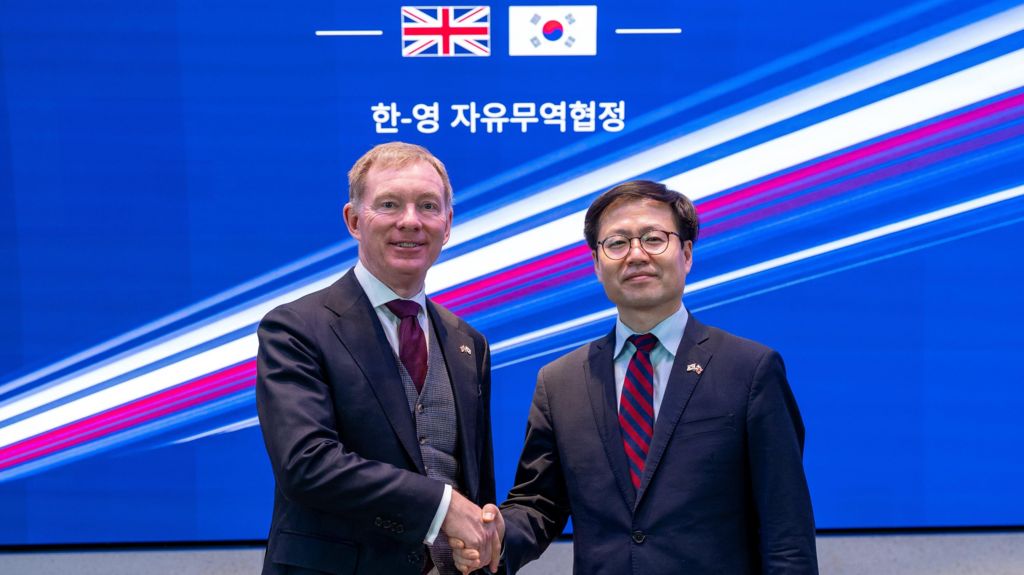
The United Kingdom and South Korea have formally cemented a comprehensive trade agreement designed to fortify economic relations between the two nations. Announced at Samsung’s flagship London store by UK Trade Minister Chris Bryant and his South Korean counterpart, Yeo Han-koo, the pact ensures that 98% of bilateral trade will remain tariff-free, mirroring the terms previously established between South Korea and the European Union.
This agreement, which supersedes a previous deal set to expire in January 2026, safeguards approximately £2 billion worth of annual UK exports from potential tariff increases. Key British industries positioned to benefit include automotive manufacturing (with prominent supporters like Bentley Motors and Jaguar Land Rover), pharmaceuticals, financial services, and alcohol producers including Diageo, owner of Guinness.
Beyond tariff preservation, the agreement focuses on reducing non-tariff barriers through streamlined regulations on product origins and enhanced digital and investment protections. South Korean Trade Minister Yeo Han-koo emphasized the complementary nature of the two economies, noting that Britain can serve as South Korea’s gateway to European markets while South Korea provides UK businesses with enhanced access to Asian markets.
Prime Minister Keir Starmer hailed the agreement as “a huge win for British business” that will stimulate job creation and economic growth nationwide. The Department for Business and Trade identifies South Korea as the UK’s 25th largest trading partner, accounting for 0.8% of total UK trade in the year ending June 2025, though official figures show bilateral trade declined approximately 14% during this period.
This agreement represents the fourth major trade deal secured by the current UK government following agreements with the EU, US, and India. While government assessments project minimal GDP impact from these agreements (the India deal estimated at 0.11-0.14% GDP growth), officials maintain that collective trade deals will generate economic expansion through job creation and reduced regulatory barriers for small businesses.