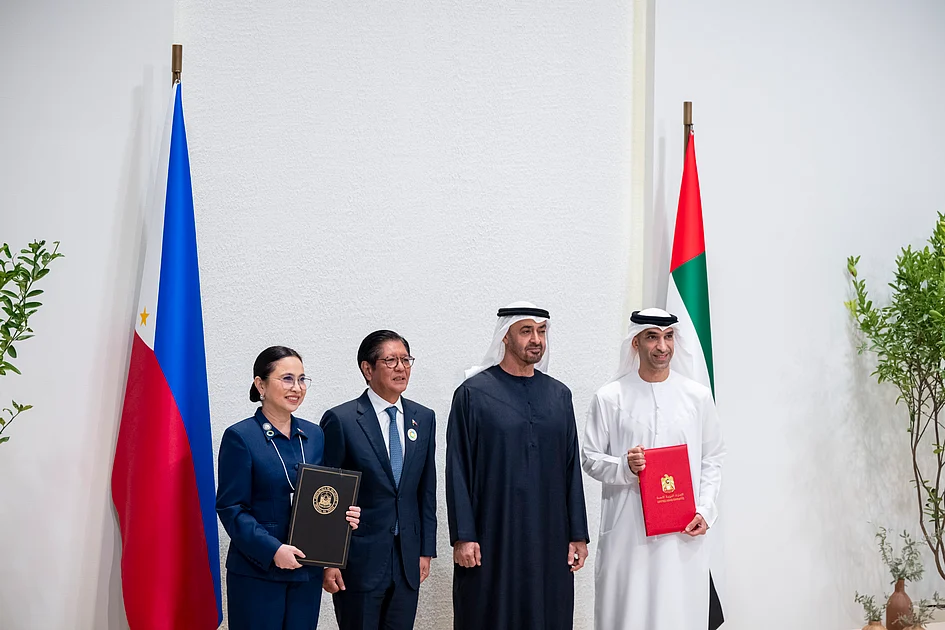
In a significant diplomatic ceremony witnessed by UAE President Sheikh Mohamed bin Zayed Al Nahyan and Philippine President Ferdinand R. Marcos Jr., the two nations solidified a groundbreaking Comprehensive Economic Partnership Agreement (CEPA) in Abu Dhabi on January 13, 2026. This landmark trade deal marks President Marcos’ first international visit of the year and coincides with his participation in Abu Dhabi Sustainability Week.
The newly ratified agreement establishes a comprehensive framework for enhanced economic collaboration, representing a strategic evolution in bilateral relations between the Gulf nation and the Southeast Asian archipelago. Sheikh Mohamed characterized the partnership as reflecting a shared vision to broaden cooperation that serves mutual interests, expressing confidence that the CEPA would significantly advance both countries’ development objectives.
From the UAE perspective, this agreement constitutes a pivotal component of the nation’s ambitious foreign trade strategy targeting $1.1 trillion in non-oil foreign trade by 2031. Current trade metrics demonstrate robust growth, with bilateral non-oil trade reaching $940 million in 2024 and showing a remarkable 22.4% year-on-year increase during the first three quarters of 2025. Economic projections indicate the partnership could boost UAE GDP by approximately $2.4 billion by 2032.
For the Philippines, this historic agreement represents their first free trade pact with a Middle Eastern nation, providing unprecedented market access to the region. The CEPA is designed to eliminate tariffs, reduce trade barriers, and stimulate investment flows across key sectors including electrical equipment, financial services, agriculture, and precious metals. The agreement additionally facilitates private-sector collaboration, strengthens supply chain resilience, promotes knowledge transfer, and empowers small and medium enterprises to expand globally.
The UAE-Philippines CEPA joins 31 other agreements under the UAE’s comprehensive trade program, which has already contributed to record non-oil trade figures of $810 billion in 2024, marking a 14% annual increase. Fourteen of these agreements are currently operational, reflecting the UAE’s commitment to rules-based trade as a mechanism for economic diversification and global business expansion.