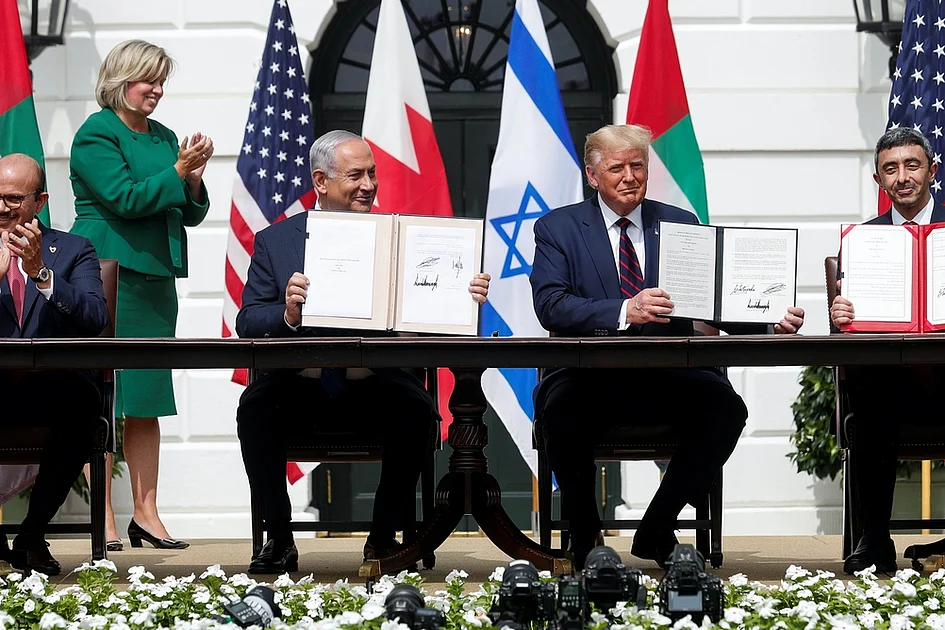
The geopolitical ramifications of the Abraham Accords are extending far beyond Middle Eastern diplomacy, fundamentally altering global power dynamics and infrastructure competition between the United States and China, according to experts speaking at a recent policy conference in Abu Dhabi.
Analysts at the Abraham Accords Conference revealed how the normalization agreements between Israel and Arab states have created ripple effects across Asia, prompting strategic recalculations in both Tehran and Beijing. The accords, initially focused on Middle Eastern reconciliation, are now influencing how China positions itself in Asia and how the United States structures its global infrastructure initiatives.
Chelsi Mueller, researcher at the Moshe Dayan Center, presented compelling evidence linking the Abraham Accords to China’s 25-year Comprehensive Strategic Partnership Agreement with Iran, signed in 2021. Mueller argued the timing was not coincidental but represented a strategic countermeasure to the region’s rapid realignment following UAE-Israel normalization. ‘Beijing perceived regional normalization as component of broader US repositioning,’ Mueller stated, adding that ‘It came in the context of US moves in the Pacific.’
The conference highlighted how the accords have become embedded in the architecture of global infrastructure competition, particularly through the India-Middle East-Europe Economic Corridor (IMEC). Experts emphasized that IMEC couldn’t have materialized without the regional cooperation framework enabled by the UAE-Israel normalization. ‘The Abraham Accords provide the foundational architecture for IMEC,’ Mueller asserted.
Michalis Kontos, Associate Professor at the University of Nicosia, underscored the geopolitical significance of this alignment, characterizing IMEC as Washington’s strategic counterweight to China’s Belt and Road Initiative. ‘The US is treating IMEC as its answer to China’s Belt and Road,’ Kontos noted, linking the project directly to transport, energy, and data-sharing corridors made possible by the Accords.
The panel concluded that China and Iran’s coordinated response, combined with US-backed infrastructure corridors depending on Accords-enabled routes, positions the Abraham Accords as a critical inflection point not only for Middle Eastern politics but for global power competition. As long as IMEC remains integral to Washington’s Indo-Pacific strategy and China-Iran agreements continue to calibrate in response to regional normalization, the Abraham Accords will maintain far-reaching implications extending well beyond diplomatic relations.