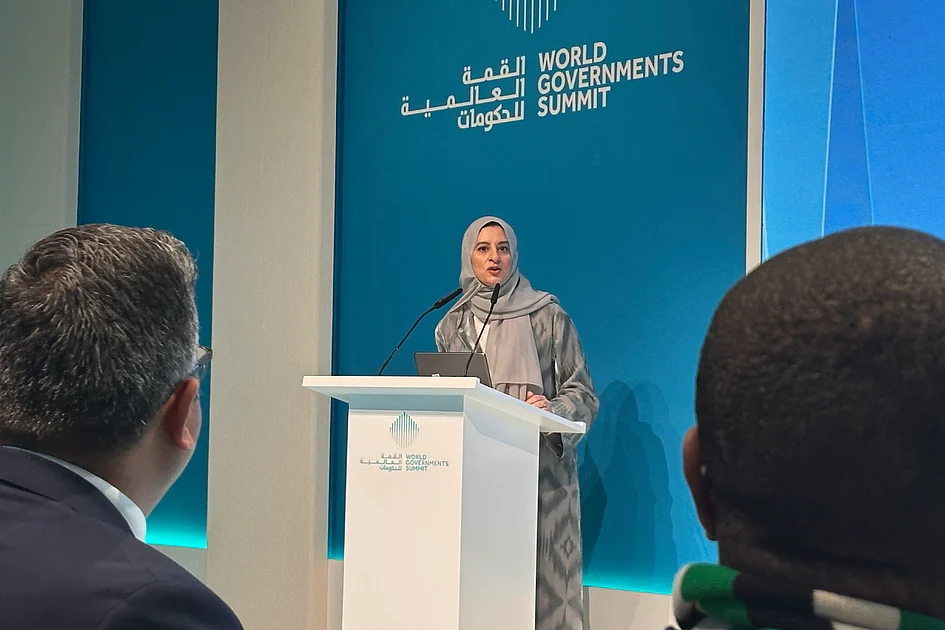
In a radical transformation of its governance model, the United Arab Emirates has achieved unprecedented success through its Zero Government Bureaucracy Programme, eliminating more than 4,000 administrative procedures and reducing service delivery times by over 70%. The comprehensive reform has yielded extraordinary results: saving 12 million work hours annually and unlocking approximately Dh1 billion in economic value each year.
Huda Al Hashimi, UAE Deputy Minister of Cabinet Affairs for Strategic Affairs, revealed these groundbreaking achievements during her address at the World Government Summit in Dubai. She presented bureaucracy not as a peripheral administrative concern but as a fundamental economic variable that directly impacts national competitiveness. “Every unnecessary procedure is a hidden tax on entrepreneurship,” Al Hashimi asserted. “Every fragmented approval process represents a significant barrier to investment.”
The Zero Government Bureaucracy Programme stands as the central pillar of the UAE’s innovative governance framework, designed specifically to enable economies to “design forward” rather than merely playing catch-up with global standards. Al Hashimi emphasized that ambitious national strategies frequently fail because “the machinery of implementation was too heavy,” warning that “you cannot outgrow your own friction.”
The UAE’s approach is built upon a sophisticated four-pillar strategy for economic resilience and competitiveness:
First, the principle of ‘Know Your Competitive Advantage’ encourages economies to concentrate on their unique strengths rather than attempting excellence across all sectors. For the UAE, this strategic focus on openness, private sector development, and financial system strength has produced remarkable results, including achieving 95% of non-oil foreign trade targets five years ahead of schedule.
Second, ‘Clarity as an Economic Asset’ demonstrates how well-defined national visions like the ‘We the UAE 2031’ plan generate market confidence and direct investment flows toward strategic objectives. Al Hashimi explained that clarity actively removes economic friction, contrasting it with the confusion that undermines confidence when governments pursue multiple competing strategies simultaneously.
Third, ‘Data and Strategic Intelligence’ addresses the challenges of radical uncertainty through substantial investments in artificial intelligence and data analytics. The UAE’s commitment of over Dh180 billion in AI since 2024 represents a strategic effort to enable superior intelligence, enhanced services, and improved outcomes across all sectors.
Fourth, ‘Simplicity as a Growth Strategy’ forms the cornerstone of the entire approach, where treating bureaucracy as a core economic problem has directly empowered entrepreneurship and facilitated investment. By embedding simplicity into its governance DNA, the UAE has created an environment where operational speed generates opportunity, and opportunity drives sustainable growth.
Al Hashimi concluded with a powerful statement on modern economic competitiveness: “The old advantages—natural resources, geography, population—still matter, but they are no longer decisive. What is decisive is the ability to see clearly, adapt quickly and execute with discipline.”