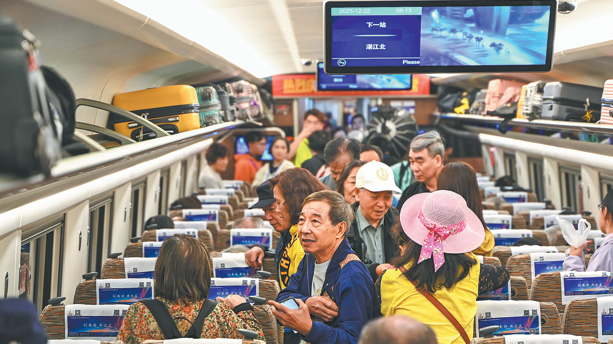
Guangdong Province has ushered in a new era of regional connectivity with the simultaneous inauguration of two major high-speed rail lines, fundamentally reshaping economic and transportation networks across the region. The groundbreaking infrastructure projects commenced operations on Monday, marking a significant milestone in China’s railway development.
The Guangzhou-Zhanjiang high-speed railway, with its inaugural G9785 service departing from Guangzhou Baiyun Railway Station, establishes a direct 350 km/h corridor linking western Guangdong to the provincial capital. This engineering marvel spans approximately 401 kilometers, traversing Foshan, Zhaoqing, Yunfu, Yangjiang, and Maoming, with bridges and tunnels constituting 76.7% of its route. The project’s crown jewel, the 9,640-meter Zhanjiang Bay undersea tunnel, set national records for large-diameter subaqueous tunneling achievements.
Parallel to this development, the Shantou-Shanwei high-speed railway initiated service with train G9787 connecting Shantou to Guangzhou. The newly operational 19.8-kilometer segment across Shantou Bay represents a technological breakthrough that integrates Shantou’s urban core into the 350 km/h high-speed network for the first time.
These twin rail developments create a transformative two-hour transportation circle connecting Zhanjiang and Shantou—key sub-center cities in western and eastern Guangdong respectively—to the economic powerhouse of the Guangdong-Hong Kong-Macao Greater Bay Area. The infrastructure advancement substantially reduces travel duration between previously remote regions and the Pearl River Delta’s core economic zone.
The economic implications are already materializing across sectors. In Maoming’s Genzi township, renowned for lychee production, agricultural enterprises are preparing for expanded market access. “Our distribution channels for premium lychees will significantly expand into the Greater Bay Area and beyond,” noted a major local farmer identified as Long, who is implementing new packaging infrastructure in anticipation of increased demand.
Meanwhile, in Shantou’s Chenghai district—a traditional manufacturing hub for toys, gifts, and garments—business operations are undergoing rapid transformation. Buyers like Mr. Chen from Shenzhen report that what previously required two-day business trips can now be accomplished in a single day, enabling morning product selection, afternoon deal finalization, and evening returns to Shenzhen.
According to China Railway Guangzhou Group, these developments represent crucial progress in constructing a highly efficient transportation network during China’s 14th Five-Year Plan period (2021-2025). The province’s total railway operational mileage now reaches 6,433 kilometers, with 3,411 kilometers dedicated to high-speed railways operating at 200 km/h or faster.