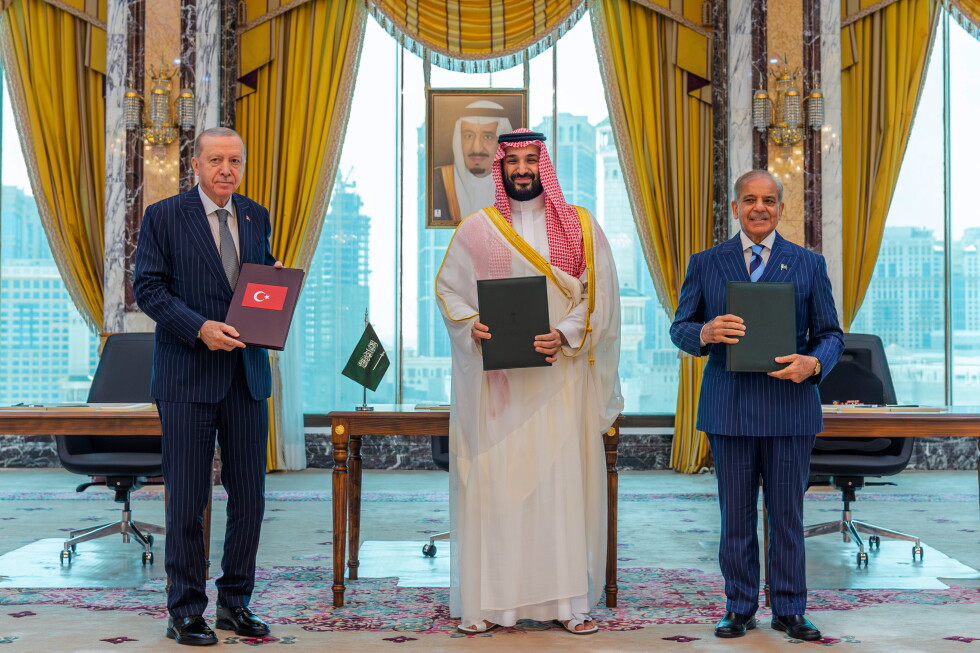
ANKARA, Turkey – In a public clarification Saturday, Turkish Foreign Minister Hakan Fidan has pushed back against speculation that a newly signed trilateral defense agreement between Saudi Arabia, Pakistan, and Turkey is crafted to target Iran or any other regional nation, framing the pact as a foundational step for strengthening collective security across the Middle East and South Asia.
The landmark “Mecca Joint Defense Agreement” was formally signed Friday by Saudi Crown Prince Mohammed bin Salman, Turkish President Recep Tayyip Erdogan, and Pakistani Prime Minister Shehbaz Sharif during a gathering in Islam’s holiest city, Mecca. Its core mutual defense clause mirrors NATO’s long-standing Article 5 framework, stipulating that any armed aggression against one signatory will be treated as an attack on all three nations.
The agreement brings together three major regional players with complementary strategic strengths: energy-rich Saudi Arabia, Pakistan—a recognized nuclear weapons state, and Turkey, which boasts NATO’s second-largest standing military and one of the fastest-expanding defense industrial bases in the Eurasian region. The pact comes amid a period of heightened regional volatility, driven in part by escalating tensions linked to ongoing conflict across the broader Middle East.
Speaking in an interview with Turkey’s state-owned Anadolu Agency, Fidan emphasized that the three signatory states have not pre-designated any country as a shared enemy. Hostile action against the alliance, he clarified, is the only threshold that would trigger the pact’s collective defense provisions.
“We do not have any codified agreement, nothing we have signed, that identifies a specific common threat,” Fidan stated. “Any country that refrains from attacking us is not a target for our alliance.”
Fidan further explained that the agreement’s mutual defense clause is operationally aligned with NATO’s Article 5, the cornerstone of the Western alliance’s collective defense posture that has been in place since the organization’s founding.
When detailing how the alliance’s support mechanism would function in practice, Fidan noted that any affected member state must first submit a formal request for assistance. The nature of support provided by the other two nations would be scaled to match the severity of the threat, ranging from intelligence sharing and logistical backing to the full deployment of combat military forces.
“These are multi-layered arrangements that adapt to the scale of any potential threat,” Fidan said. “This is the guiding framework we have established for our ongoing cooperation.”
The foreign minister also revealed that multiple unnamed countries have already expressed interest in joining the new defense agreement. He specifically named Egypt as a “natural partner” for the alliance and stated that he expects Cairo to join the pact during its next expansion phase.
To institutionalize ongoing cooperation, the agreement outlines regular coordination meetings between the three nations’ foreign ministers, defense ministers, and top military commanders. A permanent administrative secretariat for the alliance will also be established, with its headquarters set to be located in Saudi Arabia, Fidan confirmed.