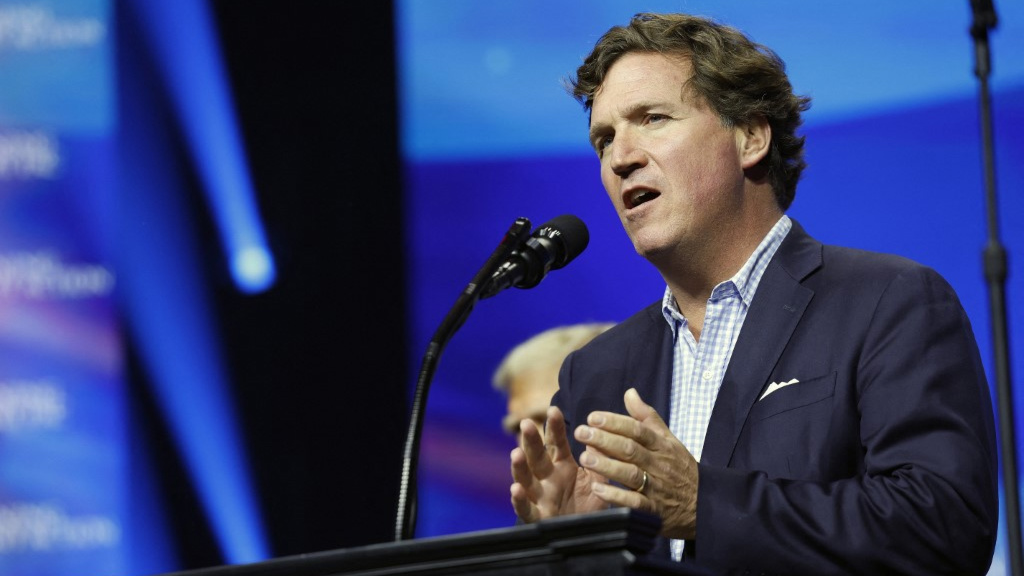
In a tense Sunday morning BBC interview that has sparked widespread debate, prominent former Fox News host Tucker Carlson launched a scathing rebuke of the British government’s decision to ban pro-Palestinian direct action group Palestine Action, pushing back against host Victoria Derbyshire’s challenges to his claims.
When Derbyshire asked Carlson – a longstanding vocal critic of the U.S.-Israeli military campaign against Iran – whether Prime Minister Keir Starmer had made the correct call on the ban, Carlson offered a blunt, controversial response: “I don’t think Keir Starmer makes any calls about anything. Keir Starmer’s not in control of Britain. No, Keir Starmer is every bit as enslaved as Donald Trump is.”
Carlson went on to argue that current British law effectively criminalizes open criticism of the Israeli government, claiming: “It is a crime for which you can be arrested in Britain right now, criticising Israel. If you say you’re for Palestine Action, you can be arrested. A lot of people have been arrested. So in other words, it is not legal in Britain to criticise another country.”
Derbyshire immediately pushed back, refuting the claim as untrue. When Carlson pressed that hundreds of people had indeed been arrested for critical speech about Israel, Derbyshire clarified that arrests stemmed from Palestine Action’s proscribed status, not criticism itself. Undeterred, Carlson fired back: “Why is it banned? It’s banned because the Israeli government wanted it banned.”
The context of the ban dates back to last July, when Starmer’s incoming Labour government officially proscribed Palestine Action as a terrorist-linked organization. Under the order, membership in the group or public expression of support for it carries a maximum criminal penalty of 14 years in prison. While the UK High Court ruled the ban unlawful in February, the government secured permission to appeal the ruling, with the appeal hearing scheduled for April 28 and 29.
In the weeks since the ban first took effect, more than 1,600 people have been arrested for holding public signs reading “I oppose genocide, I support Palestine Action,” according to on-the-ground reports. The movement against the ban reached a peak Saturday, when mass demonstrations converged on central London’s Trafalgar Square, where at least 523 people were arrested in a single day in coordinated civil disobedience. Protesters set up camping chairs on the steps of the square, all displaying identical hand-painted signs declaring their support for the banned group. Middle East Eye, which first reported on the demonstration, documented that many of the arrested protesters were elderly and disabled – including frail grey-haired attendees and participants using crutches, who were physically dragged away by police officers. Some demonstrators dressed as early 20th century British Suffragettes to draw a parallel between their fight for political voice and the historic suffrage movement.
During the interview, Carlson softened his tone to note that despite frequent criticism of British policy, he retains affection for the country, where he has family ties. He went on to argue that British citizens have been unfairly compromised by U.S. foreign policy influence: “I don’t think that Britons understand just how badly they’ve been shafted by the United States. And I am ashamed of that and I hope that we do everything we can to rectify it. I hope that our next president strikes a far more conciliatory and cooperative tone and tries to help Britain, because it has a lot of problems that will be very obvious by the next time there’s a presidential election in my country.”
The controversy over the Palestine Action ban also intersects with broader Middle East military tensions. When the U.S.-led campaign against Iran began, Starmer initially hesitated to grant the U.S. access to British military bases for strike operations. Ultimately, however, the UK relented: the bases have been used for strikes on Iranian missile sites, and for the past nearly three weeks, they have supported U.S. operations aimed at reopening the Strait of Hormuz, a critical global shipping chokepoint.