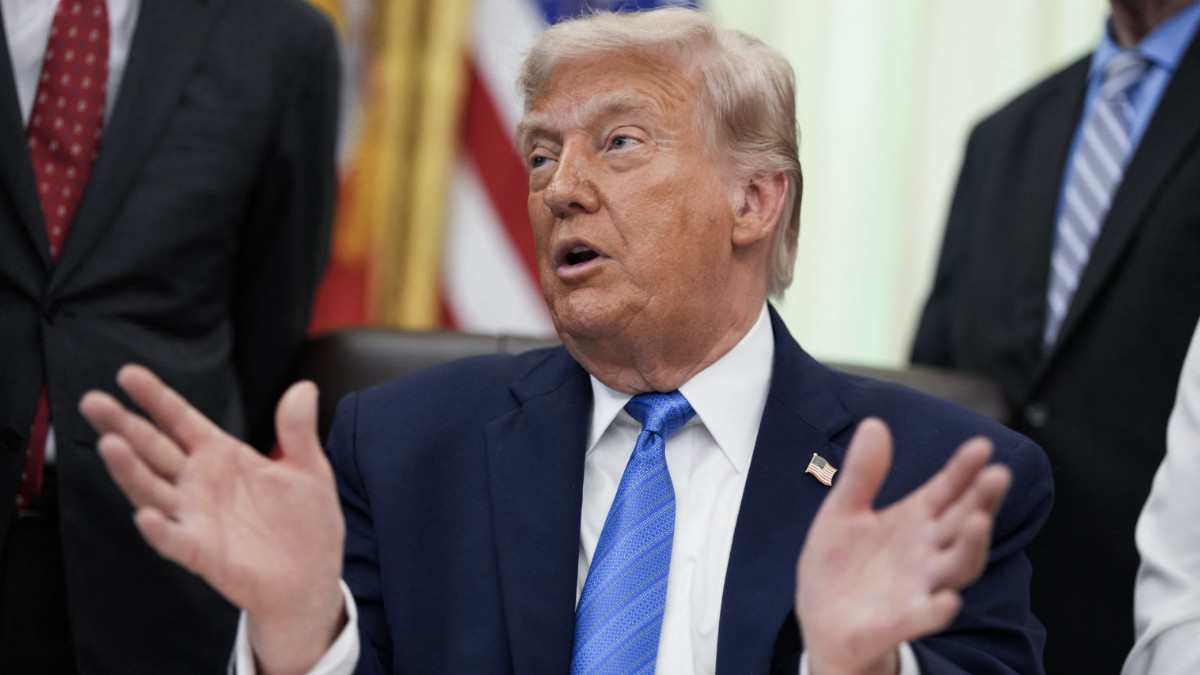
In a sudden and sharp escalation of tensions between the United States and Iran, President Donald Trump announced Wednesday that Washington would launch a new wave of military attacks on Iran “today”, just one day after the two sides exchanged deadly fire that put the months-old fragile ceasefire at its greatest risk of collapse. Speaking to reporters at the White House shortly after the latest cross-border clashes, Trump accused the Islamic Republic of acting in bad faith during ongoing ceasefire negotiations, claiming Tehran “keeps playing us for suckers” to drag out talks. “We hit them hard yesterday, and we are going to hit them again hard today,” the president told assembled journalists. The president’s sharp vow of renewed military action comes at a time when third-party diplomatic efforts to salvage the peace process are still underway: a Qatari mediation delegation touched down in Iran this week, a move widely viewed by global diplomatic analysts as a last-ditch push to keep negotiations alive, while Pakistan continues its role as an additional intermediary between Washington and Tehran. For two weeks, the tentative ceasefire agreed by the two parties back in April has limped from one crisis to the next, with violent outbursts of fighting alternating with brief lulls, as efforts to reach a broader permanent cessation of hostilities have stalled. The most recent round of open conflict reignited last week, when the U.S. launched strikes on Iranian-held islands and key military infrastructure. Tehran responded by launching missile and drone attacks targeting U.S. allies Bahrain and Kuwait. In a striking reversal just days ago, Trump intervened to halt clashes between Iran and Israel that broke out after Israeli strikes on Beirut, the capital of Lebanon. Iran has repeatedly stated that any final peace deal must include provisions for Lebanon, where its long-time close ally Hezbollah is engaged in active combat against Israeli forces. Speaking to the *Financial Times* just this past Sunday, following his order to stop an Israeli planned attack on Iran, Trump made clear his assertion of total control over U.S. policy: “I call the shots. I call all the shots. [Netanyahu] doesn’t.” He added that Israel “won’t have a choice” but to accept any ceasefire agreement Washington reaches with Tehran. However, by Wednesday the president had made a dramatic pivot back to pushing for military escalation. “Iran is all talk and no action,” he said in his remarks Wednesday. “They’ve taken too long to negotiate a deal that would have been great for them, now they will have to pay the price!!!” Despite his threats of new attacks, Trump also noted that peace talks had reached a relatively advanced stage, claiming Tehran had already agreed to the key non-nuclear provision: “They have agreed to not having a nuclear weapon, all they have to do is sign the paper,” he said. The renewed outbreak of open conflict in the strategic Persian Gulf region has already roiled global energy markets, pushing benchmark Brent crude prices up by nearly 3% to trade at $94.11 per barrel. Most commercial oil and gas shipments through the Gulf have been halted amid the ongoing hostilities, though Trump pushed back against that narrative Wednesday, boasting that “millions of barrels of oil” are being exported out of the Gulf under cover of darkness. “Now I’m going to tell you because they [Iran] just figured it out,” he told reporters. The president offered no supporting data or evidence to back up this unsubstantiated claim, but independent news reporting has indicated that some neighboring Iraq and Gulf oil producers have been able to ramp up their exports in recent weeks. Bloomberg reported Wednesday that Iraqi crude oil passing through the Strait of Hormuz or loading at the country’s key southern Basra port has reached roughly seven million barrels so far this month. The United Arab Emirates has also increased exports by sailing tankers through the Strait of Hormuz with their identification transponders turned off to avoid detection. The current cycle of escalation was triggered Tuesday, when Iranian forces shot down a U.S. Apache attack helicopter operating in the region. Iranian Foreign Minister Abbas Araghchi appeared to confirm the strike in a social media post, but framed the incident as an accidental engagement resulting from opposing military forces operating in close proximity to one another. Currently, both the U.S. and Iran are locked in a struggle for control of the strategic Strait of Hormuz, with each side enforcing rival blockades and opening fire on commercial vessels they accuse of violating their respective blockade terms. U.S. Central Command confirmed it launched what it called “a proportional response” to the downing of the helicopter, targeting Iranian air defense systems, ground control stations and radar installations across the country. In turn, Iran retaliated with a coordinated barrage of missiles and drones targeting U.S. military bases stationed in Bahrain and Jordan. This latest shift in policy is part of a pattern of inconsistent messaging and decision-making from Trump, who has oscillated repeatedly between declaring a historic peace deal is just days away and threatening devastating new military action against Iran, a country whose military capabilities he has repeatedly claimed are “obliterated”. As recently as Tuesday, Trump stated that the U.S. and Iran were just “two or three days” away from finalizing a “very good deal” that would end the open conflict and fully reopen the Strait of Hormuz to global commercial shipping. In a development that adds further uncertainty to the situation, independent outlet Middle East Eye reported Wednesday that U.S. Secretary of State Marco Rubio is planning an official visit to Bahrain, a key U.S. Gulf ally that has found itself on the front lines of Iranian retaliation for recent U.S. strikes. While the planned trip could still be scrapped in light of Trump’s new threats, diplomatic observers note it is unlikely such a visit would be scheduled in advance if a major new U.S. offensive was imminent. This article is adapted from original reporting by Middle East Eye, which provides independent, in-depth coverage of the Middle East, North Africa and global affairs.