Escalating tensions across the Middle East have reached a new boiling point, after former U.S. President Donald Trump issued fiery, explicit threats against Iran over its blockade of the strategically critical Strait of Hormuz, paired with revelations of a high-stakes U.S. search and rescue mission that extracted a wounded American airman from inside Iranian territory.
In a incendiary post shared on his Truth Social platform Sunday, Trump demanded Iran immediately reopen the key oil and gas shipping lane, which Tehran has effectively closed amid the ongoing regional conflict that began with joint U.S.-Israeli strikes on Iran in late February. “Open the Fuckin’ Strait, you crazy bastards, or you’ll be living in Hell,” Trump wrote. He went on to warn that Tuesday would bring coordinated U.S. strikes on Iranian power plants and bridges, declaring “There will be nothing like it!!!” In a subsequent interview with Fox News, however, Trump softened his tone slightly, noting he saw a “good chance” Iran would agree to a diplomatic resolution on the Hormuz issue by Monday.
The threats came just after Trump announced what he called one of the most daring rescue operations in U.S. history: the extraction of a seriously wounded U.S. airman from deep inside Iran’s mountainous interior. Multiple U.S. media outlets have since shed light on the risky mission, revealing the airman, a weapons systems officer, was equipped with a sidearm, location beacon and encrypted communications device to coordinate with rescue teams. According to reports from The New York Times and CBS, two aircraft intended to extract the airman and his rescuers became stuck at a remote Iranian base, forcing U.S. forces to destroy the planes to prevent sensitive technology from falling into Iranian hands. Three additional transport planes were ultimately used to successfully pull the team out of the country.
Iran’s account of the operation differs sharply from the U.S. narrative. Tehran says it foiled the mission, which it claims made use of an abandoned airport in Iran’s southern Isfahan province, and released footage showing charred, smoking aircraft wreckage scattered across a desert area. Iranian state media reports five people were killed in strikes connected to the operation, and the Iranian military claims it destroyed four U.S. aircraft involved in the mission. Tehran has not explicitly denied that U.S. forces successfully extracted the airman, however. Trump also confirmed the operation marked the second successful rescue of an American service member in as many days, noting the first mission was kept secret to avoid endangering the second.
Conflicting reports also surround the downing of the American fighter jet the airman ejected from. Iran says its forces shot the plane down, a claim U.S. media has repeated, though the Trump administration has not publicly confirmed the detail.
The harsh exchange over the rescue operation comes as the broader regional war, which entered its third month after launching February 28, continues to expand and disrupt global markets. After opening the conflict with joint strikes, Iran responded by blocking the Strait of Hormuz — a passage through which roughly a fifth of the world’s oil supplies pass — and launching retaliatory strikes against Israel and its Gulf allies. On Sunday alone, Iran targeted critical infrastructure across the Gulf, damaging civilian facilities in the United Arab Emirates, Bahrain and Kuwait. Pro-Iran armed groups also launched two separate attacks on U.S. diplomatic sites in Baghdad overnight, the U.S. embassy confirmed.
Diplomatic efforts to de-escalate tensions over the Strait of Hormuz are already underway, however. Reports indicate Omani and Iranian deputy foreign ministers have held recent talks focused on reopening the shipping lane to commercial traffic.
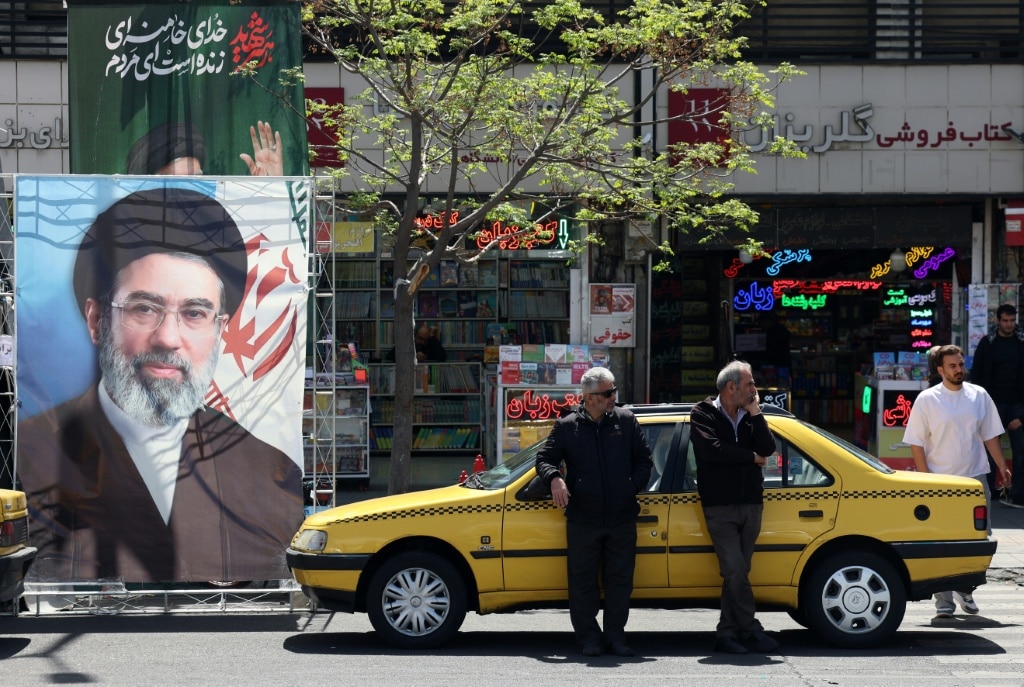
For many ordinary Iranians, though, Trump’s stark threats have so far failed to disrupt daily life. In interviews with AFP on the ground in Tehran, residents appeared largely indifferent to the rhetoric. In a large western park, young Iranians gathered for picnics, played frisbee to techno music, and flew kites near the city’s iconic Milad Tower, going about their weekend routines as usual.
The conflict has spread steadily to neighboring Lebanon, where the Iran-backed Hezbollah movement has traded near-daily strikes with Israel since the war began. Israel has responded with counter-strikes and deployed ground forces into southern Lebanon. An Israeli strike on the southern Lebanese village of Kfar Hatta Sunday killed a family of six who were waiting to evacuate, alongside a relative who had arrived to pick them up, a Lebanese civil defense source told AFP. A second Israeli strike on southern Beirut killed at least four people, Lebanon’s health ministry confirmed.
The ongoing violence has also upended religious celebrations across the region. For Christian minorities marking Easter Sunday, the conflict cast a dark shadow over traditional observances. In Jerusalem’s Old City, normally bustling with pilgrims this time of year, silence reigned Sunday. Israeli security restrictions have limited access to the Church of the Holy Sepulchre, one of Christianity’s holiest sites, leaving many faithful unable to carry out their traditional Easter rites. “It’s very hard for all of us because it’s our holiday… It’s really hard to want to pray but to come here and find nothing. Everything is closed,” said 44-year-old pilgrim Christina Toderas, visiting from Romania. In his annual Easter blessing from the Vatican, the newly inaugurated Pope Leo XIV addressed the conflict directly, urging leaders with the power to end hostilities to “choose peace” and decrying global indifference to the “deaths of thousands of people” in the region.
Tensions also spiked Saturday after a strike near Iran’s Bushehr nuclear plant killed a security guard. Russia, which helped construct the facility and continues to support its operations, condemned the strike as an “evil deed” and announced it would evacuate 198 Russian personnel from the site. Iranian Foreign Minister Abbas Araghchi issued a stark warning that continued strikes on the coastal plant could trigger catastrophic radioactive fallout that would threaten Gulf Cooperation Council capitals far more than Tehran, noting Bushehr sits much closer to Kuwait, Bahrain and Qatar than it does to the Iranian capital.
Domestically, the Iranian government continues to crack down on dissent weeks after crushing a large wave of anti-government protests. Iran’s judiciary announced Sunday it had executed two men convicted of collaborating with the U.S. and Israel. Nationwide internet restrictions, implemented amid the unrest, have now stretched into the longest full-country blackout in Iran’s history, internet monitoring group NetBlocks confirmed Sunday.