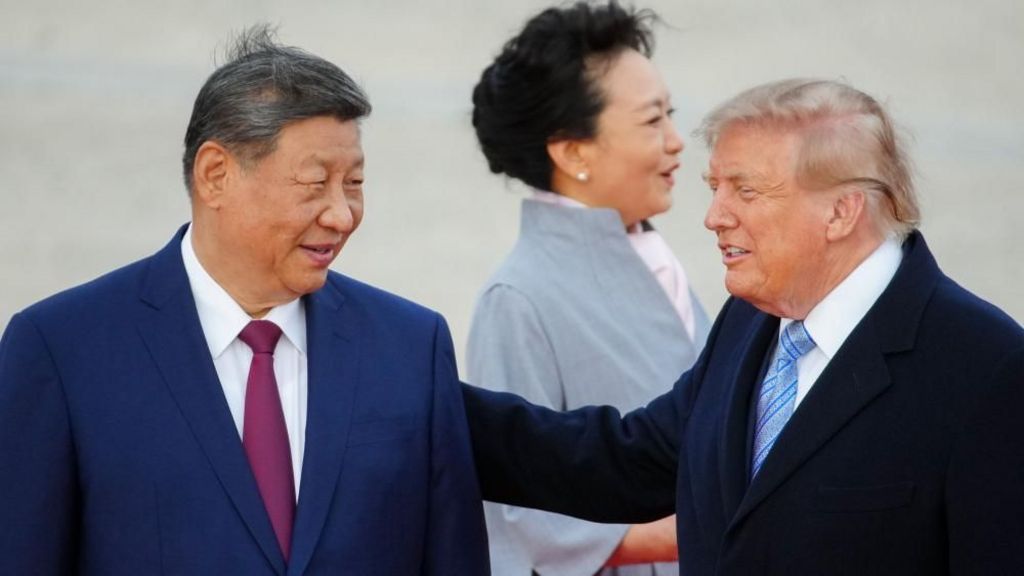
In an extraordinary display of diplomatic priority not seen in more than six decades, US President Donald Trump personally welcomed Chinese President Xi Jinping to Washington Wednesday, kicking off a three-day landmark summit packed with discussions on critical global and bilateral issues. The warm reception, complete with a 30-meter red carpet, a full military honor guard, and a flyover of two B-1 supersonic bombers, marked the first time a sitting US president has greeted a foreign leader at Maryland’s Joint Base Andrews since President John F. Kennedy welcomed British Prime Minister Harold Macmillan in 1962.
Xi Jinping touched down at the base at 17:39 local time aboard an Air China jetliner, accompanied by his wife Peng Liyuan and a high-level delegation that includes Politburo Standing Committee member Cai Qi, widely regarded as Xi’s closest advisor, Vice Premier He Lifeng, Foreign Minister Wang Yi, and other senior diplomatic and trade officials. After the plane came to a stop, honor guard troops lined both sides of the red carpet, and two official limousines pulled up to the aircraft steps. President Trump and First Lady Melania Trump stepped forward to greet the Chinese delegation, shaking hands with Xi and Peng before the two couples walked the red carpet together, posed for official photographs, and departed for Washington in separate motorcades.
Even before the formal summit talks began, a key preliminary agreement was announced: US Treasury Secretary Scott Bessent confirmed that Washington and Beijing have agreed to extend their ongoing bilateral trade truce until January, pushing back the original November 10 expiration date. The current truce framework saw the US reduce tariff rates on a range of Chinese imports in exchange for China loosening export restrictions on critical rare earth minerals, materials essential to US manufacturing and high-tech supply chains. Bessent noted that he and He Lifeng held preliminary talks focused on laying the groundwork for a potential more comprehensive long-term trade deal down the line.
In a written statement released by China’s state news agency Xinhua ahead of the summit, Xi emphasized the shared potential of the world’s two largest economies. “Both China and the United States are great nations, and their people are great people,” Xi wrote. “The two countries should be partners rather than rivals.” He added that China’s goal of national rejuvenation and the Trump administration’s “Make America Great Again” agenda are fully compatible, saying “they can coexist, reinforce each other, and benefit the whole world,” and expressed confidence the summit would deliver tangible, positive outcomes.
First Lady Melania Trump, who has taken a hands-on role in planning the summit’s itinerary, told Fox News that President Trump made the decision to greet Xi personally at the base because of the strong rapport the two leaders share. The three-day schedule includes closed-door leadership talks, a lavish state dinner Thursday evening that will be attended by top US artificial intelligence industry leaders, and a cultural visit to the Smithsonian National Museum of Asian Art, where Melania Trump will host Peng Liyuan to highlight cultural ties between the two nations. The summit will conclude Friday with a visit to the US National Archives, where the two couples will view historical documents marking key milestones in US-China relations.
Unlike Trump’s May 2026 visit to Beijing, which included a delegation of top US tech executives from firms including Apple, Tesla, and Nvidia, it remains unclear whether Xi brought any Chinese business leaders along for the Washington trip. Analysts note that bringing Chinese business figures would likely draw renewed scrutiny of Chinese industrial practices, state subsidies, and overcapacity in key manufacturing sectors – issues that have long been points of contention in bilateral relations.
The summit comes as the two global powers are locked in a race for dominance in artificial intelligence, a sector that sits high on the meeting agenda. Trump has publicly dismissed industry warnings about unregulated AI development as a “hoax,” and both sides are expected to lay out their priorities for AI governance and competition during the talks. Other key issues on the agenda include the ongoing Iran conflict, cross-Strait relations around Taiwan, and US arms sales to the self-governing island that Beijing claims as its own territory.
David Firestein, a China expert at the Bush China Foundation, outlined the core priorities each side brings to the table: Trump is pushing for further progress on trade, including lower Chinese tariffs on US goods, increased Chinese rare earth exports to the US, and higher purchases of American agricultural products. Firestein noted that Beijing has so far failed to follow through on earlier commitments to expand these imports and exports, a sticking point in negotiations. For China, Firestein said Xi will push for Trump to delay or block a congressionally approved $14 billion arms sale to Taiwan, and to deepen bilateral trade integration.
Notably, Firestein observed that while the core issues dividing the two nations have not changed, the bilateral relationship is currently more stable and less volatile than it was in 2025. This shift comes as public opinion in the US has grown more favorable toward engagement with China: a recent Chicago Council on Global Affairs poll found that just 41% of Americans now view China’s territorial ambitions as a direct threat to the US, down from 52% in 2022. A 57% majority of Americans – including 57% of non-MAGA Republicans and most Democrats across the ideological spectrum – now support continued cooperation and engagement with Beijing. The only notable divide comes among Trump’s core loyalist base, where 63% favor limiting bilateral relations, creating a split between the president’s diplomatic outreach and the views of his most committed supporters.