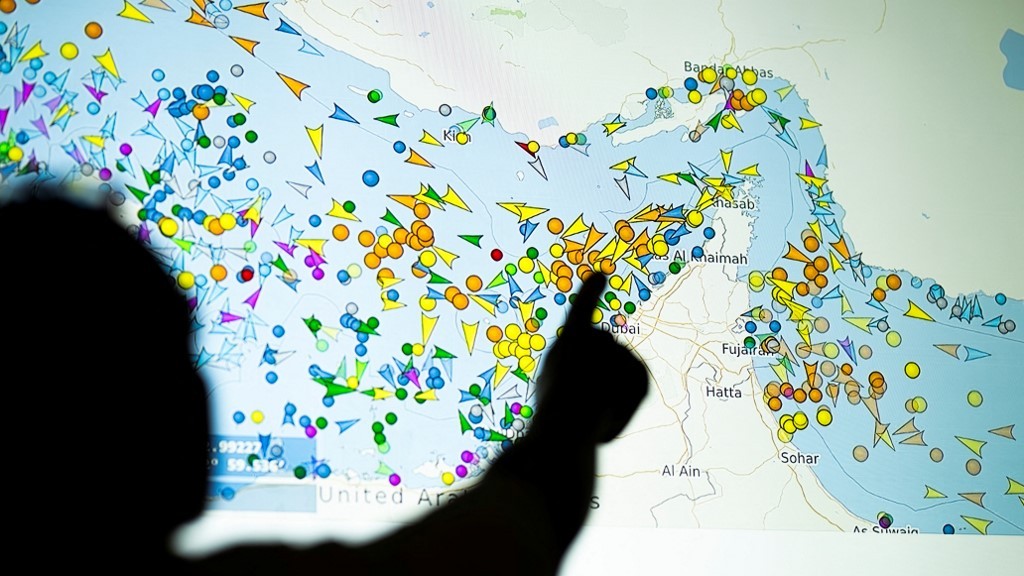
A rapidly escalating standoff over the strategically critical Strait of Hormuz has sent shockwaves through global markets and international diplomacy, after former U.S. President Donald Trump reignited tensions with a provocative claim declaring the key waterway as new American territory.
Trump first floated the idea of claiming the strait last week, tying the move to an expected Iranian surrender that never materialized. On Tuesday, he doubled down on the threat, sharing a map of the waterway on his social platform Truth Social with the simple caption: “New US Territory”.
Far from backing down to Washington’s pressure, Iran has responded with firm defiance, linking any reopening of the closed strait to the United States fulfilling its obligations under a previously agreed interim memorandum of understanding. Tehran’s demands include an end to U.S. naval blockade measures, the full lifting of crippling economic sanctions, and the release of billions of dollars in frozen Iranian assets held overseas.
Iranian Parliament Speaker and chief nuclear negotiator Mohammad Bagher Ghalibaf cemented Tehran’s position in remarks Tuesday, leaving no room for compromise. “Let me state clearly: Until all the commitments made by the United States in the memorandum of understanding — including the lifting of the blockade, the release of frozen assets, the lifting of oil sanctions, the end of threats and military operations on all fronts, and other conditions to which America agreed — are fully implemented, the strait will not be opened,” Ghalibaf said.
The ongoing closure has already gutted commercial traffic through the waterway, which handles roughly 20% of global oil and 30% of global liquefied natural gas trade. Preliminary shipping data from analytics firm Kpler shows that only six commodity vessels transited the strait on Monday, split evenly between inbound and outbound journeys. This marks a steep drop from the 10-day average of around 11 vessels, with even steeper declines recorded over the weekend: just three vessels crossed on Saturday, and only two on Sunday. No supertankers or LNG carriers appeared in public tracking data, though Kpler noted that vessels operating with their transponders turned off would not be counted in these figures.
Tensions spiked further Tuesday when the UK Maritime Trade Operations agency confirmed that a commercial vessel departing the strait had been struck by an unknown projectile. “The Company Security Officer has reported that the vessel was struck by an unknown projectile while conducting an outbound transit of the Strait of Hormuz,” the agency said in a statement. “The impact caused damage to the engine room and resulted in a crew casualty,” it added, noting that Omani coastguard vessels were already on site providing assistance to the uninjured remaining crew.
In response to the attack, Iranian Foreign Minister Abbas Araghchi blamed Israel for orchestrating the incident to derail ongoing negotiations and prolong the regional conflict. “The Zionist regime was and remains the biggest opponent and obstacle to the implementation of the memorandum of understanding. They made every effort to prevent such an agreement from being reached, every effort to make this agreement fail, and every effort to prevent it from being implemented,” Araghchi told Iran’s state-run IRNA news agency.
Araghchi also pushed back against Trump’s earlier demand for Iran’s unconditional surrender, arguing that Tehran had turned the tide of the conflict to force Washington to negotiate on Iranian terms. “It was us who said we would not accept a ceasefire and continued the war until we reached a point where they accepted a ceasefire and negotiations on Iran’s terms,” he said, adding that those who initially demanded unconditional surrender were now begging for talks just weeks after the conflict began.
Qatar, which has led regional mediation efforts, announced that diplomatic negotiators would resume work to end the wider conflict and restart stalled talks after Iran and Oman reached a separate bilateral agreement governing maritime transit through the strait.
Domestically, U.S. Democrats have criticized Trump’s handling of the standoff, arguing that his hardline tactics have failed to produce any progress on curbing Iran’s nuclear program. Democratic Senator Chris Murphy said Tuesday that it was now clear Tehran had outmaneuvered the Trump administration. “It’s crystal clear that there is no current path to get Iran to give up its nuclear program,” Murphy wrote on social platform X. “They are toying with Trump and his diplomatic ingenus. They know they can get complete sanctions relief and all their frozen money without a single nuclear concession.”
The persistent disruption to global shipping has already spilled over into the global economy, pushing up energy prices and creating supply chain bottlenecks. In a sign of shifting trade flows, China’s refined fuel exports rose 6.7% in July after Beijing adjusted wartime supply controls it had put in place to protect its domestic market from potential shortages.
For Iran, the prolonged conflict has come at a severe economic cost. Latest domestic data shows Iran’s annual inflation rate has hit 66%, with food and beverage prices skyrocketing 128.1% compared to one year ago, deepening hardship for ordinary Iranian households.