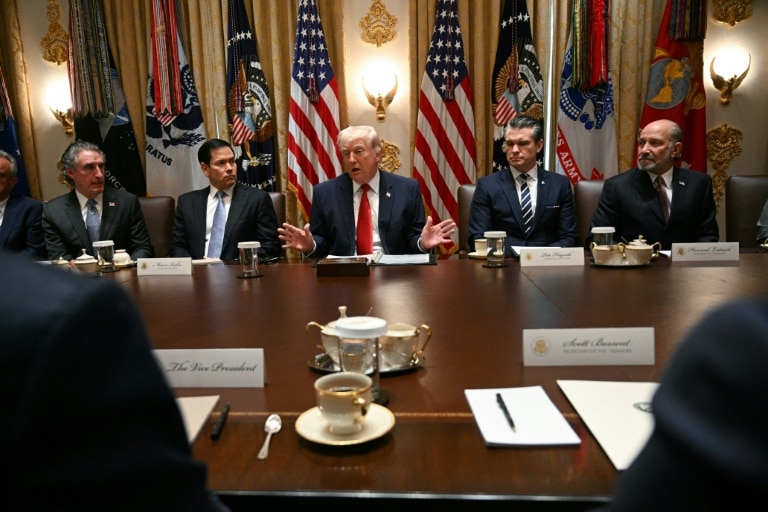
President Donald Trump declared significant advancements in the ongoing Iran military campaign during his inaugural cabinet assembly since hostilities commenced approximately four weeks prior. Addressing senior administration officials on Thursday, Trump asserted that operational objectives were substantially ahead of the initial four-to-six-week timeline projected for the joint U.S.-Israeli offensive.
Despite Tehran’s explicit rejection of negotiation overtures, the President characterized Iranian forces as deficient combatants but skilled diplomats, alleging they were ‘begging to work out a deal.’ The administration’s stance contrasted sharply with Iran’s public position denying any direct diplomatic engagement.
The meeting revealed heightened transatlantic tensions as Trump expressed profound disappointment with NATO allies for refusing naval support in securing the Strait of Hormuz—a critical oil transit route effectively blockaded by Iran in response to military strikes. The President specifically criticized British naval capabilities, dismissing UK aircraft carriers as inadequate compared to American vessels.
Diplomatic channels showed potential movement as businessman Steve Witkoff, serving as roving envoy, confirmed the transmission of a 15-point action plan to Iranian authorities through Pakistani mediation. Witkoff indicated receiving signals that Tehran might be reconsidering its position, suggesting the conflict had reached a decisive inflection point.
The cabinet discussion featured unusually vivid rhetoric from senior officials. Secretary of State Marco Rubio employed musical metaphors to describe military operations, while Defense Secretary Pete Hegseth adopted a dual approach of welcoming diplomatic solutions while continuing military pressure, stating the Department of War would ‘continue negotiating with bombs.’ Vice President JD Vance framed the conflict within religious context, linking military operations to the upcoming Easter season.