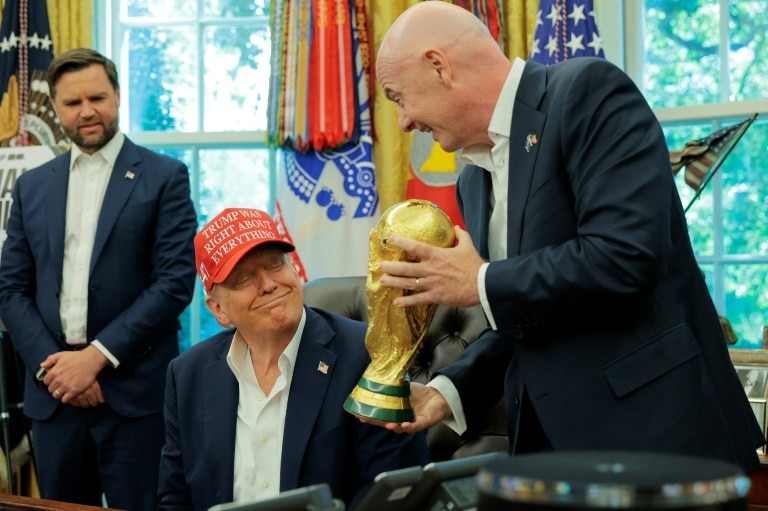
The strategic partnership between FIFA President Gianni Infantino and former U.S. President Donald Trump faces unprecedented strain amid escalating Middle East conflicts, creating complex challenges for world football’s governing body just months before the 2026 World Cup.
Since their simultaneous rise to power in 2016, Infantino and Trump have cultivated a highly visible alliance characterized by mutual political and economic interests. The relationship intensified following Trump’s electoral return to the White House in January 2025, with the North American World Cup hosting partnership between the United States, Canada, and Mexico providing substantial common ground.
Infantino’s frequent White House visits and participation in diplomatic missions to Qatar and Saudi Arabia demonstrated the depth of this geopolitical collaboration. In a notable display of their bond, FIFA established its own Peace Prize that Infantino presented to Trump during December’s World Cup draw in Washington—a move interpreted by observers as strategic flattery after the president failed to secure the Nobel Peace Prize.
According to Raphael Le Magoariec, a French political scientist specializing in Gulf sports politics, ‘Infantino’s approach remains fundamentally driven by economic calculus rather than human rights considerations or international law compliance. The current conflict dynamic fundamentally contradicts the narrative both leaders had carefully constructed.’
The expanded 48-team tournament format promises record-breaking commercial returns, with FIFA projecting $11 billion in revenue for the 2023-2026 cycle. An anonymous football governance insider noted: ‘Infantino’s pragmatism, while seemingly excessive, remains rational. His primary objective remains delivering a successful World Cup, and he perceives Trump as essential to achieving that goal.’
Geopolitical complications have emerged as the conflict impacts key FIFA partners Qatar and Saudi Arabia—nations that have become central to global football’s economy through their World Cup hosting ambitions. Saudi Arabia will host the 2034 tournament following Qatar’s 2022 event.
Sports geopolitics expert Simon Chadwick of EM Lyon Business School suggests Iran’s potential withdrawal would carry minimal commercial consequences for FIFA but would provide Trump’s administration with ‘ideal grounds to project their preferred image and values.’ Consequently, most analysts anticipate the Infantino-Trump alliance will endure, with FIFA likely prioritizing its relationship with American leadership over principled stands on international conflicts.