In the aftermath of a unilateral U.S. war of choice against Iran launched without prior consultation with global allies, President Donald Trump is now demanding international partners step in to resolve the unforeseen fallout of the conflict, as he signals he is poised to wind down American military operations soon.
The president’s frustration has mounted in recent days over Europe’s refusal to back the U.S.-Israeli war effort, with Trump launching a blistering public attack on two of America’s closest transatlantic allies—France and the United Kingdom—via social media on Tuesday. Even as Iran has effectively choked off most oil traffic through the strategic Strait of Hormuz, a development that has roiled global energy markets, Trump has continued to claim Iran’s military and infrastructure have been “decimated.”
In his social media posts, Trump targeted the U.K. first, which had declined to participate in direct offensive operations against Iran. He suggested countries facing jet fuel shortages from the closed strait should turn to U.S. oil supplies, and challenged European nations to “build up some delayed courage, go to the Strait, and just TAKE IT.” Minutes later, he accused France of being “very unhelpful” for denying overflight rights to U.S. military planes carrying weapons bound for Israel.
Trump’s sharp rebuke of NATO members for failing to join the war effort and address its spillover effects has been echoed by top officials in his administration, amplifying longstanding questions about the future of the transatlantic alliance—an institution whose core value Trump has openly questioned since taking office. Top Cabinet members including Secretary of State Marco Rubio, Treasury Secretary Scott Bessent, and Defense Secretary Pete Hegseth have all ramped up anti-NATO rhetoric in recent days, indicating the administration’s skeptical posture toward the alliance is hardening, even as Trump hints at an early exit from the Iran conflict.
Speaking at a Pentagon press briefing Tuesday, Hegseth argued the U.S. had already done the “heavy lifting on behalf of the free world” to counter the Iranian threat. He stressed that securing the Strait of Hormuz, a waterway critical to global oil trade, should not fall exclusively to Washington, noting that other dependent nations, including the U.K. with its historic Royal Navy, must contribute to security efforts. “There are countries around the world who ought be prepared to step up on this critical waterway as well,” he said.
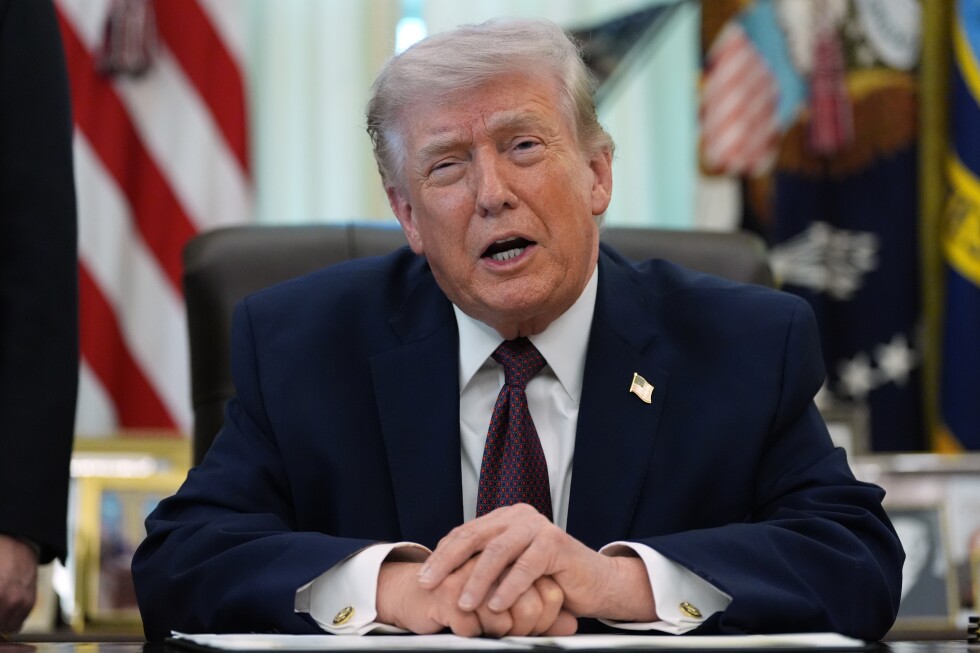
Later that day, during an Oval Office meeting with reporters, Trump confirmed the timeline for U.S. offensive operations, estimating that American strikes on Iran would wrap up within two to three weeks. He made clear that securing the strait long-term would be the responsibility of other nations that rely on the shipping lane. “That’s not for us,” he said. “That’ll be for France. That’ll be for whoever’s using the strait.” The president added that while he is not yet prepared to withdraw the thousands of U.S. troops massed near the strait, that move will come soon.
Despite the sharp diplomatic friction between the U.S. and its European allies, U.S. investors reacted positively to Trump’s timeline for ending the conflict. The S&P 500 jumped 2.9% to notch its largest single-day gain since the previous spring, while the Dow Jones Industrial Average climbed more than 2.5%, as Wall Street shifted from uncertainty over prolonged conflict to renewed optimism for a quick de-escalation.
Even so, weeks of sustained criticism of NATO have left European capitals on edge about the alliance’s future, already strained by Trump’s earlier cuts to U.S. military support for Ukraine and his open threat to seize Greenland from Denmark. Multiple NATO members, including France and Spain, have already banned or restricted U.S. use of their airspace and joint military facilities for operations related to the Iran conflict. While these nations have signaled willingness to join an international coalition to secure the strait once the war ends, the details of their participation and the coalition’s overall stability remain unresolved.
On Tuesday, both France and the U.K. sought to downplay Trump’s verbal attacks. A spokesperson for French President Emmanuel Macron expressed surprise at the criticism, noting “France has not changed its position since day one.” British Defense Secretary John Healey acknowledged the U.S. remains a critical ally despite the rebuke, and outlined steps the U.K. is already taking to support Gulf security. During a visit to Qatar, Healey announced the U.K. would deploy additional missile and air defense systems to Bahrain, Kuwait, and Saudi Arabia, and extend the deployment of Royal Air Force Typhoon fighter jets to Qatar. “The U.S. is a uniquely close ally to the U.K.,” Healey said. “We do things as two nations that no other militaries or intelligence services do.”
Analysts note that while European nations have distanced themselves from the offensive, they have strong incentives to remain engaged and push for a quick end to the conflict to prevent broader regional escalation. More than a decade of civil war in Syria already pushed over 5 million people to flee their homes, with hundreds of thousands seeking asylum in Europe and generating lasting social and political disruption across the continent. More recently, Yemen’s Iran-aligned Houthi movement launched its first direct missile attacks on Israel over the weekend and has threatened to disrupt shipping through the Red Sea—a major trade artery for European economies.
Yasmine Farouk, Gulf and Arabian Peninsula Project director at the International Crisis Group, argued the moment presents a key opportunity for Europe to cement its role as a regional security partner. “I think this is a true opportunity for Europe to show the Gulf that it can be a partner,” she said. “And I think they have already been showing that in the defense (weapons they’ve provided to Gulf nations), they need now to make it more into the diplomatic side in terms of offering offramps and working on a deal.”
Jeremy Shapiro, U.S. programs director of the European Council on Foreign Relations, wrote in a Tuesday analysis that European negotiators can advance their goals by focusing on the war’s economic costs, pushing for a ceasefire tied to a maritime security mission, and crafting an exit that aligns with Trump’s political priorities. “Trump will claim victory no matter how this war ends,” Shapiro wrote. “Europeans should want that to happen sooner rather than later.”