In a sudden Sunday announcement via his Truth Social platform, U.S. President Donald Trump has ordered an immediate military blockade of the Strait of Hormuz, a move that comes after Vice President JD Vance’s negotiation team failed to secure the trust of Iranian officials amid already heightened tensions between the two nations. Iranian negotiators, who have a long history of broken agreements with the United States, have refused to compromise on their sovereignty over the country’s nuclear program, derailing the first direct high-level talks between Washington and Tehran since 1979.
Trump’s early morning post framed the closure as a response to what he called “world extortion” by Iran, claiming the country has leveraged unconfirmed claims of hidden mines in the strategic waterway to extract illegal tolls from commercial shipping. Prior to the Trump administration’s launch of the latest conflict, the strait — which carries roughly 20% of global oil trade — remained open to all vessels. “At some point, we will reach an ‘ALL BEING ALLOWED TO GO IN, ALL BEING ALLOWED TO GO OUT’ basis, but Iran has not allowed that to happen by merely saying, ‘There may be a mine out there somewhere,’ that nobody knows about but them,” Trump wrote. “THIS IS WORLD EXTORTION, and Leaders of Countries, especially the United States of America, will never be extorted.”
The U.S. president went on to outline the parameters of the new blockade, stating he has instructed the U.S. Navy to interdict any vessel in international waters that has paid the so-called toll to Iran — a provision that was reportedly part of a draft ceasefire agreement Trump approved just last week. “No one who pays an illegal toll will have safe passage on the high seas. We will also begin destroying the mines the Iranians laid in the Straits. Any Iranian who fires at us, or at peaceful vessels, will be BLOWN TO HELL!” he added. Trump doubled down on his hardline stance, warning that Iran will not be permitted to profit from what he calls illegal extortion, and reiterated that the U.S. military is “locked and loaded” to complete the destruction of remaining Iranian military infrastructure if necessary, citing Iran’s pursuit of nuclear capabilities as a core casus belli.
The announcement sparked immediate pushback from peace advocates, policy experts, and Iran-focused analysts across the political spectrum. Medea Benjamin, co-founder of the anti-war organization CodePink, highlighted the contradictory logic of Trump’s policy in a post on X, writing, “So get this. Trump wants to open the Strait of Hormuz by closing the Strait of Hormuz. Blow up the world economy to punish Iran. Make sense?” Ryan Costello, policy director for the National Iranian American Council, went further, noting that a blockade qualifies as an act of war under international law. “Trump is announcing he will reenter the US into a war has been illegal under domestic and international law and has been disastrous for US interests, regional security, and the people of Iran,” Costello added. Independent journalist Séamus Malekafzali called the policy one of the most reckless in modern U.S. history, saying “I have legitimately never heard of a more insane, designed-to-backfire policy under this administration; maybe ever. Not only attempting to blockade Iranian ships, but ANY ship that goes through the Strait of Hormuz by paying the toll.”
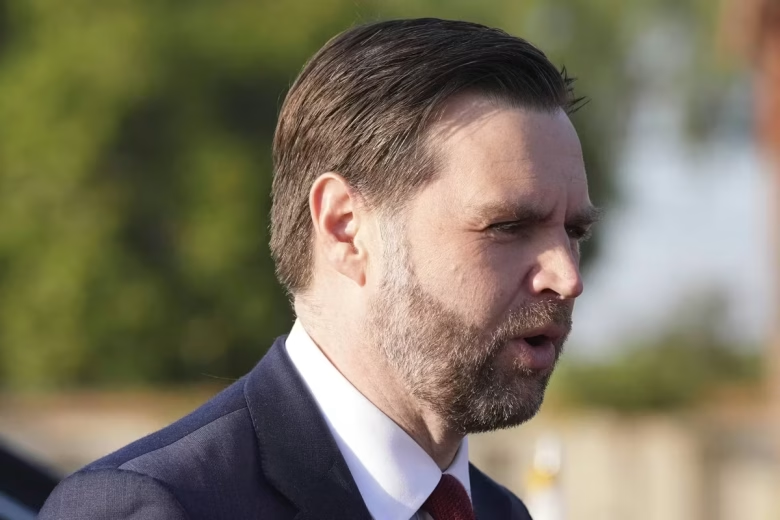
While Trump and Secretary of State Marco Rubio attended a high-profile Ultimate Fighting Championship event in Miami, Vance led the collapsed talks with Iranian officials in Islamabad, Pakistan. Speaking to reporters after the negotiations concluded, Vance reaffirmed the White House’s core demand: “We need to see an affirmative commitment that [Iran] will not seek a nuclear weapon, and they will not seek the tools that would enable them to quickly achieve a nuclear weapon. That is the core goal of the president of the United States, and that’s what we’ve tried to achieve through these negotiations.”
Contextualizing the collapse of trust, Iranian officials note that Tehran was open to sweeping nuclear concessions before the U.S. and Israel launched a joint bombing campaign against Iran on February 28. Notably, every U.S. administration former President George W. Bush’s term — including Trump’s first term — has concluded that Iran is not actively pursuing a nuclear weapons program. Iran previously committed to permanent non-proliferation under the 2015 Joint Comprehensive Plan of Action (JCPOA), the landmark nuclear deal brokered during the Barack Obama administration. Trump unilaterally withdrew from the agreement in 2018 during his first term, despite widespread confirmation that Iran was in full compliance with its terms.
Iranian Parliamentary Speaker Mohammad Baqer Ghalibaf publicly blamed the U.S. for the failed talks, confirming that Iranian negotiators refused to trust Vance’s team despite Tehran putting forward new, forward-looking proposals. The Iranian negotiating delegation was named “Minaab 168” in honor of 168 children and school staff killed in a U.S. cruise missile strike on the town of Minaab on the first day of the current war. “Before the negotiations, I emphasized that we have the necessary good faith and will, but due to the experiences of the two previous wars we have no trust in the opposing side,” Ghalibaf explained on X. He added that “America has understood our logic and principles, and now it’s time for it to decide whether it can earn our trust or not.”
This is not the first time talks have collapsed amid accusations of bad faith from Tehran: just hours before Trump ordered the start of bombing in February, Omani mediators — who have facilitated backchannel talks between the two sides for years — announced a peace deal was within reach, leading Iranian officials to accuse Washington of walking away from a near-agreement to launch hostilities. Similar accusations arose when the U.S. and Israel launched offensive strikes against Iran in summer 2025, mid-way through an earlier round of nuclear negotiations.
As of Trump’s blockade announcement, the U.S. and Israeli bombing campaign against Iran has entered its 43rd day. Coalition forces have struck more than 13,000 targets across Iran, assassinated dozens of senior political and military leaders — including former Supreme Leader Ayatollah Ali Khamenei — and killed more than 3,000 Iranians, hundreds of whom are women and children, according to Iranian medical officials. Concurrent Israeli bombing operations in Lebanon have killed hundreds of additional civilians, and the Israeli campaign in Gaza has killed and maimed over 250,000 Palestinians, leading to an ongoing genocide case against Israel at the International Court of Justice and an arrest warrant for Israeli Prime Minister Benjamin Netanyahu from the International Criminal Court on charges of war crimes and crimes against humanity. Trump has previously publicly vowed to bomb Iran “back to the Stone Ages” and “destroy Iranian civilization.”
Despite major military losses, Iran retains strategic leverage in the conflict, a reality Trump has rejected in his public statements. “The Iranians don’t seem to realize they have no cards, other than a short term extortion of the World by using International Waterways,” Trump wrote on Truth Social as Vance departed for negotiations in Pakistan. “The only reason they are alive today is to negotiate!” Iranian Foreign Ministry spokesperson Esmaeil Baghaei struck a measured tone in response to the collapse, advising that breakthroughs do not come after a single round of talks. “Naturally, from the beginning we should not have expected to reach an agreement in a single session,” Baghaei said. “No one had such an expectation.”