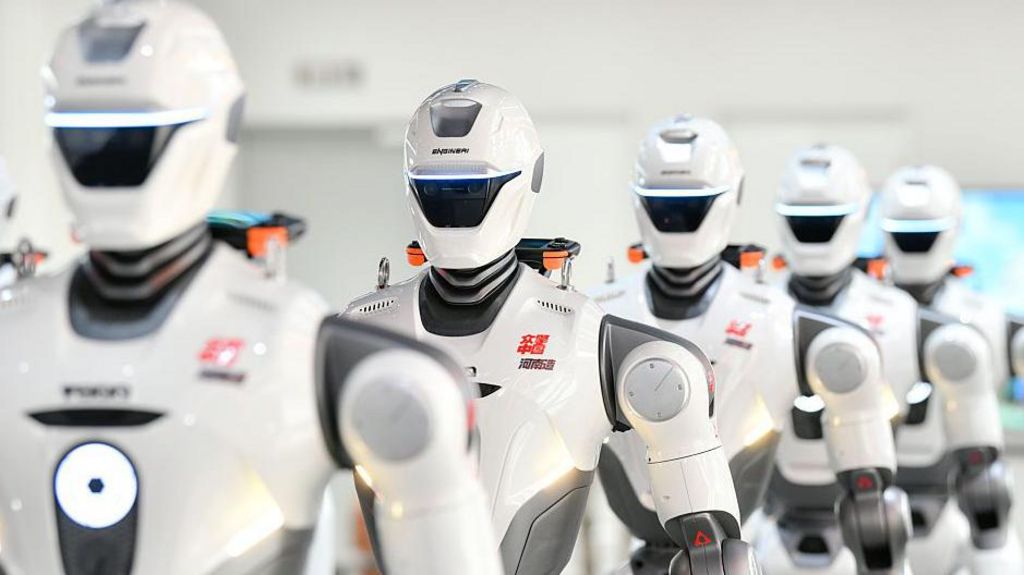
In a policy announcement delivered Tuesday, the Trump administration formally enacted a ban on new imports of foreign-produced advanced humanoid robots into the United States, citing what it called “unacceptable risks” to American national security. The restriction does not only target humanoid machines—it also extends to four-legged advanced robotic systems, a category of next-generation robotics where Chinese manufacturers hold the lion’s share of global production.
This trade action comes amid a intensifying global technology race between the United States and China, the world’s largest producer of humanoid robots, focused on advancing cutting-edge innovation in both robotics and artificial intelligence.
Alongside the robotics ban, the U.S. Federal Communications Commission (FCC) added another trade restriction: a ban on imports of specific foreign-manufactured power inverters. These components are critical to the operation of data centers and solar energy infrastructure, and the FCC asserted that they carry similar risks that could harm the U.S. economy. FCC Chair Brendan Carr framed the dual actions as part of the agency’s broader mandate to protect critical U.S. supply chains from potential threats.
Chinese technology firms have moved aggressively in recent years to scale development of humanoid robots, designing models that can be deployed across a wide range of use cases, from industrial manufacturing lines to domestic residential settings. Unlike many U.S. competitors—including high-profile developers such as Elon Musk’s Tesla robotics division and Boston Dynamics—Chinese companies have accelerated their go-to-market strategies, rolling out commercial products for both business clients and general consumers earlier than many of their American rivals.
As of Wednesday, the BBC has confirmed it has reached out to the Chinese Embassy in Washington, D.C. to request comment on the new restrictions, and no official response has been published yet.