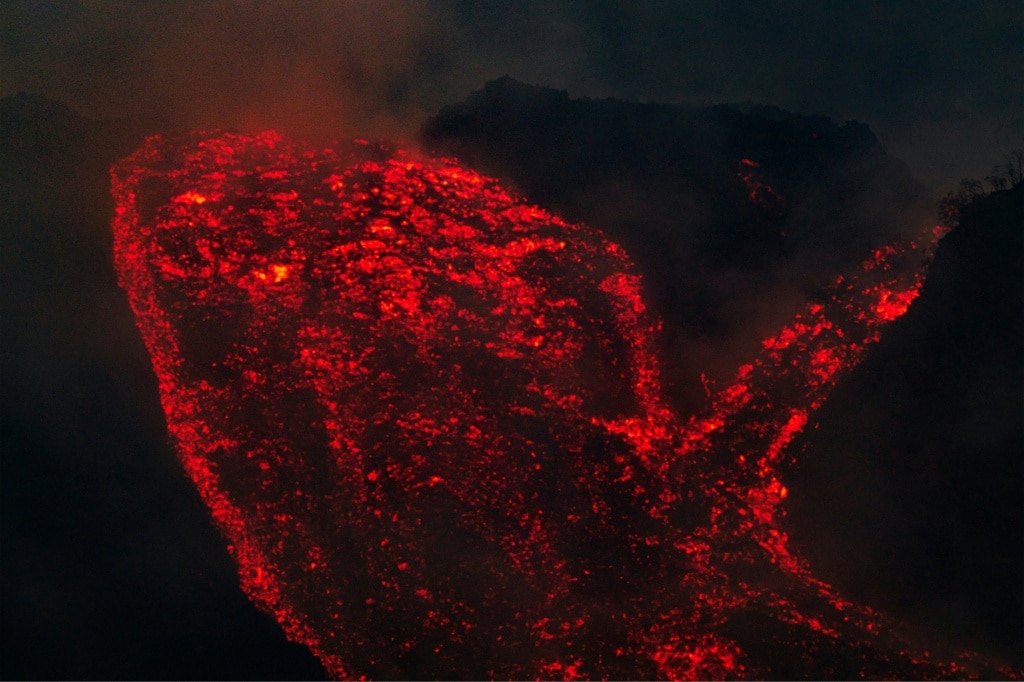
Europe’s tallest active volcano, Mount Etna, has captured global attention after days of continuous ash and lava eruptions, triggering an unexpected surge in tourist footfall to Sicily’s eastern coast. Striking visual footage of glowing lava cascading down the volcano’s slopes has become a viral draw, drawing crowds of casual sightseers and adventure seekers alike—even as the ongoing activity has forced extended closures of nearby Catania Airport, the primary travel hub for visitors to the island.
Local tour guiding companies that specialize in guided nighttime hikes to view volcanic activity up close have reported a staggering spike in booking requests. Daniele Perricelli, a 41-year-old veteran guide who runs the firm Guide Etna, told Agence France-Presse on Wednesday that his team normally hosts a few dozen guests per evening during peak summer season. Currently, however, the company receives roughly 300 booking inquiries every day—three times the average volume. “They all want to come and see the lava flow, everyone is drawn to this unique beauty,” Perricelli explained.
Fellow local guide Ernesto Maria Magri described the event as a “touristic eruption,” noting that the lava flow remains observable from relatively safe lower-altitude zones, making it accessible to a broad range of visitors. Even local residents, who have witnessed dozens of Etna’s eruptions over the years, are flocking to the mountain to see the spectacle, though Magri added that many onlookers gather in disorganized, unregulated crowds that create additional hazards.
A growing number of visitors are choosing to hike the mountain without professional guidance, either because they cannot secure a spot with a registered guide or because they believe they can navigate the terrain safely on their own. This trend has sparked urgent safety warnings from local guides, who emphasize that the volcano remains geologically unstable, and only experienced professionals can read subtle signs of changing activity to avoid danger.
Perricelli warned that overcrowding on existing hiking trails has amplified risks, with up to 2,000 people attempting the climb each evening. He pointed to alarming examples of underprepared visitors, including some who attempted the hike in flip-flops, and called on Italian civil authorities to increase patrols and enforce safety regulations more strictly. High-profile visitors, including popular Italian television host Diletta Leotta, have also faced social media criticism for sharing photos taken within meters of active, glowing lava, prompting concerns that the images could encourage other tourists to take unnecessary risks.
Guides note that it is safe to approach cooled lava flows within a few meters at lower altitudes, but higher elevation zones closer to the active crater carry far greater risk. Under current Italian regulations, visitors are permitted to hike independently up to an altitude of 2,400 meters, but any climb beyond that point requires accompaniment by a licensed guide. The summit of Mount Etna sits at 3,324 meters.
Italy’s national civil protection agency has maintained a yellow alert for Mount Etna, the second-highest level on a four-tier warning scale that ranges from green (low risk) to red (extreme risk). A yellow alert indicates frequent ongoing eruptive activity and a risk of unexpected explosions. The sustained ash emissions from the eruption have forced repeated flight suspensions at Catania Airport, with hundreds of commercial flights cancelled since Saturday. As of Wednesday, airport authorities extended the suspension of all arrivals and departures through 2:00 pm GMT on Thursday.
Catania International Airport is a critical infrastructure hub for Sicily’s $10 billion annual tourism industry, handling roughly 12 million passenger transits in 2024. The region surrounding Mount Etna is one of Italy’s most popular tourist destinations, drawing millions of visitors each year for its volcanic landscapes, coastal towns, and cultural heritage.