High-stakes negotiations between U.S. and Iranian delegations in Pakistan’s capital Islamabad collapsed over the weekend, with Iran’s top diplomat accusing the Trump administration of tanking a near-final preliminary ceasefire agreement through unrealistic, overreaching demands that brought an end to marathon talks aimed at ending a six-week open conflict.
Abbas Araghchi, Iran’s foreign minister, outlined the breakdown in a public post to social media Sunday, noting that the weekend discussions marked the first high-level direct engagement between the two nations in 47 years. Araghchi emphasized that Iran entered the bargaining process in good faith to end the ongoing war, but as negotiators closed in on a finalized Islamabad Memorandum of Understanding, the U.S. side shifted its demands, insisted on maximalist positions, and maintained its economic blockade on Iran. “Zero lessons earned,” Araghchi wrote. “Good will begets good will. Enmity begets enmity.”
This failed talks mark the second time in just two months that U.S. negotiators have been accused of sabotaging a potential deal that was widely seen as within reach. In late February, just hours before U.S. and Israeli forces launched airstrikes on Iranian targets, Oman’s top diplomat—who had mediated earlier rounds of negotiations—confirmed that substantial progress toward a negotiated settlement had already been reached.
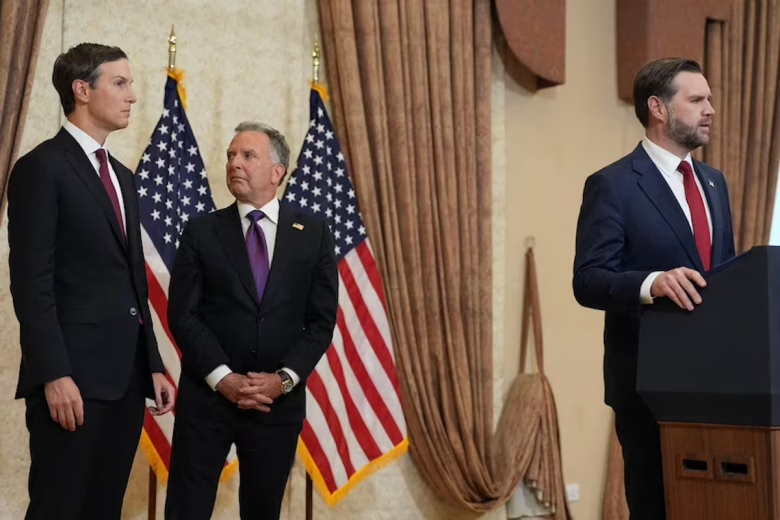
The U.S. negotiating team in Islamabad was led by Vice President JD Vance, alongside special envoys Steve Witkoff and Jared Kushner, the son-in-law of former President Donald Trump. During the talks, the U.S. delegation laid out a series of non-negotiable red lines, including demands that Iran permanently end all uranium enrichment activities and dismantle its core civilian nuclear energy infrastructure. Nuclear non-proliferation experts widely note that Iran retains the legal right to conduct civilian uranium enrichment under the terms of the Treaty on the Non-Proliferation of Nuclear Weapons.
Speaking to reporters after the talks collapsed, Vance pushed back against Iran’s accusations, claiming the U.S. side had approached negotiations with significant flexibility. “We just could not get to a situation where the Iranians were willing to accept our terms,” Vance said.
President Trump echoed that framing in his own social media statement, arguing that most negotiating points had been agreed upon, but the core issue of Iran’s nuclear program remained unresolved. “The meeting went well, most points were agreed to, but the only point that really mattered, NUCLEAR, was not,” Trump wrote.
Iran’s lead negotiator, Parliament Speaker Mohammad Bagher Ghalibaf, echoed Araghchi’s criticism, adding that decades of conflict with the U.S. have left Iran with no reason to trust American negotiating commitments.
Within hours of the single-day talks faltering, Trump announced that the U.S. would implement a naval blockade of the Strait of Hormuz, a strategic waterway that carries roughly a fifth of the world’s daily oil trade. Critics have universally labeled the blockade an illegal act of war that risks dragging both nations into a far wider, more destructive conflict.
Ryan Costello, policy director at the National Iranian American Council, warned that the U.S. approach continued to prioritize dictating terms over good-faith negotiation. “It is concerning that Vance already suggests that the U.S. has put forward a final and best offer, suggesting that the U.S. is still trying to dictate terms rather than negotiate a better future,” Costello said. “We urge President Trump to walk back his blockade threat and for the U.S. and Iran to reengage and consider implementing practical steps where there is agreement to lower tensions and build on this fragile pause to the war.”
The Wall Street Journal reported Sunday that the Trump administration is also considering resuming limited military strikes against Iran targets to complement the Hormuz blockade, which is scheduled to go into effect at 10 a.m. ET. The outlet noted that a full-scale return to a sustained bombing campaign remains on the table, though anonymous administration officials said that option is currently less likely.
U.S. Representative Pramila Jayapal, a Washington Democrat, issued a scathing rebuke of Trump’s actions Sunday, calling the ongoing conflict with Iran illegal, immoral, a war crime, and a catastrophic threat to American public interests. Jayapal called for urgent action to remove Trump from office, saying that impeachment, invocation of the 25th Amendment, or a push for voluntary resignation are all on the table. “This is so grave of a situation,” Jayapal told MSNBC’s *MS NOW*.