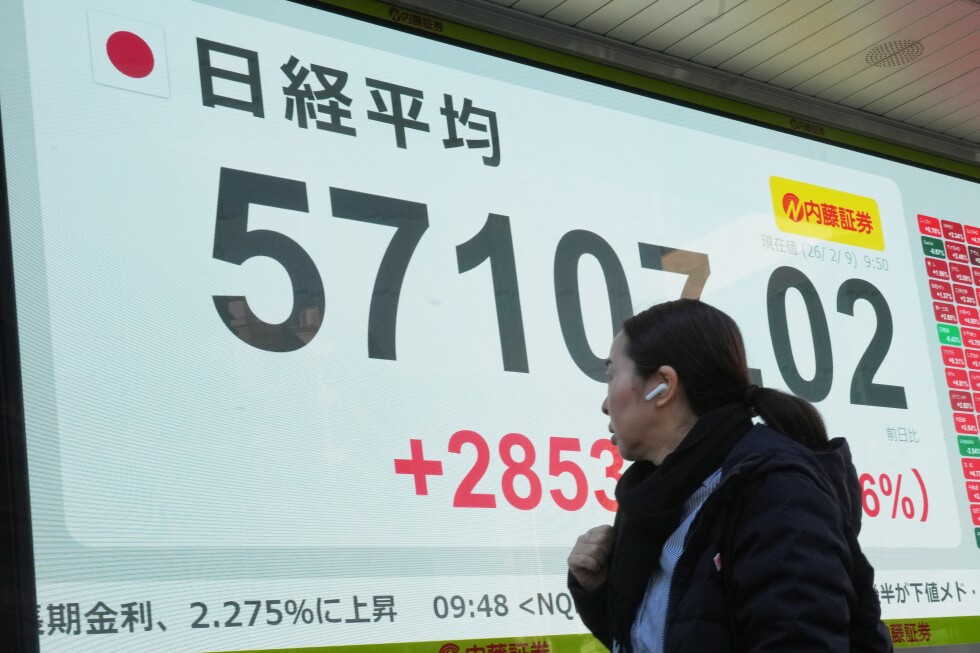
Asian financial markets experienced a significant surge on Monday, propelled by a powerful combination of political stability in Japan and a robust rebound on Wall Street. The catalyst for the regional rally was Tokyo’s Nikkei 225 index, which skyrocketed 4.7% to close at 56,788.85 after briefly surpassing the 57,000 mark during the session—setting a new historical record.
The dramatic market response followed Japanese Prime Minister Sanae Takaichi’s governing party achieving an extraordinary political victory. According to NHK public broadcaster, Takaichi’s Liberal Democratic Party (LDP) secured 316 seats in the 465-member lower house of parliament, comfortably exceeding the 261-seat absolute majority requirement. This remarkable achievement represents the party’s strongest performance since its establishment in 1955, surpassing the previous record of 300 seats set in 1986 under late Prime Minister Yasuhiro Nakasone.
Prime Minister Takaichi reinforced market confidence by announcing her commitment to pursuing policies that would “make Japan strong and prosperous” through NHK. Her market-friendly approach and the supermajority victory provide unprecedented political stability for implementing economic reforms.
The bullish sentiment spread across Asian exchanges, with South Korea’s Kospi surging 4.3% to 5,308.84. Hong Kong’s Hang Seng index advanced 1.5% to 26,963.25, while China’s Shanghai Composite rose 1% to 4,106.54. Taiwan’s Taiex gained 2.4%, and Australia’s S&P/ASX 200 jumped 1.9% to 8,876.50.
This regional rally built upon Friday’s dramatic recovery on Wall Street, where technology stocks rebounded strongly from earlier weekly losses. The S&P 500 posted its best performance since May with a 2% rally, while the Dow Jones Industrial Average soared 1,206 points (2.5%) to close above the 50,000 level for the first time. The Nasdaq composite leaped 2.2%, driven by semiconductor companies like Nvidia (up 7.8%) and Broadcom (up 7.1%), both recovering significantly from weekly declines.
Additional positive factors included Bitcoin’s stabilization above $70,000 after recent volatility and calmer conditions in metals markets, with gold settling at $4,979.80 per ounce after a 1.8% increase.
Looking ahead, Prime Minister Takaichi’s immediate challenge involves addressing delayed budget legislation when parliament reconvenes in mid-February, focusing on economic measures to counter rising costs and stagnant wages—a task now facilitated by her party’s commanding parliamentary position.