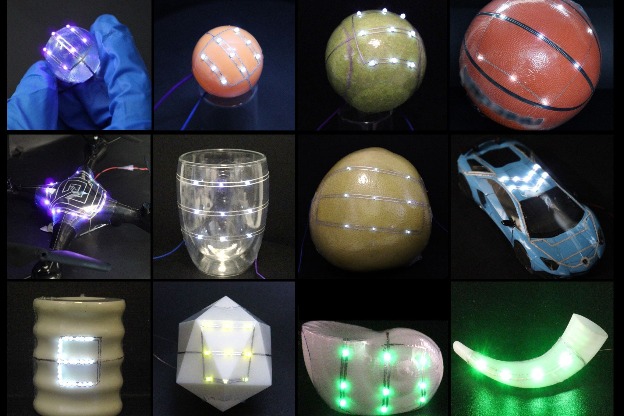
A research team from Tianjin University has achieved a groundbreaking advancement in flexible electronics by developing an ultra-rapid, cost-effective method for printing high-performance electronic circuits directly onto complex three-dimensional surfaces. This technological leap addresses longstanding challenges in manufacturing circuits on non-planar structures and promises to accelerate innovation in robotic systems, wearable technology, and multiple industrial applications.
The core innovation involves a novel approach utilizing commercially available thermoplastic films that contract when heated, enabling them to conform tightly to irregular shapes ranging from robotic appendages to aerodynamic surfaces and even human fingers. The research team, led by Jiang Chengjie, overcame the critical limitation of conventional metal conductors—which typically fracture during film contraction—by engineering a specialized semiliquid metal material boasting exceptional electrical conductivity and fluid properties.
Through sophisticated pre-calculation simulations, the researchers developed a printing technology that precisely applies circuit patterns onto flat thermoplastic sheets. When subjected to warm water or hot air at approximately 70°C, these two-dimensional circuits transform into perfectly fitted three-dimensional configurations within a remarkable five-second timeframe. The resulting circuits demonstrate extraordinary mechanical resilience, maintaining stable electrical performance through 5,000 cycles of bending and twisting stress tests.
The practical applications are already demonstrating significant potential. In embodied intelligence, the team has created customized tactile sensor arrays for robotic arms and heads, effectively granting machines sensitive electronic skin capabilities. They’ve additionally developed an intelligent glove integrating pressure and temperature sensors that enables robots to identify objects through touch with 97% accuracy.
Beyond robotics, this technology shows promising applications across smart agriculture, aerospace engineering, and healthcare technology. Specific implementations include environmental monitoring systems, aircraft wing de-icing mechanisms, and advanced wearable health sensors. The circuits have additionally proven reliable adhesion on challenging surfaces including polytetrafluoroethylene, moist wood, and rough plaster—significantly expanding potential use cases across industries.