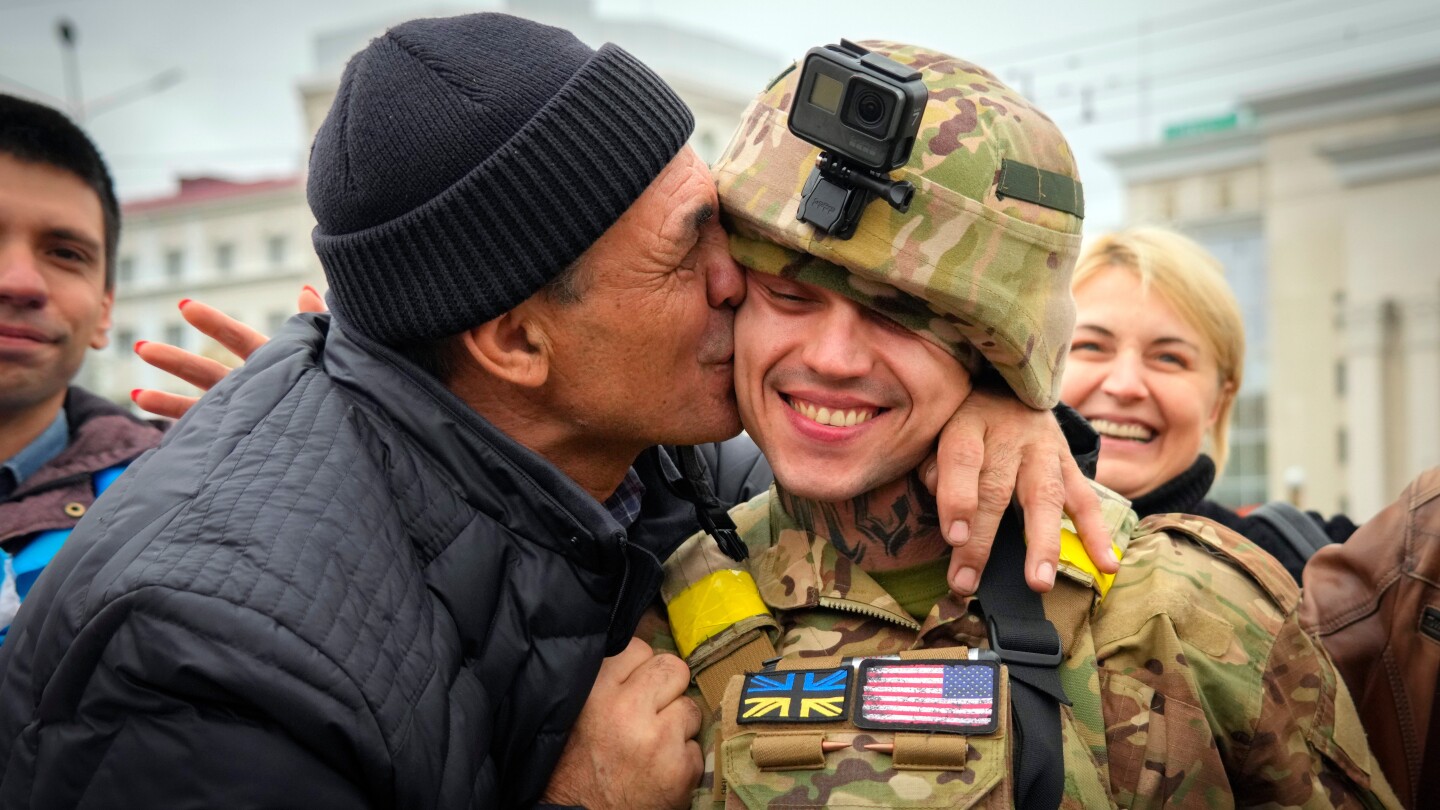
KHERSON, Ukraine — Once a bustling southern Ukrainian port city, Kherson now lies eerily quiet, its streets largely deserted three years after its liberation from a nine-month Russian occupation. The joy that erupted on November 11, 2022, when residents waved blue-and-yellow flags and embraced their liberators, has faded into a tense stillness. Daily life now unfolds behind walls or underground, as Russian forces continue to strike from across the Dnipro River, and drones patrol the skies above a city scarred by broken windows and empty courtyards. Despite the constant threat, those who remain insist that life, even in a shuttered city, is preferable to living under Russian rule. A recent visit by Angelina Jolie provided a brief morale boost, highlighting the daily survival challenges faced by residents. Once home to nearly 280,000 people, Kherson has become a forgotten front line, where explosions echo daily beneath billboards proclaiming the city’s strength, freedom, and resilience. Amidst the ruins, 55-year-old florist Olha Komanytska tends to her small kiosk, a surreal burst of color in a bomb-scarred center. Her red and white roses spill from tall buckets, a poignant reminder of the city’s former vibrancy. For nearly 30 years, Komanytska and her husband grew flowers in Kherson’s countryside, but their greenhouses were destroyed in the war. Her husband died of a heart condition, which she believes was exacerbated by the stress of the conflict. She now wears a black headscarf in mourning, her eyes filling with tears as she speaks of him. The city’s new rules of survival are harsh: Komanytska can identify every weapon by its sound and has learned to close her kiosk early, walking home pressed against walls to avoid drones. The only time her somber face softens into a smile is when she recalls the city’s liberation. “That day was amazing,” she says, repeating the word as if to make it real again. Kherson’s residents have adapted to their new reality with ingenuity and resilience. Municipal workers stretch protective mesh over streets, repurposed from construction sites to shield civilians from drones. Hospitals are wrapped entirely in netting, with only narrow passages left for staff and patients. Post offices still operate, their entrances blocked by concrete slabs meant to absorb blasts. At bus stops, small cement bunkers stand ready, reminders that shelling can come at any moment. Above the nets, an invisible shield protects Kherson: electronic warfare systems that detect, jam, or disable enemy drones. Max, 28, who serves in the 310th Separate Marine Electronic Warfare Battalion, works tirelessly to intercept up to 250 FPV drones heading toward Kherson in just half a day. His unit intercepts more than 90% of these threats, a testament to the critical role of electronic warfare in the city’s defense. “When you see a strike hit a soldier or a civilian, it hurts you — it weighs on your soul,” Max says. “I think they simply want to destroy us as a nation — not just the military, but everyone — so that we cease to exist.” To preserve a sense of normalcy, some activities, especially for children, have moved underground. Former apartment basements are now cozy rooms where children gather to play chess and checkers, laugh, and make friends. Chess coach Oksana Khoroshavyna notes that the club has become a vital social outlet for children who study online and rarely leave their homes. In another basement, 16-year-old Artem Tsilynko practices boxing with his peers, finding unity and purpose amidst the limitations of life in Kherson. “For me, this place is about unity,” he says. “Even though life in Kherson is so limited — social life, sports life — we still have a chance to train.” Artem has spent nearly a quarter of his life in war, and while fear for his own life has dulled with time, it still returns at night during heavy shelling. “When you’re sitting in the basement, your heart races,” he says. “After that, it’s hard to fall asleep.”