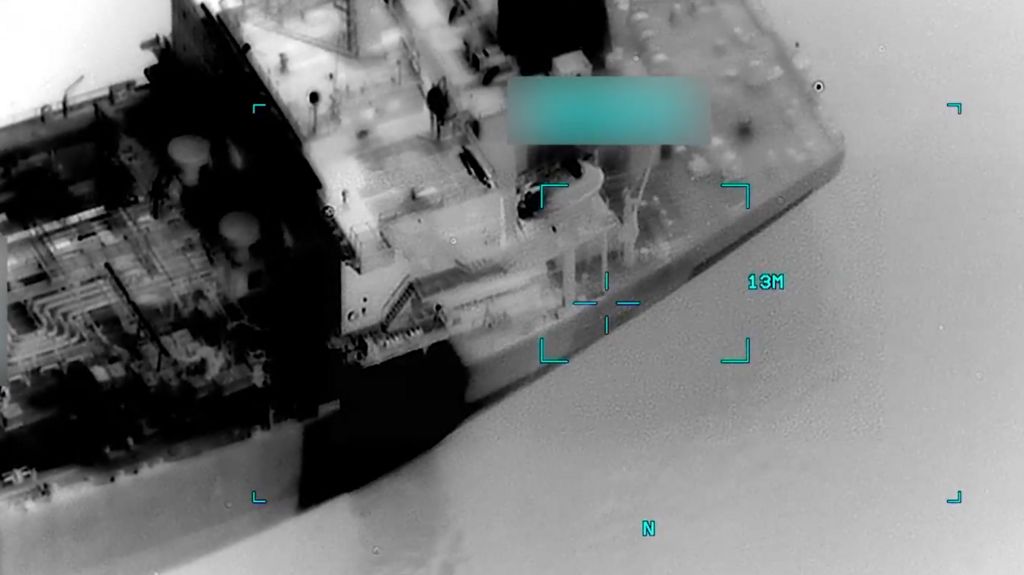
Escalating maritime enforcement actions amid a months-long regional conflict have put the U.S. military at the center of a new diplomatic incident, after U.S. Central Command (Centcom) announced it had disabled a Palau-flagged oil tanker carrying an Indian crew in the Gulf of Oman over accusations it violated an American blockade on Iranian oil shipments.
In a public post on the social platform X, Centcom confirmed that a U.S. military aircraft launched precision-guided munitions at the engine room of the vessel, identified as the Settebello. The strike was carried out, the command said, after the ship’s crew ignored repeated orders to halt and comply with inspections from U.S. forces operating in the area. Centcom also published footage it claims shows the damage to the tanker’s engine compartment following the attack.
Indian government officials have confirmed that three Indian nationals among the Settebello’s crew remain missing, while 21 other Indian crew members have been safely rescued from the disabled vessel. In an official statement, New Delhi condemned the incident, saying that “the targeting of commercial shipping and civilian infrastructure in the region must end.” Following the attack, Indian authorities summoned the deputy chief of the U.S. diplomatic mission in New Delhi to raise formal objections, multiple government sources confirmed to the BBC.
This strike marks the second time in one week that U.S. forces have targeted a Palau-flagged oil tanker with an Indian crew in the Gulf of Oman. Earlier this week, Centcom carried out a similar strike on the Marivex, another vessel accused of violating the blockade. All 24 crew members of that vessel were eventually rescued by Omani military forces, Indian officials confirmed.
The U.S. imposed the full naval blockade on access to Iranian ports in mid-April, after Iran blocked traffic through the Strait of Hormuz — a critical global chokepoint through which roughly 20% of the world’s daily oil and natural gas supplies pass. Since the blockade went into effect on April 13, Centcom reports that U.S. forces have disabled a total of eight vessels that violated the blockade, and redirected 134 other ships to comply with the restrictions.
The incident comes as broader regional tensions between the U.S. and Iran remain at a boiling point, with no sign of de-escalation despite a recent temporary ceasefire. On Wednesday, former U.S. President Donald Trump issued a harsh new threat against Iran, saying the U.S. would strike the country “hard” if Tehran did not move quickly to sign a negotiated peace deal. Trump accused Iranian leaders of dragging out negotiations to deceive the U.S., saying they were “playing Americans for suckers.”
Trump’s comments came just days after an American helicopter was shot down on Monday, an incident that broke the fragile ceasefire agreed to by both sides in April. That ceasefire was initially scheduled to last two weeks, but has been repeatedly violated by both sides in recent weeks. Iran has accused the U.S. of being the first to break the terms of the truce.
The current full-scale conflict in the Middle East traces back to February 28, when the U.S. and Israel launched coordinated surprise strikes on Iran that killed the country’s supreme leader. Iran responded immediately with large-scale missile and drone attacks against Israel and U.S. ally states across the Gulf region. Fighting spread rapidly across the Middle East, with Lebanon officially joining the conflict in March.