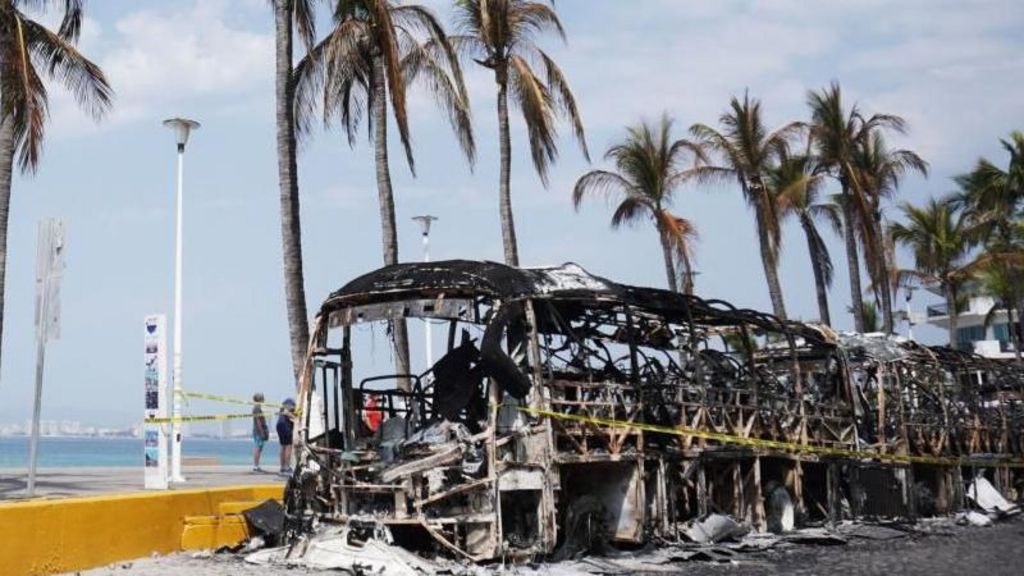
GUADALAJARA, Mexico – The aftermath of a coordinated cartel assault continues to haunt Mexico’s western Jalisco state, where charred vehicle carcasses and scorched asphalt bear witness to Sunday’s eruption of violence. The Jalisco New Generation Cartel (CJNG), among Mexico’s most formidable criminal syndicates, orchestrated this display of force in retaliation for the killing of their leader, Nemesio “El Mencho” Oseguera.
The systematic torching of vehicles and looting of convenience stores served as a stark demonstration of the cartel’s operational capacity and its intent to maintain dominance regardless of leadership decapitation. This calculated spectacle of chaos successfully instilled widespread fear across urban centers, challenging governmental authority and disrupting civilian life.
President Claudia Sheinbaum’s administration has attempted to project control, emphasizing the restoration of “peace and tranquillity” during daily briefings while deploying military and police convoys throughout Guadalajara. Despite these visible security measures, public apprehension persists, evidenced by unusually empty streets, shuttered businesses, and closed educational institutions as residents adopt precautionary measures.
Amid the tension, local entrepreneur Anwar Montoya defied the climate of fear by reopening his Severo café. “We’re a new business and I have a lot of things to pay for,” Montoya explained, acknowledging the previous day’s events as “strange and difficult” while hoping his establishment might provide a safe haven for the community. His café attracted patrons including left-wing parliamentarian Mariana Casillas, who criticized both the cartel violence and what she characterizes as the government’s inadequate response.
Casillas contextualized the crisis within Mexico’s two-decade-long drug war, noting that Sunday’s violence represented an intensified manifestation of persistent patterns rather than an isolated incident. She argues that the government’s continued focus on high-profile leader extraction fails to address root causes including systemic violence, poverty, and forced recruitment that sustain cartel operations.
Security analysts echo these concerns, with Insight Crime managing editor Deborah Bonello observing that leadership decapitation strategies consistently trigger violent power struggles within criminal organizations. “When you take out a major leader, there’s a detonation of a struggle to take control in that vacuum,” Bonello noted, predicting intensified conflict in various regions.
This security crisis emerges as Guadalajara prepares to host World Cup matches in June, raising international concerns about spectator safety. While FIFA President Gianni Infantino expressed being “very reassured” about security preparations and Mexican officials guarantee fan protection, local skepticism remains profound. Montoya questioned the city’s readiness, stating “I don’t think this is a safe place for the World Cup,” while Casillas emphasized that residents prioritize basic security, clean water, and locating disappeared relatives over international sporting events.
The unfolding situation underscores Mexico’s complex security challenges as the government balances international commitments against domestic crises, with the upcoming tournament presenting both an opportunity for global prestige and a potential flashpoint for further violence.