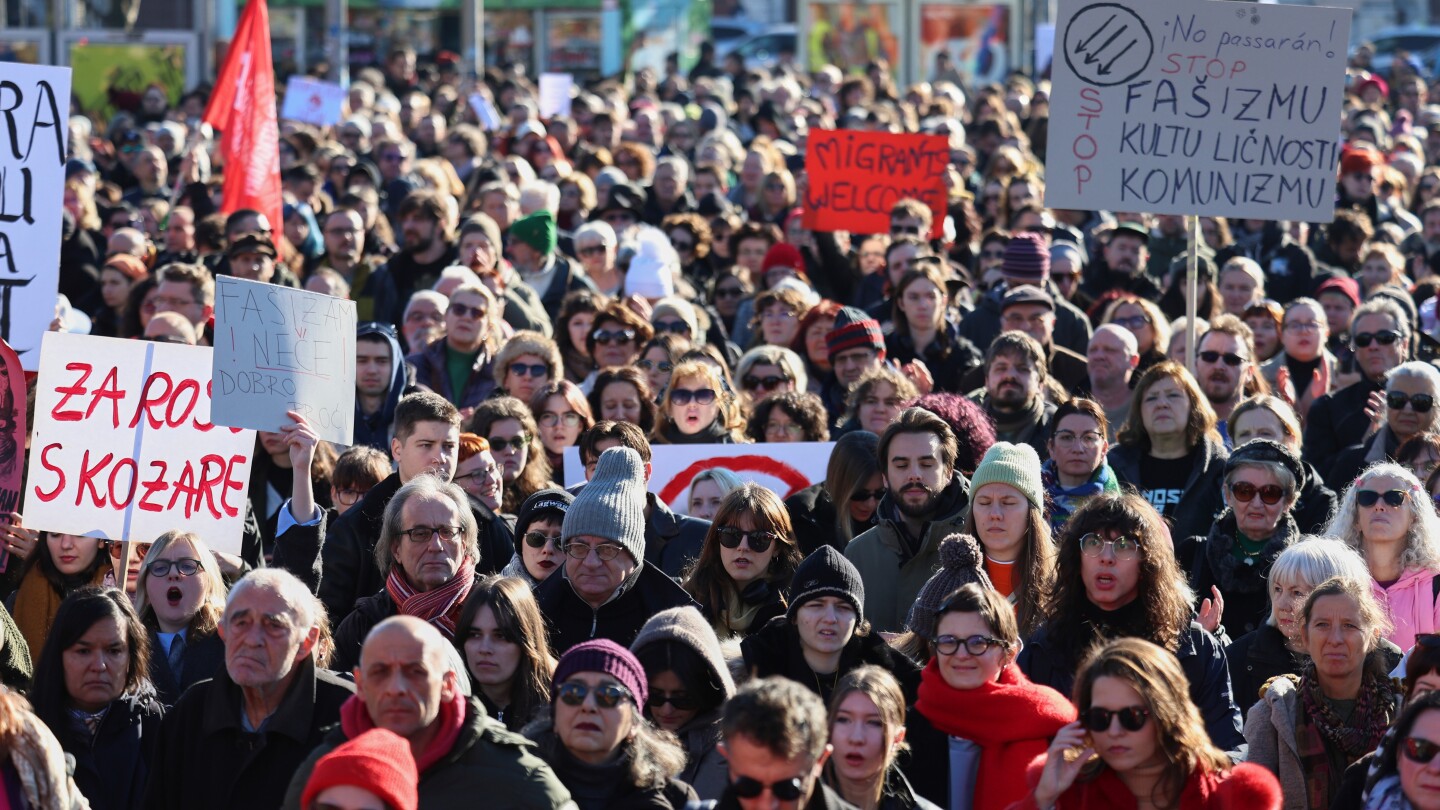
Thousands of Croatians took to the streets across multiple cities on Sunday in a powerful display of opposition against escalating far-right activities that have heightened ethnic and political tensions within the European Union nation. Organized under the banner “United against fascism,” the demonstrations saw participants in Zagreb, Rijeka, Zadar, and other urban centers chanting “we are all antifascists!” while condemning right-wing groups’ attempts to spread fear and suppress dissent.
The protests emerged in response to a series of extremist incidents, including November’s targeting of ethnic Serb cultural events in Zagreb and Split, where groups of young men dressed in black chanted pro-fascist slogans and nationalist rhetoric. Participants demanded authorities take decisive action against hard-right groups that frequently employ symbols from Croatia’s World War II pro-Nazi puppet state, the Ustasha regime, which operated concentration camps responsible for executing tens of thousands of ethnic Serbs, Jews, Roma, and antifascist Croats.
Journalist Maja Sever addressed the Zagreb rally, warning that recent developments represent “very dangerous” trends and praising demonstrators for their commitment to defending democratic values. Meanwhile, counter-gatherings organized by right-wing supporters resulted in minor scuffles with police, leading to at least one detention according to local media reports.
This surge in far-right activity traces its political roots to last year’s parliamentary election, when Prime Minister Andrej Plenkovic’s conservative party formed a coalition with a far-right faction, excluding an ethnic Serb party from government for the first time in years. The trend reached a cultural climax with a mass concert in July featuring controversial right-wing singer Marko Perkovic (known as Thompson), whose use of the Ustasha-era slogan “For the homeland — Ready!” in his music has long been a source of national division.
Prime Minister Plenkovic has rejected accusations that his administration turns a blind eye to neo-fascist hate speech, instead blaming leftist opponents for exaggerating the problem and deepening societal divisions. The current tensions evoke painful memories of Croatia’s 1991-95 war with ethnic Serbs, which claimed over 10,000 lives following the breakup of Yugoslavia. Despite joining NATO in 2009 and the EU in 2013, Croatia continues to grapple with the legacy of its wartime past and the resurgence of extremist ideologies.