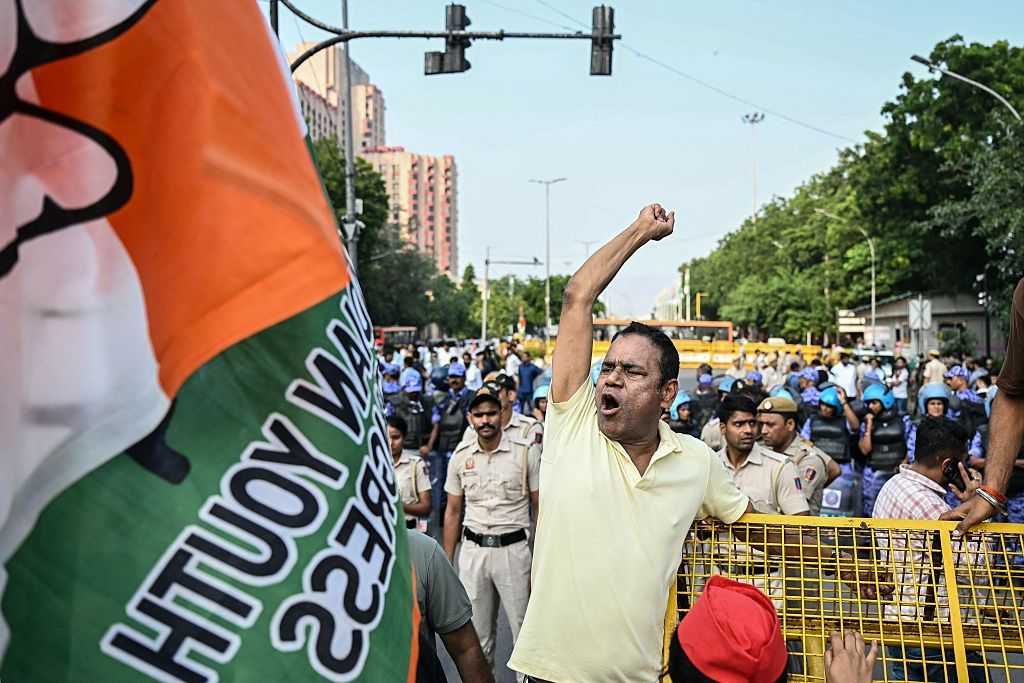
A mass protest led by India’s main opposition bloc has converged on the Supreme Court in New Delhi, amplifying weeks of growing unrest over a contentious voter list revision that opposition leaders claim amounts to systemic electoral fraud favoring Prime Minister Narendra Modi’s ruling Bharatiya Janata Party (BJP).
Dubbed the “March for Democracy,” Monday’s demonstration marked the latest escalation of a conflict that has already seen thousands of protesters detained, harsh police crackdowns on public assembly, and sharp partisan divisions over the integrity of India’s electoral process. Tens of millions of names have been removed from national electoral rolls during the ongoing revision, a move opposition figures argue deliberately disenfranchises voters unlikely to support the BJP ahead of upcoming elections. Both the Election Commission of India and the ruling BJP have repeatedly denied the allegations of biased roll management.
Leading the march was Rahul Gandhi, leader of the Indian National Congress, the country’s largest opposition party, who submitted a formal petition to the Supreme Court challenging the voter roll revision process. In a pre-march press conference, Gandhi shared an open letter addressed to Chief Justice Surya Kant co-signed by Congress President Mallikarjun Kharge that detailed claims of misconduct by Chief Election Commissioner Gyanesh Kumar. Gandhi also issued a public call for all opposition parties, civil society organizations and pro-democracy activists to join the demonstration, framing the action as a defense of India’s democratic foundations.
After the petition was filed, Chief Justice Kant confirmed the case was already pending before the court and thus sub judice, meaning no public comment could be provided on the merits of the challenge. He nevertheless offered a formal assurance that the petition would be heard at the earliest possible opportunity in line with Indian law.
To manage the demonstration, Indian authorities deployed thousands of security personnel across central Delhi, barricaded major roads, implemented traffic restrictions, and temporarily closed entry and exit at several key metro stations along the march route. A bus carrying Gandhi and other senior opposition leaders traveled from Barakamba Road to the Supreme Court complex, with crowds of flag-waving supporters lining the streets to cheer on the procession. When the bus stopped at Mandi House, a central commercial and cultural district, Gandhi and several top allies climbed onto the vehicle’s roof to address the gathered crowd, where thousands of demonstrators joined in anti-government chants accompanied by drums and public cheering. Many protesters climbed onto nearby parked buses to join the demonstration, waving national and party flags as the procession moved forward.
For weeks, Delhi police have denied opposition and activist groups permission to hold public protests over the voter roll issue, citing broad law and order concerns. The crackdown intensified over the weekend ahead of Monday’s march, when pressure group Cockroach Janta Party (CJP), which previously led a successful summer protest that forced the resignation of India’s federal education minister, attempted to hold a rally at Jantar Mantar, New Delhi’s historic designated protest site. Authorities implemented sweeping movement restrictions: dozens of metro stations were shuttered, local train services were canceled, and tens of thousands of police and paramilitary personnel were deployed to block access to the site. This crackdown resulted in the detention of thousands of would-be protesters across the capital.
In a dramatic pre-protest move, CJP founders Abhijeet Dipke, Saurav Das and Ashutosh Ranka were detained directly off a commercial plane after landing in Delhi to attend the weekend demonstration. All three were released within 24 hours: Dipke returned home to attend his grandmother’s funeral, while Das and Ranka reaffirmed in a press conference that protests would continue and confirmed they would apply for a new permitted protest date. Following the weekend crackdown, India’s Home Ministry announced that public demonstrations would no longer be permitted at Jantar Mantar, offering three alternative locations for future protests only if formal permission is granted.
Footage and eyewitness accounts from the weekend crackdown have sparked additional controversy over excessive use of force by police. Multiple videos show security personnel dragging detained protesters, including women, into detention buses, and the BBC captured on-the-ground footage of an officer slapping a detained protester while in custody. The Delhi Police has not responded to repeated requests for comment on allegations of violence against peaceful demonstrators. Journalists were also targeted in the crackdown: at least 16 reporters covering the protests were detained, prompting a formal condemnation from global press freedom organization Reporters Without Borders. “Covering events of public interest is not a crime. It is their job. The police’s actions against the press are unacceptable,” the organization said in a public statement.
Gandhi has condemned the police response, saying young Indians who joined the protests peacefully “with love in their hearts, not hatred or anger” were beaten by security forces. Over the past week, Gandhi and other senior opposition leaders have been briefly detained multiple times while leading protests in central Delhi. BJP President Nitin Nabin has pushed back against the opposition, accusing protest organizers and opposition parties of attempting to destabilize India “at the behest of foreign forces,” though he provided no evidence or details to support the claim.
Many protesters who joined Monday’s march framed the demonstration as an existential defense of the world’s largest democracy. “If they take away our right to vote, what is left with us?” one protester told Agence France-Presse. Another described the action as “a fight to save the very fabric” of India.