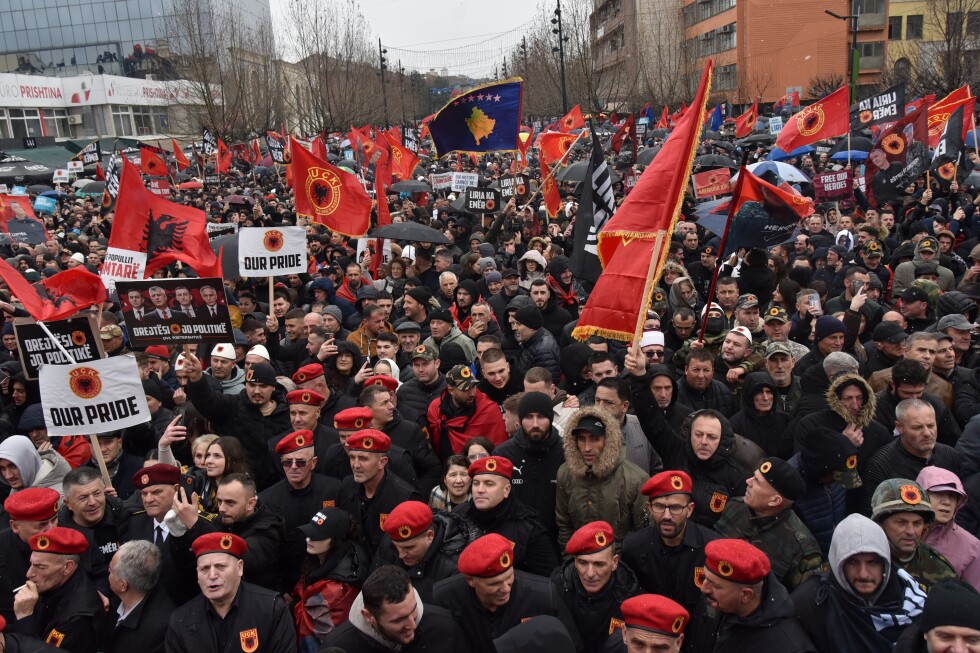
PRISTINA, Kosovo — Kosovo’s independence anniversary celebrations on Tuesday were overshadowed by mass protests against an international war crimes tribunal prosecuting former rebel leaders. Thousands of demonstrators, braving frigid temperatures and snowfall, marched through the capital city of Pristina wrapped in red-and-black Albanian flags to express solidarity with former President Hashim Thaçi and three other defendants facing trial at the Kosovo Specialist Chambers in The Hague.
The tribunal—which operates under Kosovo’s judicial system despite being headquartered abroad—has brought charges of crimes against humanity and war crimes against the former Kosovo Liberation Army (KLA) leadership for alleged atrocities committed during the 1998-1999 separatist conflict with Serbia that resulted in approximately 13,000 fatalities.
Earlier in the day, official ceremonies included a military parade by Kosovo’s security forces and a special parliamentary session. However, the prevailing mood shifted to one of defiance as protesters surrounded a landmark independence monument with metal fences and mounted a sign proclaiming “Kosovo in Prison.” Banners reading “History cannot be rewritten” and “Freedom for the liberators” dominated the demonstration.
President Vjosa Osmani and Prime Minister Albin Kurti both issued statements defending the KLA’s struggle, with Kurti characterizing the conflict as “a pure liberation struggle and an anti-colonial war” while Osmani asserted that “truth cannot be changed by attempts to rewrite history.”
The proceedings have been widely criticized in Kosovo as politically motivated and designed to create false equivalence with Serbian war crimes previously adjudicated by a separate UN tribunal. Meanwhile, Serbia’s government office for Kosovo condemned the 2008 independence declaration as a “flagrant violation of international law” and accused Kosovo of “systematic terror” against minority Serbs.
The geopolitical divide over Kosovo’s statehood continues, with the United States and most EU nations among the 100+ countries recognizing its independence, while Russia and China support Serbia’s territorial claims. Both countries must normalize relations as a prerequisite for EU membership consideration.
Thaçi resigned from the presidency in 2020 to face charges that include ten counts of crimes against humanity and war crimes. Prosecutors have requested maximum 45-year sentences for the defendants, with closing arguments currently underway.