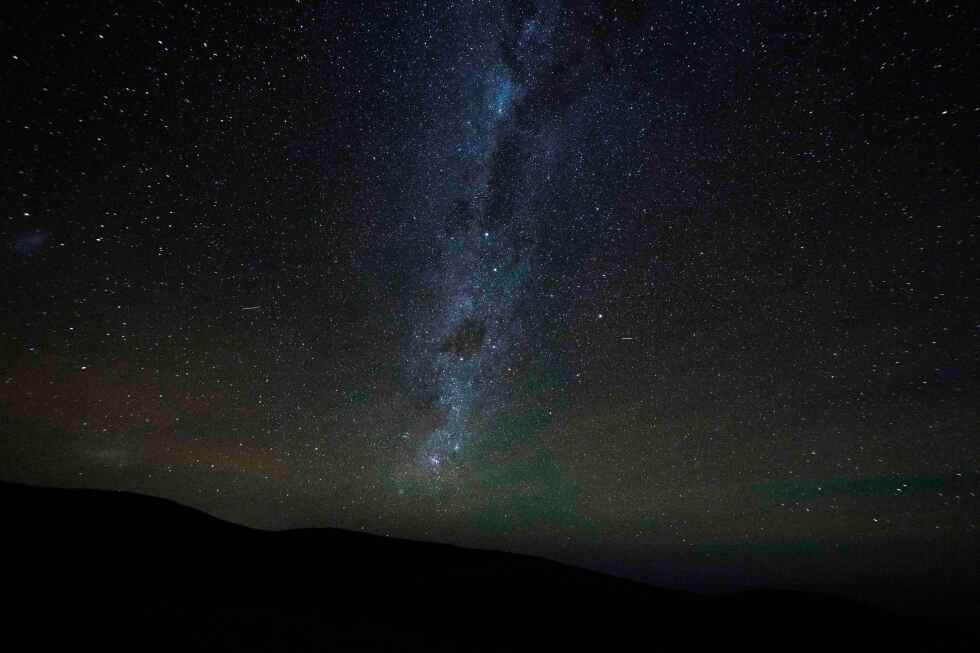
Tucked into northern Chile, the Atacama Desert — widely recognized as the driest terrestrial landscape on the planet — offers one of the clearest unobstructed views of the cosmos available anywhere on Earth. For first-time visitors, the experience of gazing up at its night sky is transformative: eyes adjust slowly to the profound darkness, first picking out faint pinpricks of light, then brighter stars, until entire galaxies stretch out in full view, visible to the naked human eye.
This extraordinary stargazing environment is the product of a rare confluence of natural conditions: extreme aridity, high elevation, and, most critically, geographic isolation far from the glow of urban light pollution. This combination has turned Atacama into the global gold standard for ground-based astronomy, hosting more of the world’s largest and most advanced astronomical observatories than any other region on Earth.
“The conditions in the Atacama Desert are unique in the world,” explained Chiara Mazzucchelli, president of the Chilean Astronomical Society. “There are more than 300 clear nights per year, meaning no clouds and no rain.”
Today, the desert’s nearly 41,000 square miles of open, high-altitude terrain are home to nearly 30 separate astronomical research sites, most run by international scientific collaborations. Dubbed “Photon Valley,” this concentrated corridor of cutting-edge observation facilities draws thousands of scientists from across the globe annually, all pursuing answers to fundamental questions about the origins of the universe. Even with the region’s popularity, access is highly competitive: Julia Bodensteiner, an assistant professor at the University of Amsterdam and a visiting researcher at the European Southern Observatory’s (ESO) Paranal Observatory, the flagship facility in Atacama, notes that only 20 to 30 percent of competing research proposals win observation time.
While the harsh desert terrain — with altitudes pushing past 10,000 feet, where oxygen is scarce, scorching daytime heat gives way to freezing nighttime temperatures, and rocky ground makes travel difficult — poses challenges for human researchers, it is perfectly suited for astronomical observation. The region is currently host to the most ambitious ground-based telescope project in history: ESO’s $1.5 billion Extremely Large Telescope (ELT), scheduled for completion in 2028 at Paranal. With 798 individual mirrors and a total light-collecting area of nearly 1,000 square meters, the ELT will be 20 times more powerful than any existing leading optical telescope, and capable of producing images 15 times sharper than NASA’s iconic Hubble Space Telescope.
For astronomers, the ELT promises to unlock breakthroughs that were previously unthinkable. “We should be able to see Earth-like planets in what we call the habitable zone, so basically the planets which are candidates towards life,” explained ESO astronomer Lucas Bordone. Data collected from Atacama’s observatories does not only advance our understanding of deep space; it also delivers critical insights for life on Earth, and research into the future of human exploration beyond our home planet. That makes protecting these sites a global scientific priority.
But the world’s most valuable window into space is under growing threat. Last year, a proposed green energy complex just 6 miles from Paranal Observatory ignited a global dispute between the energy company developing the project and the international astronomical community. The proposal exposed a critical gap: Chile’s existing regulations designed to protect dark skies for astronomical research are lax, outdated, and unclear, leaving the region’s unique scientific assets vulnerable to unregulated industrial development.
After widespread outcry from astronomers, physicists, and even Nobel laureates, the energy company canceled the project in January. But the risk of future development remains. The incident sparked a review of Chile’s environmental regulations governing protected astronomical zones, but scientists warn that no meaningful regulatory update has been enacted to prevent similar proposals from moving forward in the future.
“We are working to ensure the new criteria are strict enough to guarantee that there will be no impact on astronomical areas,” said Daniela González, director of the Cielos de Chile Foundation, a non-profit founded in 2019 dedicated to preserving the quality of Chile’s night skies for research.
Eduardo Unda-Sanzana, director of the Astronomy Center at the University of Antofagasta and a member of the ministerial advisory commission that delivered regulatory recommendations to the Chilean government after the energy project controversy, recalled how dramatically the Atacama has changed over the past two decades. “Twenty years ago, the Atacama Desert was ‘an ocean of darkness,’” he said. “It was just you and the universe.”
Today, urban expansion, industrial growth, mining operations, and renewable energy development have turned the remote desert into a highly coveted territory, and balancing competing interests has grown increasingly difficult. Even small amounts of human activity can derail cutting-edge astronomical observation: at Paranal, researchers live in an underground residential facility designed to minimize their impact, with all windows covered, hallways kept dark, and outside movement limited to red-filtered flashlights to avoid even the faintest light pollution interfering with telescope data.
The proposed energy project near Paranal posed multiple threats beyond light pollution: project construction and operation would have generated constant micro-vibrations, increased dust pollution, and disrupted atmospheric stability, all of which would have rendered high-precision astronomical observation impossible. As Itziar de Gregorio-Monsalvo, ESO’s Chile representative, put it: “If you place the ELT next to a city, it doesn’t matter that its diameter is 40 meters long. It’s just the same as having a tiny telescope.”
History offers a stark warning of what is at stake. In the early 20th century, the first international heliophysics observatory in Chile — a major solar research station operated by the U.S. Smithsonian Institution — was forced to permanently close in 1955 after expanding mining operations in the area created irreversible pollution that made research impossible.
“We’ve had 70 years to learn from history and avoid repeating those same mistakes,” Unda-Sanzana said. Despite the high-profile cancellation of last year’s energy project, he warned that without updated, enforceable protections, the Atacama’s irreplaceable astronomical resource remains at risk: “Despite all the media hype in 2025, we find ourselves exactly where we were last year.”