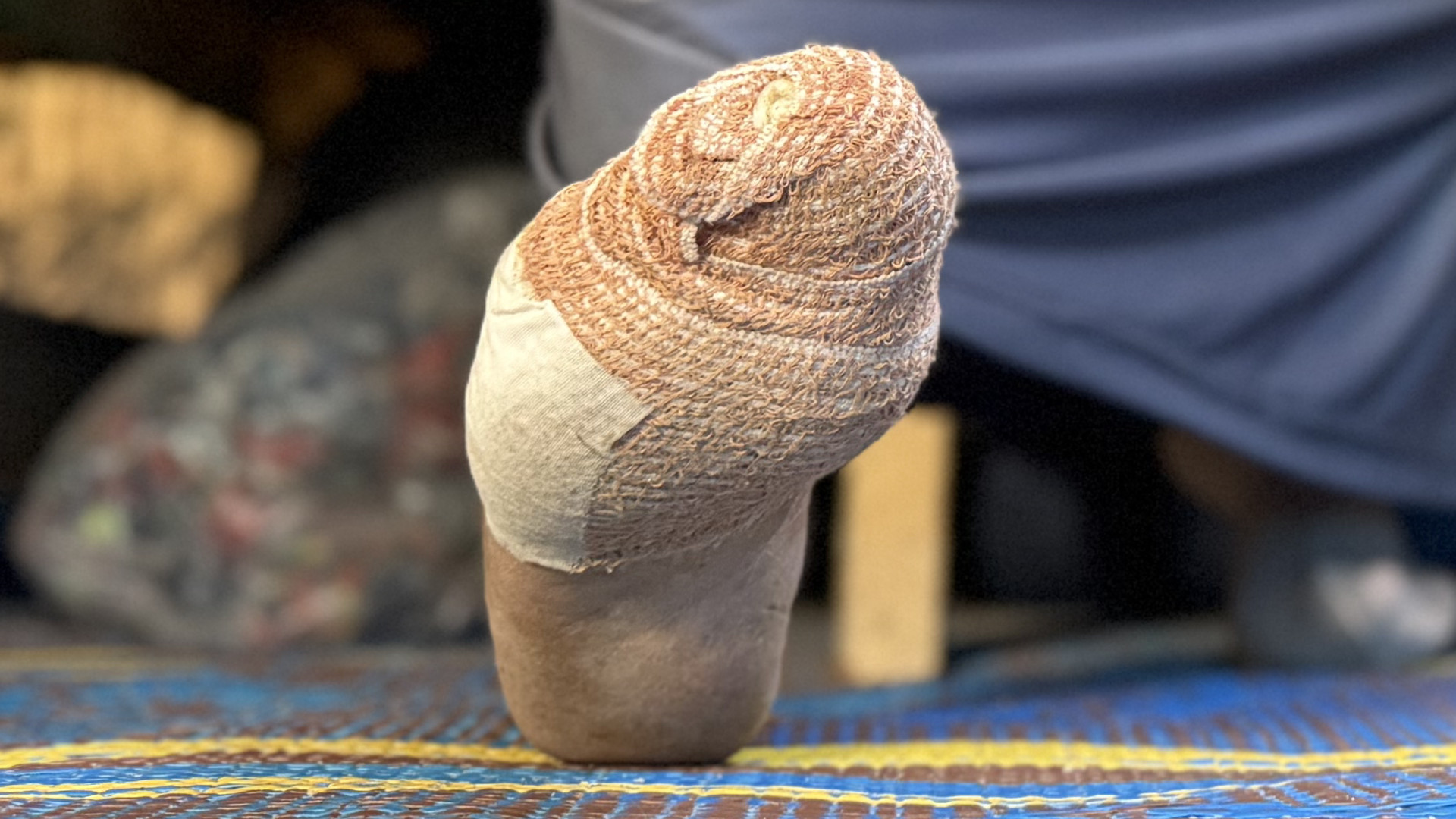
Deep inside a flimsy displacement tent in Gaza City, 63-year-old Inshirah Hajjaj was fighting to fall asleep one night, brushing off the scurry of a small mouse near her pillow. What she could not have anticipated was that a far larger rodent would begin gnawing at her toes, an attack she barely felt due to advanced diabetes that has deadened sensation in her limbs.
Hajjaj did not discover the bite until the following morning, when her sister-in-law spotted the open wound and reacted in horror. “At the time, I thought my foot had simply brushed against something sharp inside the tent, and I hadn’t felt it,” Hajjaj told Middle East Eye in an interview. “But in the following days, my toes began to swell and turn blue. Then I started waking up to find new wounds appearing every morning.”
Hajjaj is far from alone in this nightmare. For months, hundreds of thousands of displaced Palestinians across Gaza have been battling an exploding rodent infestation that has spread rapidly through overcrowded, makeshift tent settlements, a public health disaster unfolding directly alongside the widespread destruction of Israeli military operations. Today, roughly 1.5 million of Gaza’s total 2.2 million residents are crowded into temporary shelters—from tattered canvas tents to hastily built informal structures—after two years of bombardment that has levelled an estimated 80 percent of all residential structures across the Strip.
The conditions that created this infestation are directly tied to the collapse of basic infrastructure in Gaza. With Israel banning the entry of most construction materials and raw materials remaining in critically short supply, displaced families have been forced to build rudimentary, unregulated sanitation systems: open-air latrines with no connecting sewage networks, and buried waste barrels that leak into surrounding soil. Stagnant wastewater and accumulating organic waste have created ideal breeding conditions for rats and insects, allowing their populations to explode across every displacement camp in the territory.
After noticing her worsening condition, Hajjaj traveled to a local field hospital for care. There, doctors confirmed she was suffering from early-stage blood poisoning caused by the rat bite. “How painful it is for a chronic patient with advanced diabetes to have rats feeding on parts of my body at night without me even noticing,” she said. The trauma of the attack has lingered long after the initial wound. “Last night, I went to the bathroom and found a large rat standing right in front of me. I was terrified. I started screaming for my relatives to rescue me before I lost consciousness,” she recalled. “I never imagined rats would eat my feet. It devoured my body while I slept. It had been eating my feet every day without mercy. After the rat gnawed at my toes, I don’t think I will ever be able to sleep peacefully again.”
For 28-day-old Adam al-Ustaz, the danger came even sooner, just weeks after he was born into displacement in the al-Maqousi area of northwestern Gaza City. His father, Youssef, woke in the middle of the night to the infant’s ear-piercing screams. When he switched on his mobile phone flashlight, he found Adam’s small face soaked in blood, with a large rat hiding under a small camp table nearby.
Youssef rushed his newborn son to Rantisi Hospital, where doctors confirmed the wounds were rat bites. Adam is one of hundreds of children across Gaza treated for rodent attacks in recent months, alongside a surge in preventable digestive and respiratory illnesses worsened by the unsanitary camp conditions. “I don’t know what this child’s fault is, to be born in a tent made of worn-out fabric and to be vulnerable to attacks by rats every night,” al-Ustaz said. “We repeatedly tried to buy rat poison, but it is extremely scarce and prohibitively expensive for displaced families. If our home had not been destroyed, we would have lived in safety, without my child facing creatures that threaten his life every day.”
United Nations data underscores the scale of destruction that has created this public health emergency. Jorge Moreira da Silva, executive director of the UN Office for Project Services (UNOPS), confirmed that Gaza is now covered in more than 60 million tonnes of rubble from destroyed buildings, a clearance project that experts estimate will take decades to complete. UN calculations show that every resident of Gaza is surrounded by an average of 30 tonnes of collapsed building debris, which provides ample shelter for rat populations to spread undisturbed.
Local authorities in Gaza say they are completely overwhelmed by the scale of the crisis, with thousands of complaints about rodent invasions flooding into the Gaza Municipality every single day. “Despite our efforts to address the rodent problem, such as partial sewage interventions and removing random garbage dumps, we cannot eliminate the problem under current conditions,” Hosni Muhanna, spokesperson for the Gaza Municipality, told Middle East Eye. “The scale of the disaster far exceeds available capacities. The war decimated infrastructure, especially sewage networks. It left over 25 million tonnes of rubble in Gaza City alone, along with 350,000 tonnes of solid waste accumulating in residential neighbourhoods.”
Muhanna added that the municipality cannot launch large-scale pest control or waste clearance operations due to sweeping Israeli restrictions on border crossings, which block the entry of critical supplies including pest control chemicals, fuel, heavy machinery, and spare parts needed for rubble removal. “Any meaningful response would require far more than rat poison,” he explained, noting that the rodent crisis is inextricably tied to the wider humanitarian and military crisis playing out across Gaza.
The UN Agency for Palestinian Refugees (UNRWA) has also highlighted the growing emergency in its recent situation reports, confirming that rodent populations have spread across nearly all official and informal displacement sites, and warning that there is an “urgent need for pest-control materials and chemicals” to curb the infestation. Local medical professionals have issued additional warnings that rat bites and scratches can turn life-threatening in Gaza’s current environment, as the ongoing Israeli siege has left the territory critically short of life-saving antibiotics and basic medical supplies.
For Hajjaj and thousands of other displaced Palestinians, the suffering extends far beyond physical injury. The constant threat of rodent attacks has created a pervasive state of psychological trauma, with no end to the crisis in sight amid stalled reconstruction and ongoing military pressure. “Waste surrounds our tents on every side, and the rubble of bombed houses is everywhere,” Hajjaj said. “Every day we see dozens, even hundreds of mice spreading through the debris and into the camps. The greatest suffering is not only the injury itself but the absence of any refuge or solution as I face a future with no reconstruction in sight.”