Just days after former U.S. President Donald Trump announced a two-week ceasefire agreement between the United States and Iran, the Middle East has been plunged back into deadly violence after Israel carried out the most destructive and lethal wave of air strikes on Lebanon since the start of 2024.
The scale of the attack was unprecedented in recent months: Israeli military officials confirmed they launched 100 separate strikes across Lebanon in just a 10-minute window on Wednesday, with the heaviest bombardments concentrated in the capital Beirut. Lebanon’s Ministry of Public Health confirmed Thursday that the assault left at least 200 people dead and more than 1,000 others injured, marking the single deadliest day of Israeli bombing in Lebanon in months.
Israeli officials have repeated longstanding justifications for the large-scale attack, stating that all operations target only members of the armed group Hezbollah, with the stated goal of weakening the organization’s capacity to launch cross-border attacks against Israeli territory. In a video address released Thursday, Israeli Defense Minister Israel Katz claimed that “more than 200 terrorists were eliminated yesterday” in the strikes.
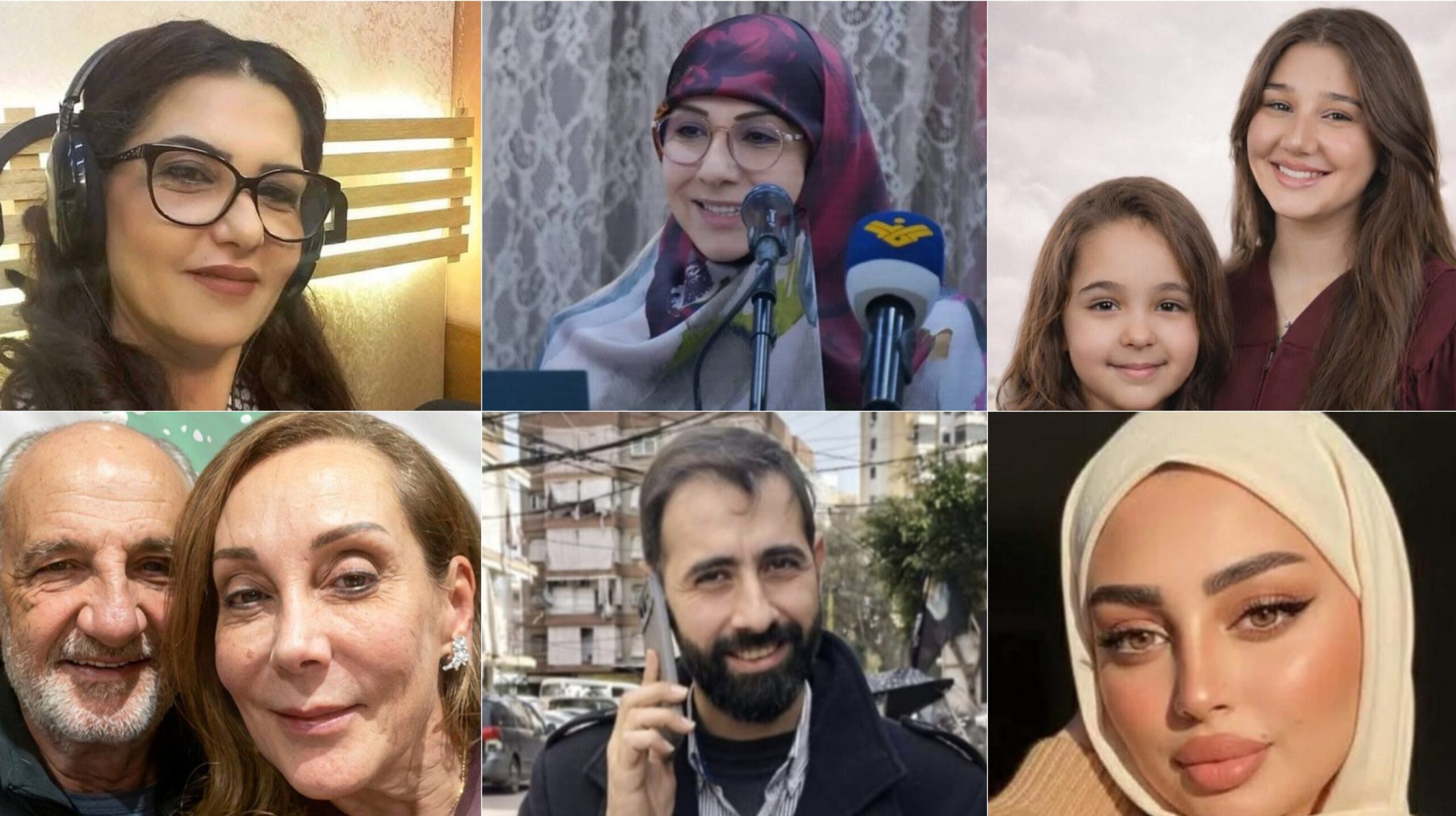
However, on-the-ground reporting and multiple verified accounts confirm that a large share of the fatalities are innocent civilians, including children caught in the sudden, widespread attacks. Multiple reports document that children being collected from schools by their parents were among those killed in the surprise bombardments. Outlets including Middle East Eye have begun profiling the civilian victims of the assault, whose lives spanned multiple professions and communities across the country.
Among the dead is Ghada Dayekh, a veteran radio presenter and reporter with the independent Sawt Al-Farah radio station. Dayekh had worked at the outlet for nearly four decades, reporting from southern Lebanon continuously since the 1980s, before an Israeli strike destroyed her home in the southern city of Sour.
Another journalist, Suzanne Khalil, a presenter and reporter for Al-Manar TV, was killed in an Israeli strike targeting the village of Kaifoun in Lebanon’s Mount Lebanon Governorate. Khatoon Salma Kershet, a respected poet and researcher who was an alumna of the American University of Beirut, was killed alongside her husband Mohammed in a strike on the Tallet al-Khayyat neighborhood of central Beirut; her death was officially confirmed by the university.
Two young people affiliated with Al-Karama High School in Choueifat — student Talin Ahmed Hamzi and recent graduate Yasmin Hussein Allam — were also killed in the strikes, the school announced via its official Instagram page. In Kaifoun, Rana Hessaiki Mlaheb was killed while on a mission to purchase medication for people displaced by previous Israeli air raids, local outlet L’Orient Today confirmed.
In one of the most devastating individual losses reported, physician Nadim Shamseddine was killed alongside his wife Asrar and their three young children when a strike hit their family home in Kaifoun — a space where Shamseddine also saw patients for his medical work. In Beirut, Ola Attar became the latest member of her family to die from violence: her husband Hamad Attar was killed in the catastrophic 2020 Beirut Port explosion, and she leaves behind two orphaned children.
The deadly attack comes at a moment of fragile hope for de-escalation in the region, following Trump’s ceasefire announcement between Washington and Tehran just 48 hours before the strikes. It has already drawn widespread condemnation from humanitarian groups, who have called attention to the rising civilian death toll and the growing displacement of Lebanese communities amid escalating cross-border violence.