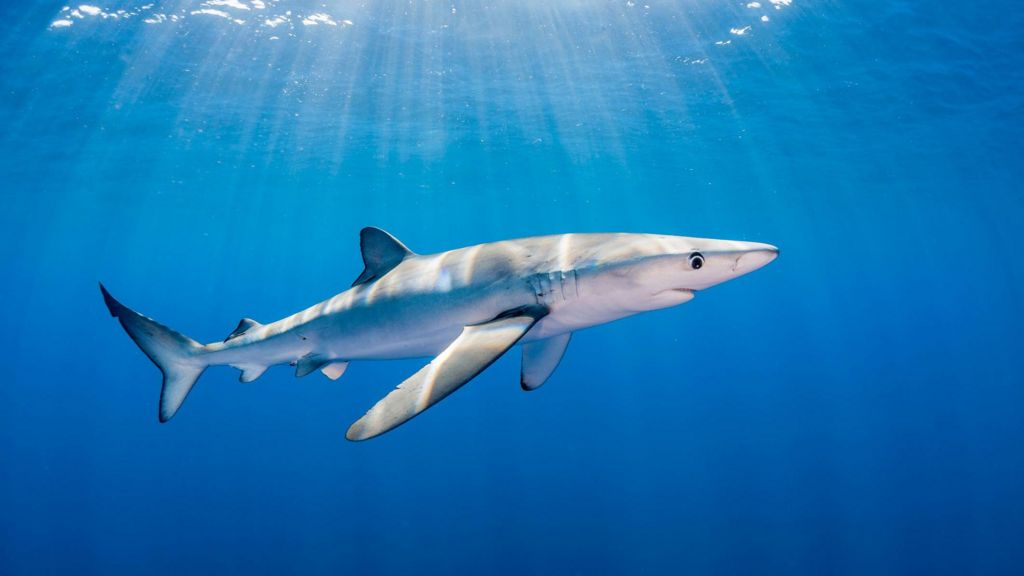
A shark bite incident off Ireland’s southern coast has left a member of a marine research tagging crew with serious injuries, requiring urgent surgery this week. The encounter unfolded Tuesday near Ram Head, Ardmore, County Waterford, when 38-year-old Sebastian Achim pulled a blue shark onto his vessel after hooking it as part of a research catch-and-tag project.
The crew on board the boat were all experienced fishermen carrying out work for Ireland’s Marine Sportfishing Tagging Programme, a long-running initiative that collects ecological data on shark populations around the Irish coast. Achim told Ireland’s national broadcaster RTÉ that after successfully removing the hook from the animal and stepping roughly half a meter back from its tail to maintain a safe buffer zone, he paused to observe the shark before the sudden attack.
“I was just admiring the fish itself, when he just jumped in a millisecond and grabbed into my calf,” Achim recalled in an interview with RTÉ Radio One’s *Morning Ireland*. Refusing to blame the animal for the incident, he noted that the shark was acting on natural survival instincts after being pulled from its open-water habitat. “I cannot say if it was a deliberate attack or it was not a deliberate attack, but the fish is in the right anyway, we took it out of the water,” he said. The crew immediately released the untagged shark back into the ocean to avoid causing it further stress.
In the moments after the bite, Achim acted quickly to stem blood flow by tying a tourniquet above the deep leg wound, while his crew contacted emergency responders. At the time of the incident, the vessel was roughly three hours from the nearest shore, leaving Achim fighting to stay conscious as he waited for rescue. “I lost a lot of blood and kept passing out,” he said. “I didn’t think I was going to make it.”
Multiple emergency agencies launched a coordinated response to the incident, including Ballycotton RNLI, Youghal RNLI, and the Irish Coast Guard’s Rescue 117 helicopter. A rescue winch team extracted Achim from the boat and airlifted him to Cork University Hospital for urgent care.
Once he arrived at the hospital, the adrenaline from the incident faded, and Achim began to experience constant severe pain. Medical teams informed him that the bite had torn away significant amounts of tissue and skin, requiring reconstructive surgery with skin grafts to repair the wound. Despite the gravity of his injury, Achim said his primary concern during the rescue was avoiding panic among his crew and reassuring his partner, rather than his own condition. “I was trying to keep myself awake so I didn’t make anyone panic,” he said. “It doesn’t matter the gravity of the problem, it matters for me that the people around do not suffer because of my actions.”
Blue sharks, the species involved in the incident, are common seasonal visitors to Irish and British coastal waters, arriving between June and October each year to feed. These long-distance migratory sharks can grow to more than three meters in length, preying on open-water fish, squid, smaller sharks, and seabirds. They are also one of the most targeted species for recreational catch-and-release angling in Ireland, and are considered a valuable marine sport fish.
Jack Kelly, a Galway-based marine biologist and underwater cinematographer, explained that blue sharks’ famous curiosity often leads them to interact with humans and human objects. Unlike many animals, sharks do not have limbs to investigate unfamiliar items, so they often use bumping or close approaches to explore new objects in their environment. “If a shark approaches anything, really, it’s not like they have fingers to be able to investigate to see what it is,” Kelly told BBC Radio Ulster’s *Good Morning Ulster*. “For me, when I’m underwater they might give the camera a bump just to see what it is, so their curiosity for me is definitely something that stands out.”
Ecological data from Inland Fisheries Ireland shows that blue sharks are classified as Near Threatened on both the IUCN Red List and Ireland’s national Red List for cartilaginous fish. The Marine Sportfishing Tagging Programme, which has operated off Ireland’s coast since 1970, has tagged more than 19,300 blue sharks as of 2013, accounting for 45% of all fish tagged through the initiative.
This week’s incident is not the first recorded shark bite off the Irish coast. In 2018, a recreational angler from Belfast suffered serious lower arm injuries after a blue shark bit him while he was pulling the animal onto his boat off Cork, requiring a rescue from Crosshaven RNLI.