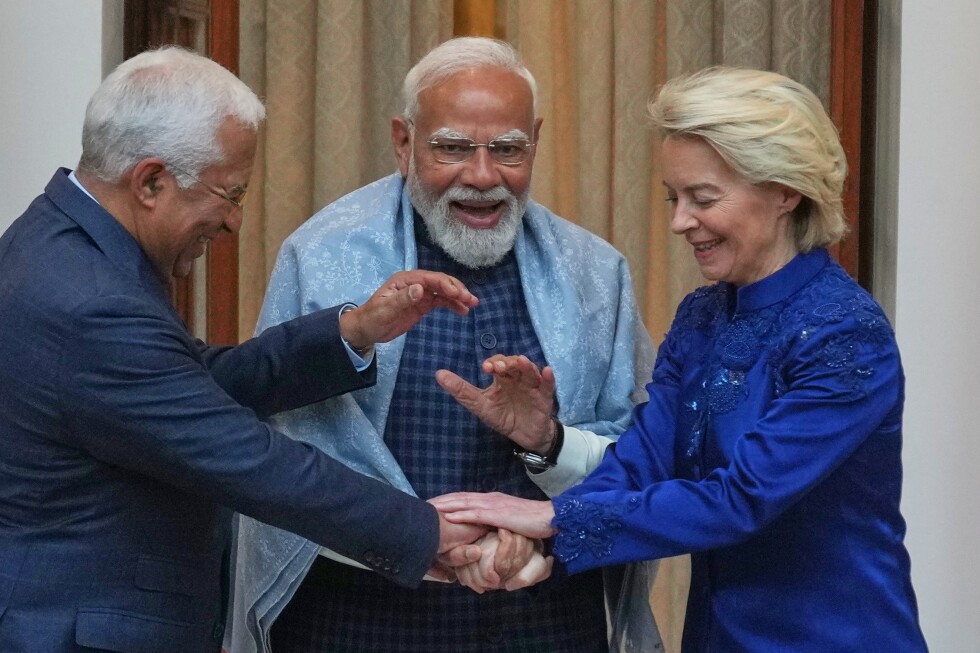
BRUSSELS — In a strategic repositioning of global economic partnerships, the European Union has cemented a transformative free trade agreement with India, signaling a fundamental shift in international alliance structures. This development emerges against the backdrop of evolving trans-Atlantic relations and growing concerns over Washington’s reliability under the Trump administration.
The comprehensive pact, formally endorsed on Tuesday, represents the EU’s most ambitious trade arrangement to date. It will eliminate tariffs on approximately 97% of European exports to India—including automobiles and premium wines—while facilitating 99% of Indian goods entering EU markets, notably pharmaceuticals and textiles. The agreement potentially impacts nearly two billion people across both economies.
European Commission President Ursula von der Leyen, during her official visit to New Delhi, characterized the arrangement as “the mother of all deals,” emphasizing its significance in strengthening economic and strategic cooperation between the two powers. The timing of this agreement reflects Brussels’ concerted effort to establish diversified global partnerships following heightened uncertainties in traditional alliances.
Analysts identify multiple geopolitical factors driving this realignment. Garima Mohan, senior fellow at the German Marshall Fund, noted that “Europe and India need each other today like never before,” highlighting mutual concerns regarding China’s economic ascendancy and recent strains in trans-Atlantic relations. This strategic diversification movement, initially prompted by tensions with Beijing, has been accelerated by fractures in traditional Western partnerships.
The India agreement constitutes just one component of Brussels’ expanded global outreach. Within the past year, the EU has finalized trade arrangements with Japan, Indonesia, Mexico, and the Mercosur nations of South America—creating a combined market exceeding 700 million people. Additionally, the bloc has enhanced diplomatic ties with Pacific nations including South Korea and Australia, all expressing wariness toward Beijing’s strategic ambitions and Washington’s political volatility.
Concurrently, European leaders are advancing initiatives to bolster continental security autonomy. Russia’s invasion of Ukraine catalyzed the development of financial mechanisms to strengthen EU defense capabilities, while recent statements from the Trump administration regarding security priorities have accelerated these efforts. France has championed the concept of “strategic autonomy,” gaining increased support among member states.
EU leaders have collectively committed to elevating defense expenditures, designating €150 billion ($162 billion) toward advanced military capabilities including missile defense systems, artillery, drone technology, and cyber warfare infrastructure. This substantial investment reflects growing recognition that meaningful military self-sufficiency requires overcoming decades-long dependence on American security guarantees.
The geopolitical repositioning extends to energy security as well. While the EU has reduced energy imports from Russia, it has simultaneously increased dependence on American liquefied natural gas—now accounting for 60% of EU imports according to Eurostat. European Commissioner for Energy Dan Jørgensen cautioned against exchanging “one dependency for another,” advocating for diversified energy sources including potential suppliers in the Eastern Mediterranean and Gulf regions.
As articulated by Nikos Christodoulides, President of Cyprus, during his European Parliament address: “The international order we relied upon for decades is no longer a given. This moment calls for action, decisive, credible and united action. It calls for a union that is more autonomous and open to the world.” This sentiment captures the essential calculus now guiding European foreign policy: in an increasingly multipolar world, strategic diversification provides crucial leverage in engagements with Beijing, Moscow, and Washington alike.