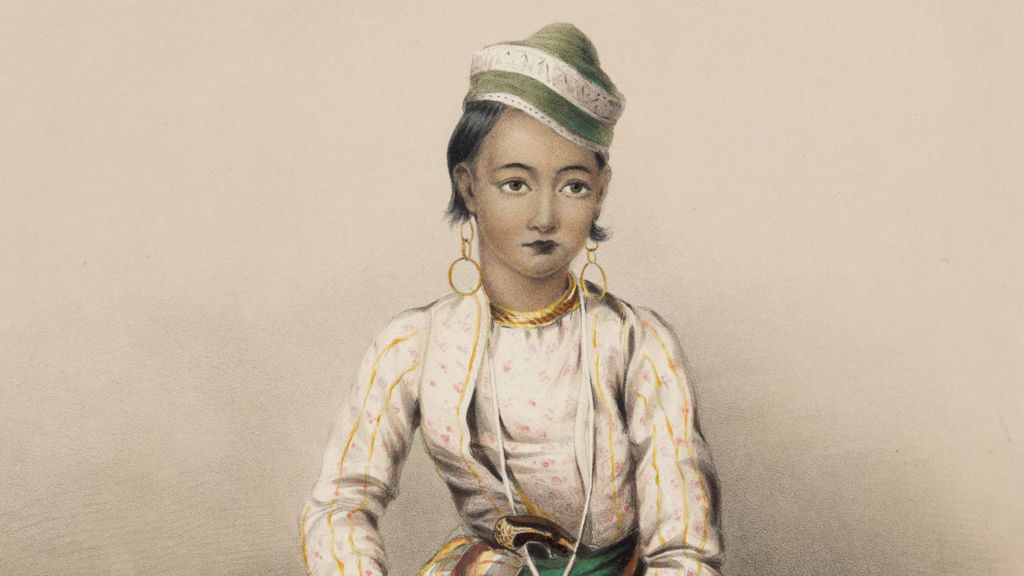
Decades before photography emerged as the dominant visual medium of British colonial rule in South Asia, a sharp-eyed and talented English artist and writer named Emily Eden traversed northern India, documenting the vast diversity of people she encountered with a curiosity and attention to detail rare among her 19th-century contemporaries.
Born into one of Britain’s most politically powerful families, Eden journeyed across the Indian subcontinent between 1836 and 1842, accompanying her brother George Eden, the first Earl of Auckland and then Governor-General of India, on his official travels. Unlike many European artists of the era who focused almost exclusively on elite imperial figures or grand colonial landscapes, Eden’s sketchbook captured a far broader cross-section of Indian society: from ruling maharajas and Afghan nobles to Akali Sikh warriors, court servants, traveling Himalayan traders, common travelers, holy fakirs, hill communities, and even the exotic animals that moved with imperial processions.
This extraordinary body of work is now the centerpiece of *Princes & People*, a new exhibition at Delhi’s DAG gallery curated by prominent art historian Mary Ann Prior. The show brings together the full published series of hand-colored lithographs created from Eden’s original field sketches, which were first released to the public in 1844 under the title *Portraits of the Princes and People of India*.
Eden’s experience of India was not without struggle. When she first disembarked in Calcutta (now Kolkata) in March 1836, she was thrown into a chaotic schedule of official events and overwhelmed by the alien culture around her. Deeply homesick and disoriented, she did not pick up her sketching tools for three weeks, and waited two months before completing her first finished painting. Her small traveling party, which included her sister Fanny, nephew William, maids, a personal nurse, cook, valet, physician, and a collection of pets, helped lift her mood and adapt to her new surroundings.
As Prior notes, the sea voyage to India had already begun to expand Eden’s creative perspective, as she encountered new communities, customs, and ways of life long before reaching shore. “The diversity of people and places motivated and improved Emily’s artistic output, and her natural curiosity sought out the unusual. She meticulously documented her observations through her sketches and paintings,” Prior explains. Rejecting the familiar European subjects of castles, churches, and pastoral English landscapes that dominated contemporary British art, Eden turned her full attention to the strangers, vibrant traditional costumes, distinct architecture, and uncharted landscapes that surrounded her.
Traveling across northern India at a moment of massive impending political upheaval on the subcontinent, Eden’s sketches offer a uniquely intimate, unfiltered glimpse into a world on the brink of change. Most notably, her work captures the court of Maharaja Ranjit Singh, whose powerful Punjab Kingdom stood as one of the most influential states in South Asia at the time, documenting the final years of his reign just as the Victorian era began to reshape the region’s political future. She also sketched exiled Afghan Amir Dost Mohammad Khan and his family during their exile in India following British intervention in Kabul, offering a rare visual record of a key figure in the 19th-century “Great Game” rivalry between Britain and Russia for control of Central Asia.
Beyond her skill as a visual artist, Eden was a gifted and engaging writer. Her lively personal journals are filled with dry humor and sharp observational detail, with place and personal names transcribed phonetically as they sounded to her English ear. Upon arriving in the holy city of Benares (now Varanasi), for example, her traveling party sailed along the Ganges before journeying to Ramnagar, where the local ruler maintained a country estate. The scene so captured Eden’s imagination that she wrote in her journal: “We mean to keep our steamer here and to go out sketching in it.”
That warm enthusiasm took time to develop. In her first months in India, the deep cultural divide between her native England and her new home left Eden longing for her old life. She chafed at the heat, persistent mosquitoes, constant cacophony of street and wild animals, and the social customs that felt alien to her, confining her indoors for much of each day. But as months passed, she began drawing prolifically, and her work quickly found an audience: her paintings sold briskly at charity fairs in Shimla, won praise from the British colonial community, and were even copied by local Indian artists.
Prior ranks Eden’s Indian sketches among the finest works produced by any British woman artist of the Regency and Victorian eras. Only two other British women artists working in India—botanical painter Charlotte Canning and later travel artist Marianne North—matched the scope and quality of her achievement, she says.
Even as her observational skills and curiosity set her apart, Eden still reflected the common colonial biases of her social class and era. She held an unwavering belief in Britain’s so-called “civilising mission” in India, framing her years on the subcontinent as “an unwelcome ordeal to be endured for a higher purpose,” as Prior writes, and viewed colonial rule as a necessary obligation to “civilise” the country.
The Eden family left India for Britain in 1842, eager to return to their home. Back in Europe, Emily continued to paint, but the urgent drive that pushed her to document unfamiliar people and landscapes in India had faded. Her later works were far fewer in number, and focused on the familiar English landscapes she had grown up with. Increasingly, writing became the medium through which she shared her Indian experiences with a broader British audience: her collection of lively travel letters *Up the Country* was published in 1866, followed by *Letters from India* in 1872. Though Emily Eden died in 1869, her reputation has outlasted the initial association of her work with her family’s role in the First Afghan War, and today her legacy rests on her own independent accomplishments as both a writer and a visual artist.