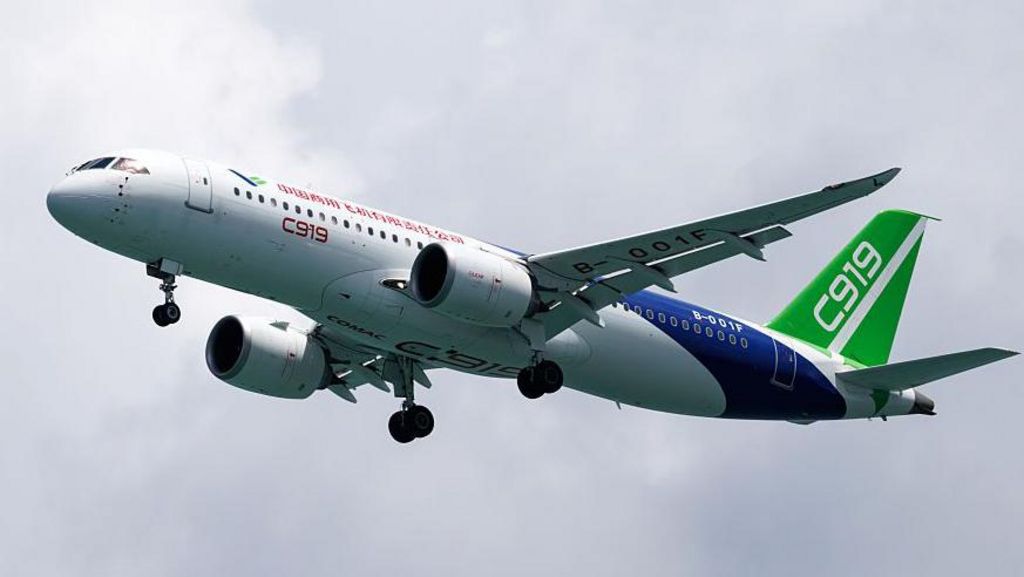
SINGAPORE — The Singapore Airshow has become the stage for China’s aviation ambitions as state-owned manufacturer COMAC positions itself as a viable alternative to established giants Boeing and Airbus. The exhibition, featuring the latest commercial jet technology, has drawn particular attention to COMAC’s C919 passenger jet—a aircraft designed to compete directly with the Airbus A320neo and Boeing 737 MAX models.
Industry analysts note that COMAC’s emergence comes at a critical juncture for Asia-Pacific carriers, who face unprecedented delivery delays and supply chain constraints from Western manufacturers. According to International Air Transport Association (IATA) data, global airlines are experiencing the longest wait times for new aircraft in history, driving up operational costs as carriers maintain older, less fuel-efficient fleets.
Willie Walsh, IATA’s Director General, acknowledged COMAC’s growing potential: “I think in time, COMAC will be a global competitor. We’ll be talking about Boeing, Airbus and COMAC in 10-15 years. Without question, they will be a considerable player in the future.”
The Chinese manufacturer has already established operational presence with over 150 jets actively serving routes within China and across Laos, Indonesia, and Vietnam. Brunei’s GallopAir has placed significant orders for COMAC aircraft, while Cambodia plans to acquire approximately 20 planes.
Subhas Menon, Director General of the Association for Asia Pacific Airlines, emphasized the need for diversification: “The problem with this industry is that the supply chain is an oligopoly and sometimes even a duopoly. COMAC is a welcome introduction—we need more suppliers in Asia Pacific especially.”
Despite the optimism, COMAC faces substantial challenges in its global expansion. European certification for the C919 may not be achieved until 2028-2031, according to regulatory estimates. The aircraft’s hybrid design—incorporating both Chinese and Western components—presents technical complexities for international standardization. Additionally, COMAC must develop comprehensive maintenance infrastructure and pilot training programs, areas where competitors have decades of established systems.
Beyond the Western giants, COMAC also faces competition from Brazil’s Embraer, which has secured orders from Singapore’s Scoot, Virgin Australia, and Japan’s ANA. Meanwhile, Boeing and Airbus are signaling improving delivery timelines to frustrated carriers.
Questions remain about COMAC’s order transparency, with reported orders exceeding 1,000 aircraft but deliveries numbering only in the dozens. As a state-owned enterprise rather than a publicly-traded company, verification of these figures remains challenging for international observers.
Mike Szucs, CEO of Philippines’ Cebu Pacific, captured the industry’s cautious optimism: “We welcome all newcomers and are keen to see more competition. COMAC has certification processes to complete, but by the 2030s, we see potential for an attractive offering.”