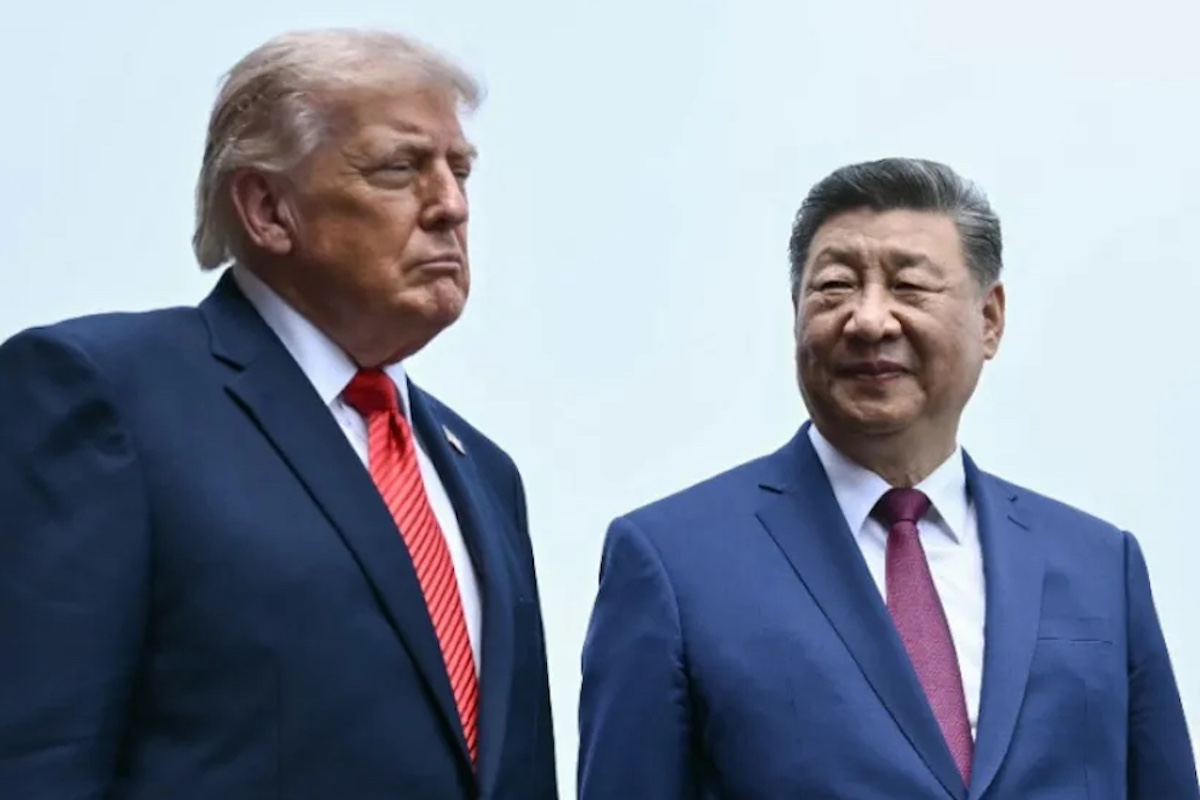
For nearly 20 years, a consistent trend defined global public opinion: the United States held a clear lead over China in global favorability ratings. That long-standing pattern has shifted, with new polling showing China now viewed more positively than the US across a majority of surveyed nations.
The landmark finding comes from Pew Research Center’s July 15 report, which draws on 42,151 interviews conducted across 36 countries between February and May 2026. Confidence in Chinese leader Xi Jinping also sits 10 percentage points higher than confidence in US President Donald Trump across 20 nations Pew has tracked continuously since 2023, a crossover that Gallup first recorded a full year earlier, when it put China’s global approval at 36% and the US at 31%.
While many are quick to frame this shift as a straightforward win for China and defeat for the US, a deeper analysis of the data tells a far more nuanced story. Far from a dramatic surge in China’s global standing that propelled it to the top spot, the crossover is driven almost entirely by a steep collapse in global approval of the United States. To frame this dynamic correctly, we can draw a distinction common in medical practice: measuring the current prevalence of a disease is a very different question than tracking the rate of new infections, and favorability polling blurs these two lines in ways that change the interpretation of this reversal.
China’s global standing has improved only modestly in recent years, while the US’s has plummeted. To take one striking example: in Sweden, the share of respondents who view the US as a reliable partner dropped 52 percentage points from 83% in 2022 to just 31% in 2026. Over the same period, China’s favorable rating rose only 15 points, from 12% to 27%. A similar pattern plays out in Canada, where perceptions of US reliability fell 48 points, while Chinese reliability gained 30 points. Even in regions where Xi holds a double-digit lead over Trump in approval, enthusiasm remains muted; his highest rating in Europe is just 37%, recorded in the United Kingdom.
In short, China’s new lead is a product of subtraction rather than gain. Pew’s own internal analysis confirms this, noting the crossover stems largely from rapidly souring global views of the United States. As the old analogy goes, one patient does not become healthier simply because the patient in the next bed is declining faster.
The composition of the survey sample also shapes the headline finding. Nearly half of the nations included in Pew’s poll are middle-income countries, the exact grouping where China holds its widest global advantage. This year, China hit record-high favorability ratings in Colombia, Indonesia, Malaysia, Mexico, Nigeria, and Turkey. Across the 17 middle-income publics included in the survey, a median 75% of respondents say the US interferes in the internal affairs of other countries, compared to just 45% who say the same of China. If the sample were weighted more heavily toward wealthy democracies or China’s immediate regional neighbors, the topline result would look very different.
This regional divide is a critical, underdiscussed takeaway for Asian audiences. The overall global reversal of fortune has notably not occurred among China’s neighboring states. The US retains a favorability edge in just six nations surveyed, and four of those are in the Indo-Pacific: India, Japan, the Philippines, and South Korea. In the Philippines, 81% of respondents call the US a reliable partner, compared to just 42% who say the same of China. In Pakistan, the numbers flip: 84% trust China, while only 36% trust the US.
Geography continues to shape perceptions dramatically: sharing a border or competing maritime claims with a great power tends to erode public goodwill, and Asia is far from converging on a single unified view of China. Instead, regional opinion is split sharply along lines of proximity.
One of the most notable underreported trends from this new data is the extraordinary speed of this shift, rather than just the shift itself. The ISEAS-Yusof Ishak Institute’s annual survey of Southeast Asian opinion has flipped three times in just three years: it favored China 50.5% to 49.5% in 2024, shifted back to a 52.3% to 47.7% lead for the US in 2025, and flipped again to a 52% to 48% lead for China in 2026.
Public opinion that swings this sharply is not built on decades of accumulated goodwill. Instead, it behaves like a volatile spot commodity price, reacting immediately to the latest policy shock: a new tariff announcement, an energy market disruption, or an ill-considered diplomatic remark. Pew’s own historical data confirms how quickly these trends can reverse: American favorability and confidence in the US president jumped sharply immediately after the 2021 presidential inauguration, highlighting how rapidly sentiment can shift.
Global favorability polling also conceals as much information as it reveals. A single aggregate favorability score lumps together conflicting attitudes toward a country. For example, many respondents around the world can admire China’s cutting-edge electric vehicle technology, world-leading high-speed rail network, and global cultural breakout hits such as *Black Myth: Wukong* and *Ne Zha 2*, while still holding deep distrust of China’s system of governance.
Across the 36 surveyed countries, only 11 have half or more of respondents agreeing that the Chinese government respects the personal freedoms of its people. The United States still leads China on this metric, though the gap has narrowed almost entirely because public faith in the US’s commitment to personal freedoms has fallen sharply, dropping 25 points or more in Canada, France, Germany, Italy, the Netherlands, South Korea, Spain, and Sweden.
An aggregate poll number that cannot distinguish between appreciation for a country’s consumer and cultural exports and trust in its governing institutions is a dangerous foundation for long-term policy planning.
For middle powers across Asia, the key takeaway from this new data is neither celebration nor alarm. Right now, global publics see Beijing as a more predictable international partner than Washington, which is widely viewed as erratic. But the data itself shows that perceptions of predictability are the most volatile variable of all. A foreign policy strategy built on hedging based on 2026 sentiment could quickly be rendered obsolete by shifting opinion in 2027.
The harder, unanswered question that remains is whether each power’s current standing is rooted in temporary conditions or structural factors: can American global approval bounce back with a new presidential administration, and can China deepen its global popularity without reforms to the governance practices that global publics continue to scrutinize?
This year’s survey does not answer that question. It only confirms that two long-running trend lines have finally crossed. And as history shows, trend lines that cross once are very likely to cross again.