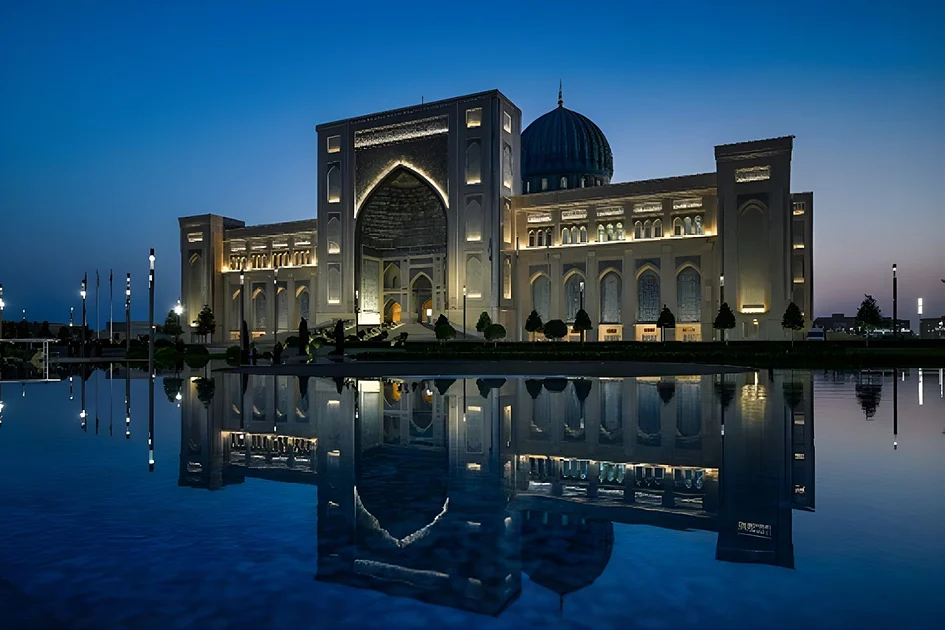
TASHKENT – In a landmark achievement for cultural diplomacy, Uzbekistan has unveiled the Center for Islamic Civilization, positioning itself as a global nexus for intercultural dialogue and heritage preservation. The monumental complex, situated in Tashkent’s historic Hast-Imam district, represents the culmination of an eight-year vision first articulated by President Shavkat Mirziyoyev at the United Nations.
The architectural marvel features a 65-meter dome and four symbolic portals representing regional unity. At its heart lies the Hall of the Holy Qur’an, safeguarding the UNESCO-inscribed 7th-century Mushaf of Uthman manuscript. Beyond its museum function, the center operates as a dynamic intellectual ecosystem housing a 200,000-volume library, calligraphy school, restoration laboratories, and craft workshops.
UNESCO Director-General Khaled El-Anany, during his November visit, praised the institution as “a true testament to cultural diversity, tolerance, and openness” that should “become a light for the entire world.”
The center’s mission extends beyond preservation to active heritage reclamation. Through coordinated efforts with auction houses and private collectors, over 1,000 cultural artifacts have been repatriated to Uzbekistan. The World Society (WOSCU) contributed approximately one thousand manuscripts and artifacts from across the Islamic world.
Dr. Firdavs Abdukhalikov, director of the center, emphasized its transformative potential: “Everything that for centuries was scattered across history is being gathered into a single whole. These spiritual heights acquire new unity, transforming into a space of memory, enlightenment, and future.”
The institution serves as both research hub and diplomatic space, hosting offices for UNESCO, ICESCO, and IRCICA alongside a 460-seat conference hall. With over 800 research projects involving 1,500 specialists from 40 countries, the center aims to reshape global understanding of Islamic heritage as a civilization of knowledge, peace, and enlightenment.