Just three days after a 14-year-old gunman killed eight people at a provincial school before taking his own life, a second fatal shooting in the same Thai province laid bare the kingdom’s long-running and deeply troubling relationship with civilian gun ownership.
The incident involved 71-year-old Chalong Riewrang, a former local politician, who entered a regional administration building to confront the office chief Thongchai Yenprasert – a man Chalong describes as a personal friend – over an unpaid large sum of money Chalong claims he was owed. What began as a scheduled discussion quickly devolved into violence: Chalong drew a handgun and fired four shots through the window of Thongchai’s parked car, striking both Thongchai and his driver. Thongchai later succumbed to his injuries.
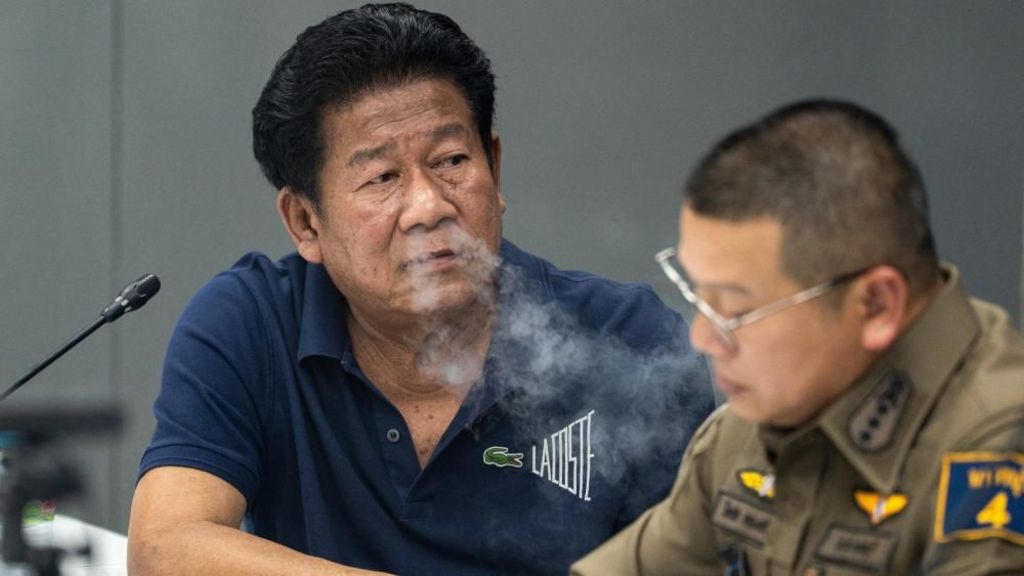
After fleeing the scene, Chalong contacted a journalist he knew mid-way through her live YouTube broadcast to confess to the shooting. Police intercepted him shortly after and took him into custody, where he spoke to reporters while casually smoking a cigarette, showing no visible distress over the killing. Chalong told reporters he “did not intend to shoot his friend”, claiming he opened fire only after the driver drew a weapon. Investigators did recover two guns from Thongchai’s car, but confirmed neither was in a condition to be fired.
This double tragedy was far from an isolated event on that same day. In Prachinburi, a province east of Bangkok, a police sergeant shot his wife in the head during an argument while she was driving the pair to pick up their young son. After the car crashed, the sergeant turned the gun on himself, and his wife later died in hospital treatment. Local analysts estimate many more unreported gun deaths occur across the country each day.
While Thai authorities do not track an official annual count of gun-related fatalities, independent estimates place the yearly death toll between 2,000 and 3,000. To put this in perspective, the United Kingdom – which has a roughly similar population to Thailand – records fewer than 50 gun deaths annually.
Gun use in hired robberies and contract killings is not unheard of in Thailand, where hitmen can be hired for relatively low fees. But most gun fatalities stem from ordinary conflicts: domestic arguments, financial disputes, and alcohol-fueled bar fights. With more than 10 million civilian-held guns circulating nationwide – 4 million of which are unregistered – even minor disagreements can quickly escalate into deadly violence.
“It’s very unfortunate that Thailand has a very high tolerance for violence,” explained Boonwara Sumano, a researcher at the Thailand Development Research Institute. “Guns are seen as a status symbol, and there are so many ways that civilians can get them. Also, showing strength, wielding power, is seen as the right thing to do in Thai society. So, when you have a norm that promotes the possession of weapons to show your strength, and access to those weapons, this is the result.”
On paper, Thailand’s gun laws appear relatively strict. Prospective buyers must first obtain a purchase permit, then apply for a separate possession permit after buying a firearm, and a third permit to carry the weapon outside the home. Imported firearms, which make up most of the country’s supply, carry steep price tags. But major loopholes undermine these rules: possession permits are valid for life, no mandatory mental health screening is required for gun owners, and there are no rules mandating safe gun storage. This is how the 14-year-old school shooter gained access to his grandfather’s legally owned gun and ammunition to carry out his attack.
A long-running government program also amplifies the illegal gun market: the scheme allows police officers and public officials to purchase firearms at heavily discounted prices. Since launching in 200, an estimated 200,000 firearms, mostly sourced from the United States, have been imported through the program. Permit holders are allowed to resell the guns after five years, turning the program into a lucrative black market trade that has faced repeated corruption investigations. Combined with unregistered locally manufactured guns from informal artisans, the program is a major source of illegal firearms across the country.
In response to the latest string of attacks, Thai Prime Minister Anutin Charnvirakul has ordered immediate emergency measures to strengthen gun control: the discounted government purchase scheme has been suspended, and all new purchase permit approvals have been halted. Anutin has also proposed limiting the validity of possession permits, offering an amnesty to encourage unlicensed gun owners to surrender their weapons, ordered parliament to draft new gun legislation, and promised harsher penalties for gun law violations.
However, this pattern of response is nothing new for Thailand. After a 2022 mass shooting that killed 36 people at a rural nursery, carried out by a former police officer, and a 2023 mass shooting at Bangkok’s busiest shopping mall by another 14-year-old gunman, Anutin – who was serving as interior minister at the time – ordered identical crackdown measures. The discounted purchase scheme was suspended, then quickly reinstated. A ban on civilian gun carrying was also imposed after a school shooting in February 2024, but enforcement has been lax.
Experts say the problem extends far beyond inadequate regulation. The massive existing stockpile of firearms, widespread systemic corruption, lax enforcement of all national laws, cultural glorification of gun ownership, and decades of military influence in Thai society all combine to create the current crisis. Even among sitting government ministers, gun ownership is common: public asset declarations show more than a dozen current ministers own guns, with the justice minister holding 10, the environment minister owning 12, and one female member of parliament declaring 48 registered firearms.
Sumano points to the deep cultural roots of gun acceptance in Thailand, shaped by decades of military rule that continues to influence society even under elected civilian government. “If you notice every Children’s Day in Thailand, instead of taking children to a museum or park, many families take their children to an army or air force base to see the weapons, take photos holding guns, this kind of thing,” she explained. “It’s in the culture. You see big men in the military looking so powerful, they kind of make you want to become one of them.”
Thailand stands out as an outlier among Southeast Asian nations. With a population four times larger than Thailand’s, Indonesia only has 82,000 registered civilian guns, while Malaysia counts just 107,000, and both nations see extremely rare gun homicides. Only the Philippines shares Thailand’s pervasive gun culture and high rates of gun violence.
Some Thai gun rights advocates argue that new restrictions on legal ownership will not solve the crisis, and will only penalize responsible gun collectors. Yod, a 53-year-old Bangkok businessman who owns a collection of more than 70 guns that he describes as luxury collectibles, most of which he has never fired, says “Most of the gun crimes in this country are carried out by illegal weapons. New measures to control legally owned guns are not the right solution. There are blank guns and spare parts which can be assembled as real guns being imported legally into the country. Why hasn’t that been chased up?”
Another gun shop owner with a collection of more than 40 guns, Sathit, says widespread crime and weak law enforcement are why ordinary people choose to arm themselves. “Look around this country nowadays. There are crimes every day. It is not safe. Drugs are rampant. People need to protect themselves because there are not enough police officers. People should have access to guns to survive, for their own safety.”
As Chalong waits in custody to be charged with the murder of his friend, the former politician, who once held permits for nine guns and had reduced his collection to just one, expressed shock at how quickly a routine financial dispute turned deadly. “I can’t believe I’m in this position, sitting here. Throughout my life, I have never had to come to a police station,” he told reporters. For Chalong, and for Thailand as a whole, one easily accessible gun was enough to end a life and upend decades of normality.