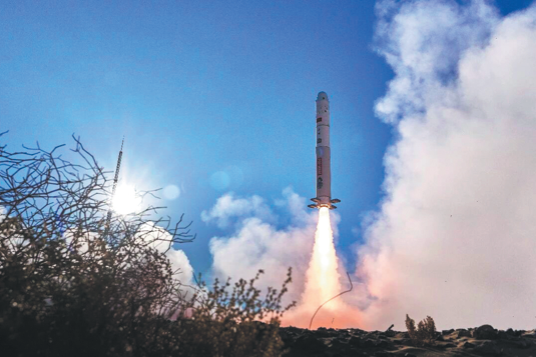
In a significant advancement for commercial space capabilities, Chinese aerospace company CAS Space successfully conducted the inaugural test flight of its PH-1 suborbital spacecraft on Monday. The demonstration mission, launched from the Jiuquan Satellite Launch Center in Inner Mongolia’s Gobi Desert region, achieved critical milestones in reusable vehicle technology.
The PH-1 vehicle ascended to approximately 120 kilometers altitude, crossing the internationally recognized Kármán line that demarcates Earth’s atmosphere from outer space. During its controlled descent, the spacecraft’s recoverable payload cabin successfully deployed parachutes at approximately 10 kilometers altitude before executing a precision landing at a predetermined site.
Technical validation encompassed multiple breakthrough systems including atmospheric re-entry deceleration mechanisms, parachute recovery operations, and advanced landing control technologies. The mission design featured separation of the unpowered payload cabin from its booster at 70 kilometers altitude, with the cabin continuing upward through inertia before initiating its return trajectory.
Notably, the spacecraft maintained a stable microgravity environment exceeding 300 seconds duration, substantially longer than achievable through conventional ground-based alternatives like drop towers or parabolic aircraft flights. The experimental payload included an innovative laser-based 3D printer engineered for microgravity operation and rose seeds with previous spaceflight heritage.
According to Chief Designer Shi Xiaoning, the PH-1 platform primarily targets cost-effective suborbital scientific research applications. The technology demonstrates particular promise for space-based agricultural breeding, biomedical investigations, and advanced materials testing. Future iterations anticipate evolution toward orbital-grade spacecraft capable of year-long orbital operations with approximately 10 reuses, potentially revolutionizing in-orbit manufacturing capabilities.
This achievement occurs within China’s rapidly expanding commercial space sector, where both state-owned enterprises and private companies are accelerating development of reusable launch systems to reduce space access costs and strengthen the nation’s position in the global space economy.