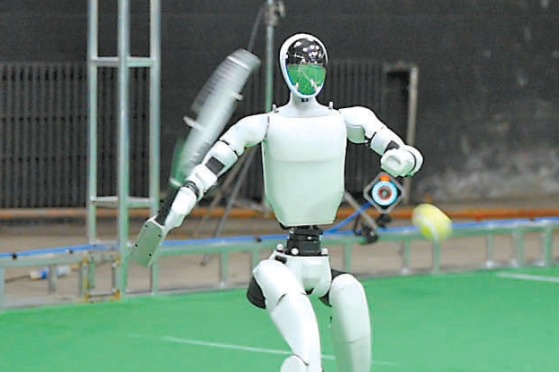
In a landmark milestone for global embodied intelligence and humanoid robotics development, the world’s first humanoid robot capable of playing competitive tennis has made its public debut in Beijing, developed by a local innovative startup in partnership with one of China’s top academic institutions.
The breakthrough machine was created by Galbot, a Beijing-based robotics firm headquartered in the city’s Haidian District, a rapidly growing national hub for advanced artificial intelligence and humanoid robot innovation. Working in close collaboration with Tsinghua University, the engineering team behind the robot broke from long-standing industry conventions that rely on pre-programmed motion scripts and external motion capture systems to enable robotic movement. Instead, the new humanoid integrates real-time environmental perception and full-body dynamic coordination to hold sustained rallies with human players on a standard tennis court, local state-run newspaper Beijing Daily reported on Thursday.
At the core of the robot’s capability is a proprietary technological advancement called the LATENT algorithm. Unlike conventional machine learning frameworks that require large, complete, structured datasets to master new motor skills, this innovative algorithm allows the robot to acquire complex tennis techniques — including footwork adjustment, racket swinging, and directional positioning — from fragmented samples of human movement data. This learning framework empowers the robot to autonomously complete a full sequence of actions: detecting an incoming tennis ball, predicting its flight trajectory, adjusting its on-court position in real time, and executing an accurate, controlled stroke in response.
Industry analysts note that this breakthrough carries far-reaching implications for the global robotics sector beyond recreational sports. The technological advances in real-time perception, dynamic motion control, and autonomous decision-making demonstrated by the tennis-playing robot clear a path for the wider deployment of humanoid robots in unstructured, unpredictable real-world environments, where pre-programmed systems have long struggled to operate effectively.
Galbot has already begun translating these core technological advancements into commercial applications outside of sports R&D. Currently, the company operates more than 40 fully autonomous, robot-staffed retail stores across China, bringing the benefits of embodied intelligence to the commercial sector.
The debut of the world’s first tennis-playing humanoid also underscores Haidian District’s growing status as a global center for embodied intelligence innovation. To date, the district is home to more than 300 enterprises focused on embodied intelligence research and development, including 24 dedicated humanoid robot manufacturers. This dense ecosystem of innovation, backed by strong ties between top local academic institutions and industrial partners, has positioned the region to lead global advances in next-generation robotics technology.