A massive grassroots protest movement demanding systemic reform of France’s crumbling education system has expanded far beyond its high school student origins, drawing hundreds of thousands of participants including parents, university students and major labor union members onto streets across the country this week.
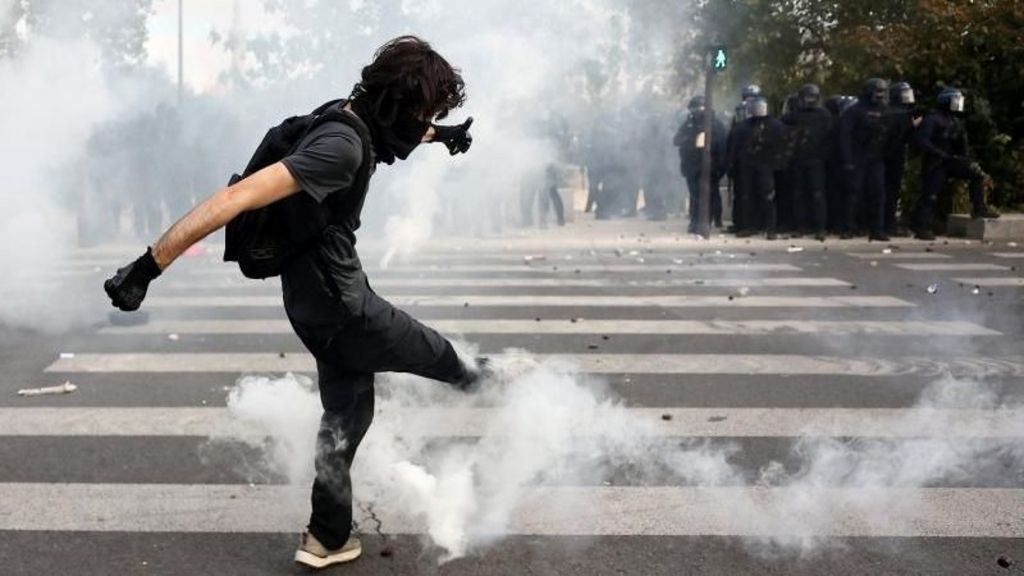
The third major national day of action, dubbed “Act Three” by demonstrators, saw thousands of young protesters gather at Paris’ Place de la République before marching through the capital, united by two core demands: increased public resourcing for underfunded schools and an end to what they call excessive police repression against demonstrators. While scattered clashes between law enforcement and protesters were reported in major cities including Lyon, Paris, Marseille and Rennes — with officers deploying tear gas and water cannon to disperse crowds — the unrest was far less severe than the violent confrontations that marked earlier rounds of protest.
French Prime Minister Sébastien Lecornu released official injury figures Wednesday, confirming that since the movement launched in mid-September, 215 students, 85 school staff members and 715 police officers have been hurt in clashes. Government data estimates that 891 lycées (French high schools), nearly a quarter of all public secondary institutions nationwide, experienced disrupted operations on Tuesday, with total protest turnout counted at more than 250,000. Student organizers dispute that figure, putting the total number of demonstrators at 450,000 and the number of blockaded high schools at 1,800.
On the ground in Marseille, thousands of demonstrators moved through city streets, pausing to chant demands before shifting routes to outmaneuver police lines. Small groups of masked protesters used bollards and discarded bins to build barricades, prompting riot officers to fire tear gas that forced the crowd to disperse. Many participating students emphasized that the vast majority of demonstrators are committed to nonviolent action, and that their anger stems from intolerable learning conditions that have been ignored by policymakers for years.
“Most of us aren’t violent,” explained Alissa, a Marseille high school student who joined the protest. “We’re going to the streets because they’ve closed our schools… our schools are falling apart.” Her friend Sacha, also a local student, added that leaking ceilings and widespread disrepair make consistent learning impossible for thousands of students. “We will keep doing this until good measures are taken,” he said.
The protests have also amplified widespread public anger over allegations of excessive and disproportionate force used by police against teenage demonstrators, leading France’s national police inspectorate, the IGPN, to open multiple investigations into high-profile injury cases. Last week, a police officer was formally charged with aggravated violence causing permanent disability after firing a tear gas grenade that struck 14-year-old Eden in the face during a blockade at a lycée in Saint-Ouen-l’Aumône, northwest of Paris. Eden suffered a fractured jaw, broken upper teeth and the complete loss of four lower teeth, according to his legal representation. Earlier this week, a 15-year-old in the northern city of Lens lost his hand after a sting ball anti-encirclement grenade exploded near his school. Authorities claim the teen picked up the inactive grenade before it detonated, but students maintain he was directly struck by the weapon when an officer fired it during a confrontation.
What began as a localized protest over overcrowded classrooms, chronic teacher shortages and crumbling infrastructure in the working-class Seine-Saint-Denis suburb north of Paris in mid-September has snowballed into a national movement that has drawn cross-generational support. Tuesday’s marches included participants of all ages, including retired teachers Alain and Michèle, a couple in their 70s who joined the central Paris march to stand with student demonstrators. “We are the grandparents of three students who are all mobilised. They have protested peacefully in front of their respective high schools in Paris in recent days, but they were still tear-gassed,” Alain told reporters, his voice shaking with emotion.
The movement has quickly become a major political flashpoint seven months ahead of France’s 2027 presidential election. Speaking in parliament, Lecornu accused the radical-left France Unbowed (LFI) party of intentionally stoking unrest to undermine political stability ahead of the vote. Current President Emmanuel Macron is in the final months of his second and final term, with LFI leader Jean-Luc Mélenchon currently placing second in national opinion polls, trailing only hard-right National Rally leader Marine Le Pen. Macron convened an emergency crisis meeting with top cabinet ministers at the Élysée Palace on Tuesday evening to coordinate a government response to the ongoing protests.
Education Minister Édouard Geffray has come under intense pressure to address protester demands, after his early attempts at de-escalation failed to calm tensions. Geffray has long called for dialogue over school blockades and has argued that “ultra-violent elements” have infiltrated the student movement to cause unrest. But the limited concessions offered so far — including a dedicated website for students to submit grievances and a school-wide discussion day scheduled for Friday — have done little to mollify demonstrators. With France’s largest union, the CGT, already planning another coordinated national day of protest for Thursday involving high school and university students, there is little sign the movement will wind down any time soon.