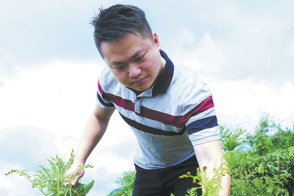
In the mountainous landscapes of Fujian province, a unique agricultural collaboration across the Taiwan Strait is transforming tea cultivation into both an economic success story and a model for cross-border cooperation. Taiwan farmer Peng An-yuan has established an innovative eco-friendly tea garden in Sanming that demonstrates remarkable agricultural harmony, where tea plants coexist with wild grasses to create a natural habitat for beneficial insects.
Peng introduced Oriental Beauty tea, a prized oolong variety from his hometown of Hsinchu, Taiwan, to Datian county in Sanming. The region’s similar climate and ecological conditions proved ideal for cultivating this distinctive tea, known for its unique production process where small green leafhoppers naturally enhance the leaves’ flavor profile. These insects bite the tea leaves, triggering a biochemical reaction that imparts a sought-after fruity and honey-like aroma, resulting in leaves with distinctive dark purple and brown tones covered with fine white hairs.
“The tea jassids feeding on the leaves are essential, but their behavior is unpredictable,” explained Peng, who serves as the primary inheritor of Taiwan’s Oriental Beauty tea tradition on the Chinese mainland. “This unpredictability is precisely what makes this tea variety so exceptionally precious.”
The successful cultivation has been bolstered by Sanming’s designation as China’s first cross-Strait rural integrated development pilot zone in November 2022. With 78 percent forest coverage earning it the nickname “Green City,” Sanming provides an ideal environment for this agricultural collaboration. The partnership has yielded substantial economic benefits: Datian county now produces 4,300 metric tons of Oriental Beauty tea annually, representing 70 percent of the mainland’s total output, with exports reaching European and Southeast Asian markets.
In a significant step toward standardization, the Fujian Provincial Administration for Market Management recently released cross-Strait technical regulations for Oriental Beauty tea processing. These standards were jointly developed by tea associations and universities from both sides of the Strait, facilitating deeper industry integration.
The collaboration extends beyond tea production. Driven by supportive policies, Sanming has approved 106 new Taiwan-invested enterprises over the past three years with total investments reaching 801 million yuan ($114 million). The region has established 12 specialized bases for Fujian-Taiwan agricultural integration, creating numerous opportunities for cross-border entrepreneurship.
In Jianning county, Taiwan entrepreneur Lin Hsiu-ying operates an oil tea camellia cooperative that applies Taiwanese techniques to boost production, increasing income for 112 local households by an average of over 4,000 yuan per person. Lin attributes this success to mainland policies providing financial support for new plant varieties and equipment.
The integration efforts align with China’s 15th Five-Year Plan (2026-30), which emphasizes high-quality development across the Taiwan Strait and strengthened industrial cooperation. According to Zhang Han, spokeswoman for the State Council Taiwan Affairs Office, implementation of the plan will create expanded opportunities for Taiwan compatriots to study, work, and live on the mainland.
Fujian officials plan to capitalize on these developments by encouraging greater youth participation in rural vitalization projects. Sanming has already attracted 30 cross-Strait youth teams, including over 80 Taiwan professionals in architecture and design, who contribute to rural environmental renovation initiatives.
Taiwan designer Tsai Hsingchueh, who works across Sanming’s villages, notes that the mainland’s rural vitalization blueprint offers significant opportunities for young Taiwan professionals with expertise in community development. His team brings graduate students from universities on both sides of the Strait for half-year internships, with many participants choosing to remain in the villages long after their programs conclude.